Latest from SalesRuns
Insights on AI sales automation, multi-channel outreach, and the future of revenue generation.
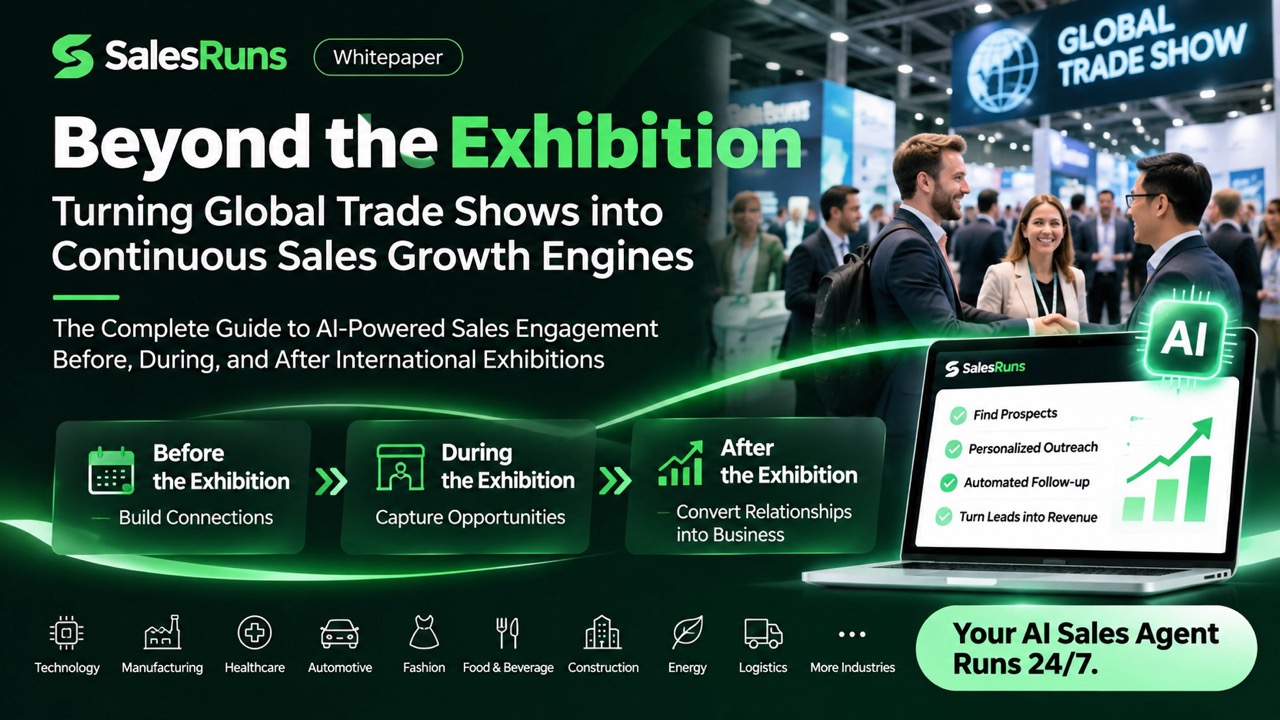
CES 2027: How Exhibitors Can Turn Booth Traffic Into Real Business Opportunities
CES 2027 runs January 6-9 in Las Vegas. A practical guide for exhibitors on turning booth traffic into qualified pipeline, with official CES resources, a three-stage sales process, and a pre-show checklist.
Beyond the Exhibition: Turning Trade Shows into Sales Growth
How to turn trade shows into continuous sales growth: AI-powered prospecting, personalized outreach, and follow-up before, during, and after every exhibition.

How to Write a Trade Show Follow-Up Email That Gets a Reply
Learn how to write a trade show follow-up email that continues the conversation: eight examples, subject lines, a five-part framework, and verification tips.
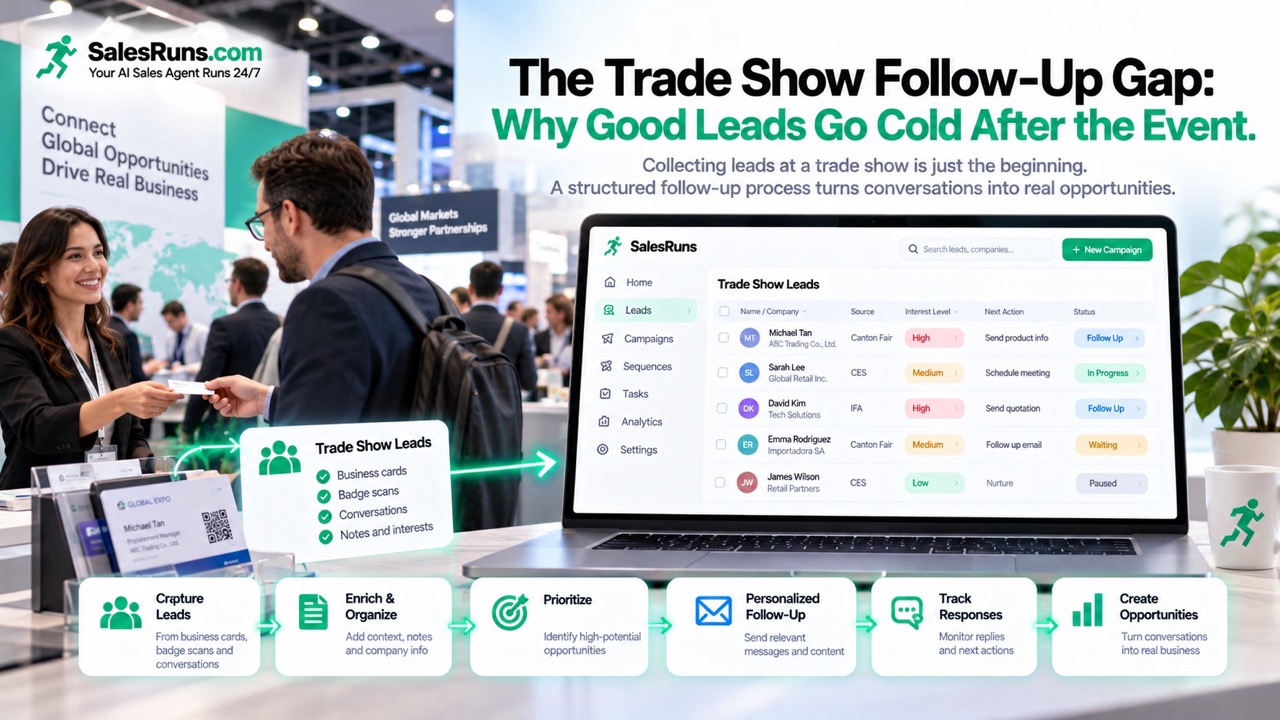
The Trade Show Lead Follow-Up Gap: Why Good Leads Go Cold
Trade show lead follow-up decides whether event conversations become customers. This guide explains why leads go cold, how to capture context, prioritize by evidence, write strong follow-up emails, and build a cadence that respects recipients, with a practical 48-hour plan and measurement framework.
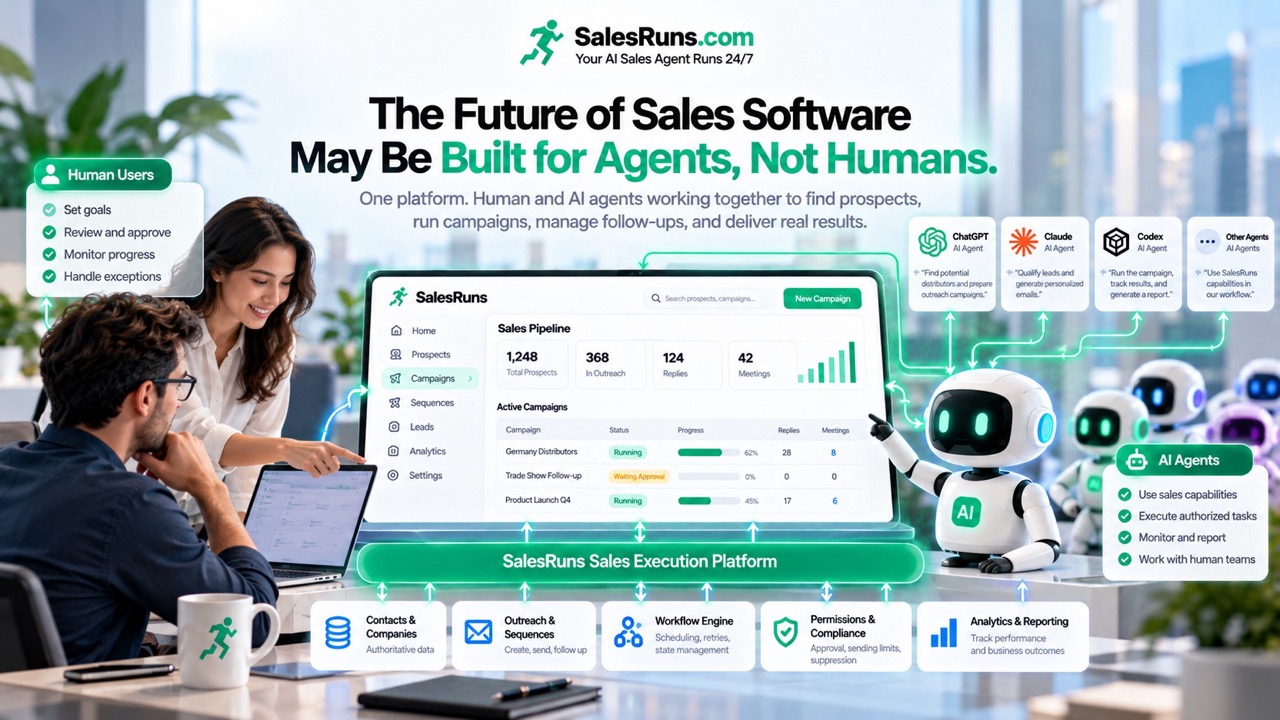
The Future of Sales Software May Be Built for Agents, Not Humans
Agent-first sales software is built so an AI agent can use it as a primary user, not just a person clicking a screen. This article explains what agent-first means, how it differs from human-first design, where human judgment stays essential, and a numbered roadmap for building it, using SalesRuns as a working example.
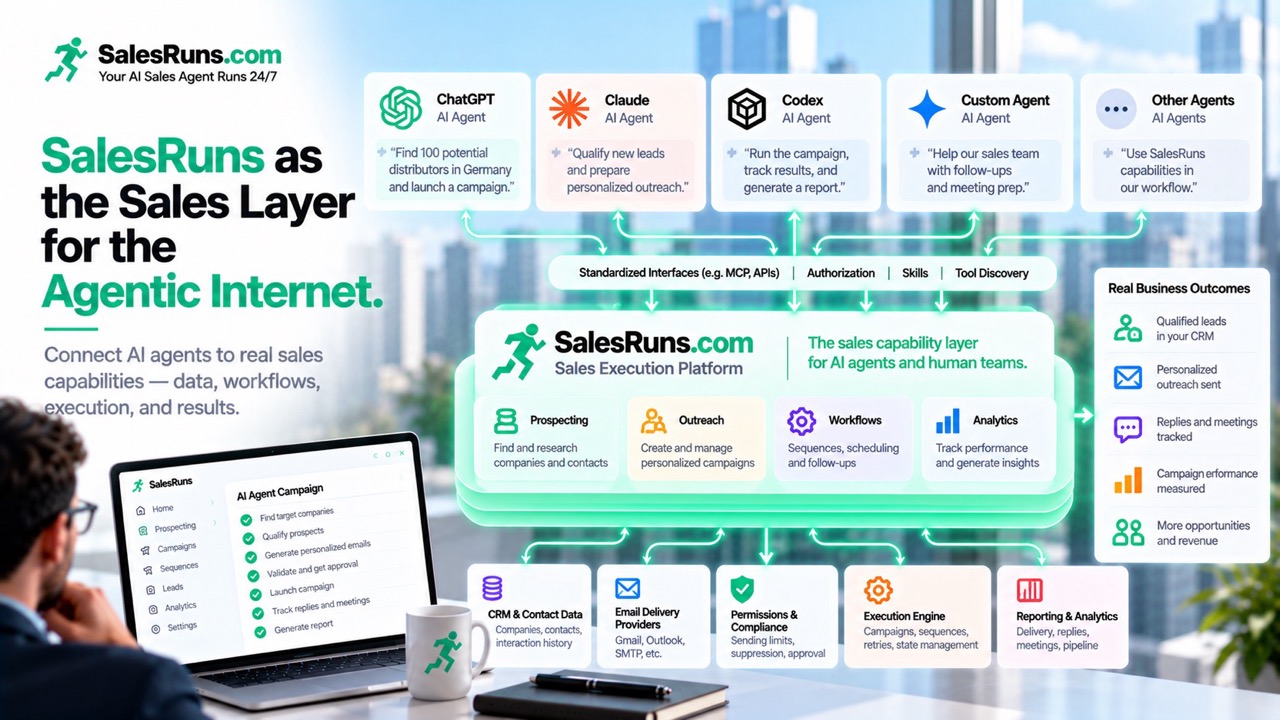
SalesRuns as the Sales Layer for the Agentic Internet
A sales layer for AI agents is a specialized service layer that exposes sales operations as structured, permission-aware capabilities that agents can discover, authorize, and execute. This article examines the ecosystem opportunity, the technical requirements, the distribution implications, and the staged path for building one, with SalesRuns as the working example.
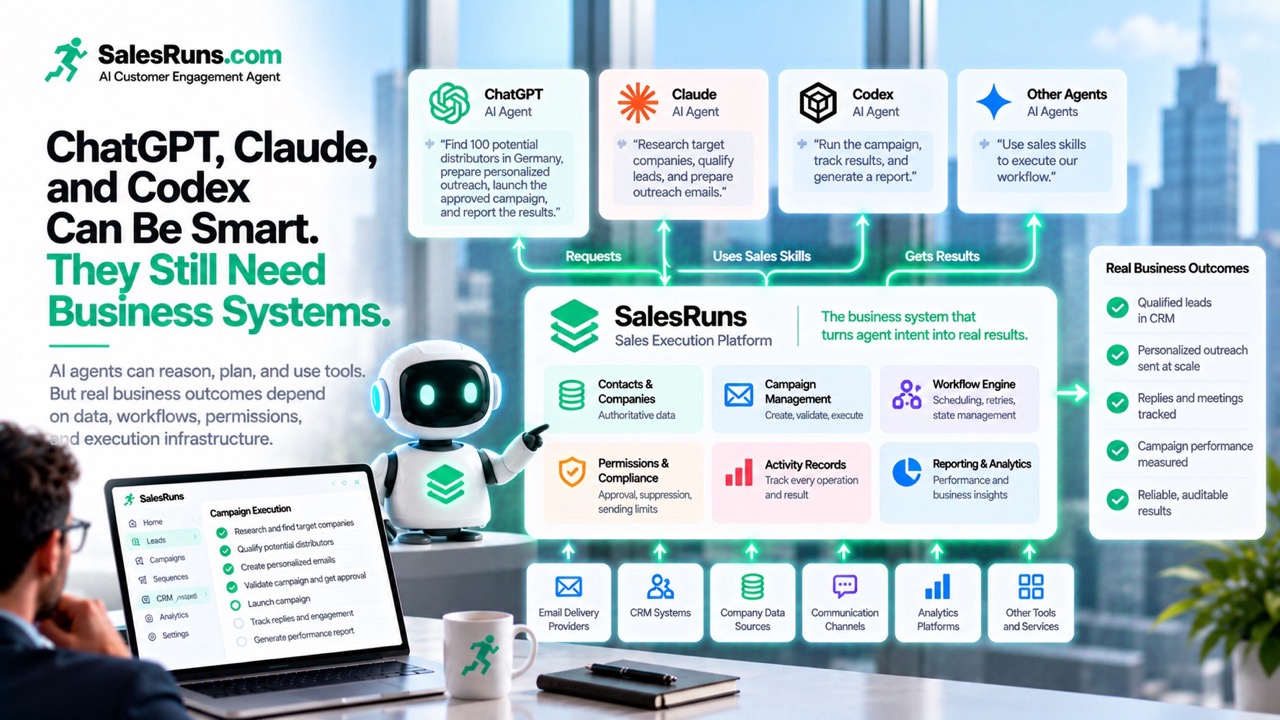
ChatGPT, Claude, and Codex Can Be Smart. They Still Need Business Systems.
Intelligence can help an AI agent decide what should happen. Business systems provide the data, permissions, operational state, and execution capabilities needed to make it happen reliably. This article examines why capable general-purpose agents still need specialized business infrastructure, using sales as the working example.
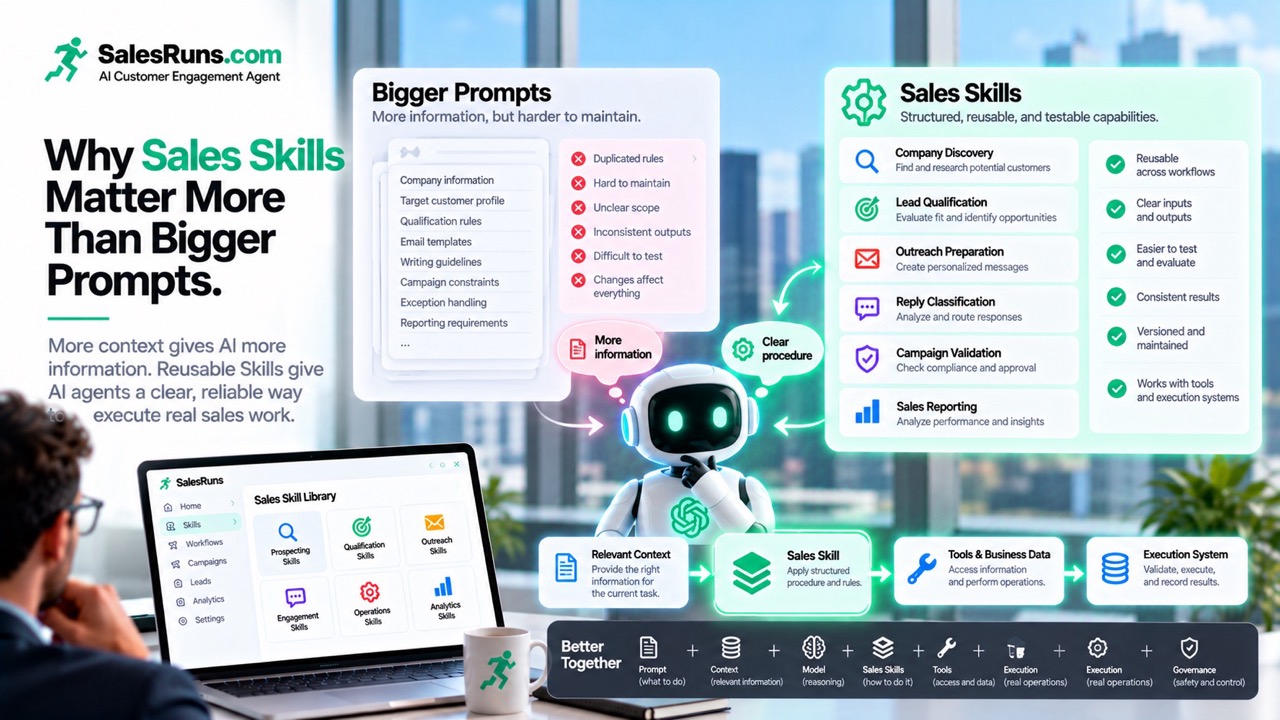
Why Sales Skills Matter More Than Bigger Prompts
More context gives an AI agent more information, and better models improve its reasoning. Neither automatically provides a reusable, testable, enforceable process for business work. This article examines the engineering trade-offs between longer prompts, larger context windows, and structured Skills, and argues that each component should own a clear responsibility.
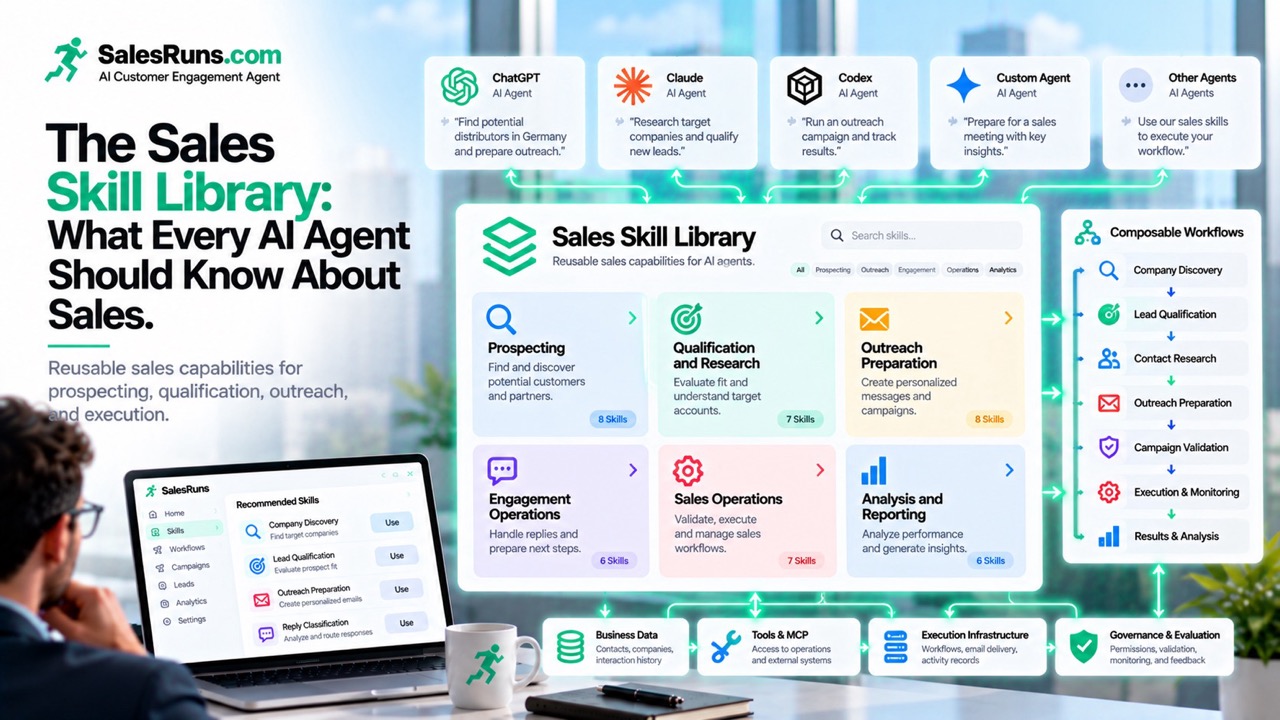
The Sales Skill Library: What Every AI Agent Should Know About Sales
A single Skill helps an AI agent perform one task. A well-designed Sales Skill Library makes a broader body of sales expertise reusable across tasks, workflows, and compatible agents. This article covers what belongs in a sales capability library, how to organize and size Skills, how agents discover and compose them, and how the library is tested, versioned, measured, and governed.
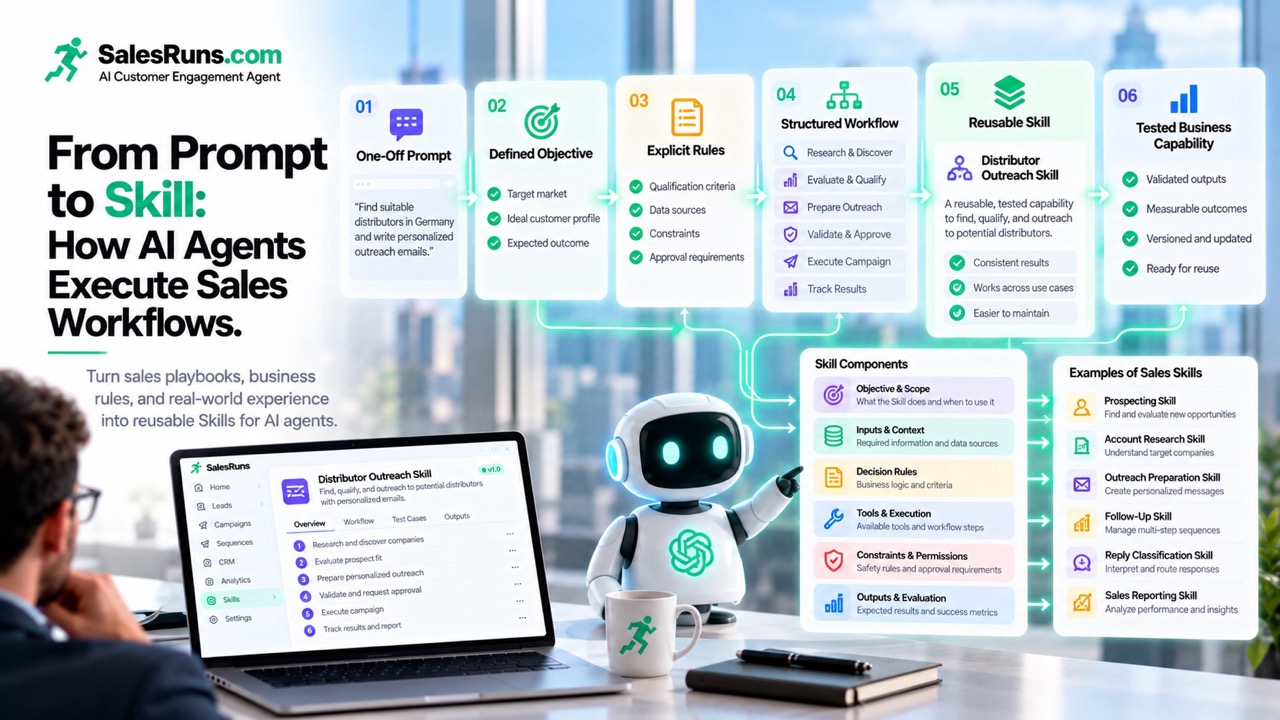
From Prompt to Skill: How AI Agents Learn to Execute Sales Workflows
A prompt describes what you want an AI to do once. A Skill captures how a task should be performed repeatedly, with explicit rules, structured workflows, and measurable outcomes. This article is an eight-step method for turning sales SOPs and playbooks into reusable AI agent Skills, covering design, testing, measurement, and maintenance.
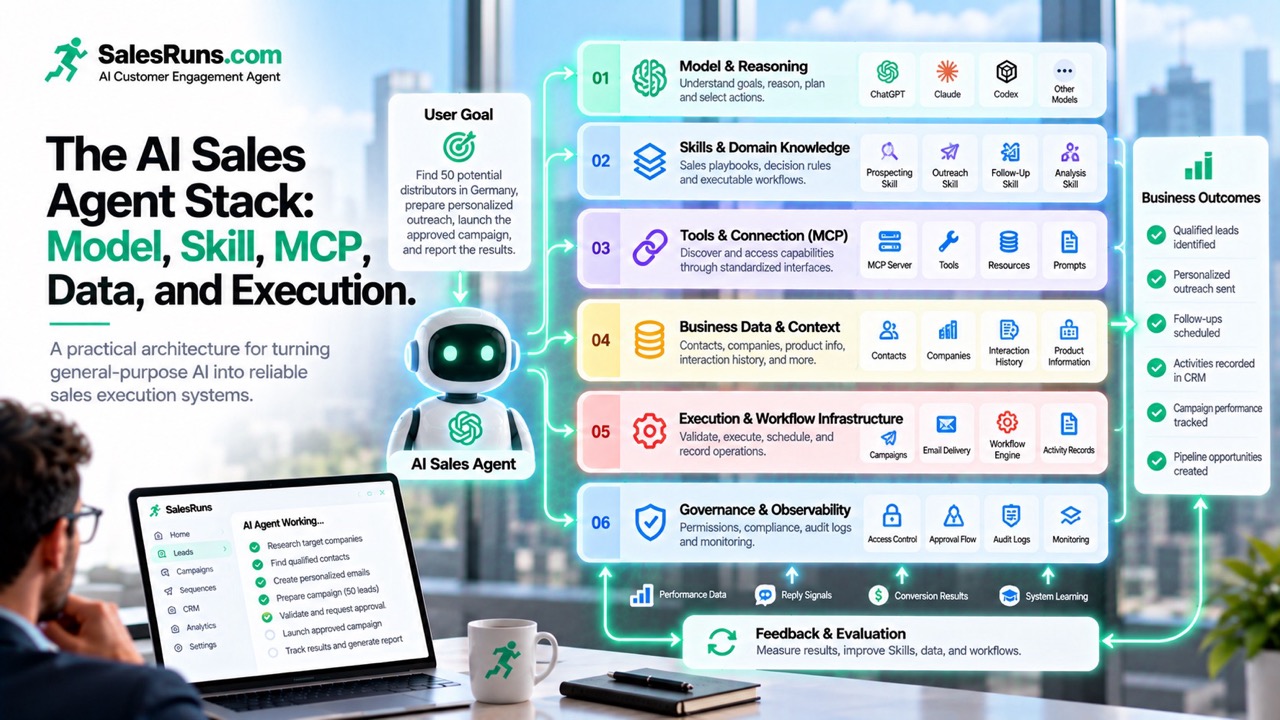
The AI Sales Agent Stack: Model, Skill, MCP, Data, and Execution
An AI sales agent is not a language model with tools attached. This article breaks down the six-layer architecture, covering model reasoning, Skills, MCP connections, business data, execution infrastructure, and governance, that turns general-purpose AI into reliable sales execution, with a complete workflow walkthrough and evaluation criteria.
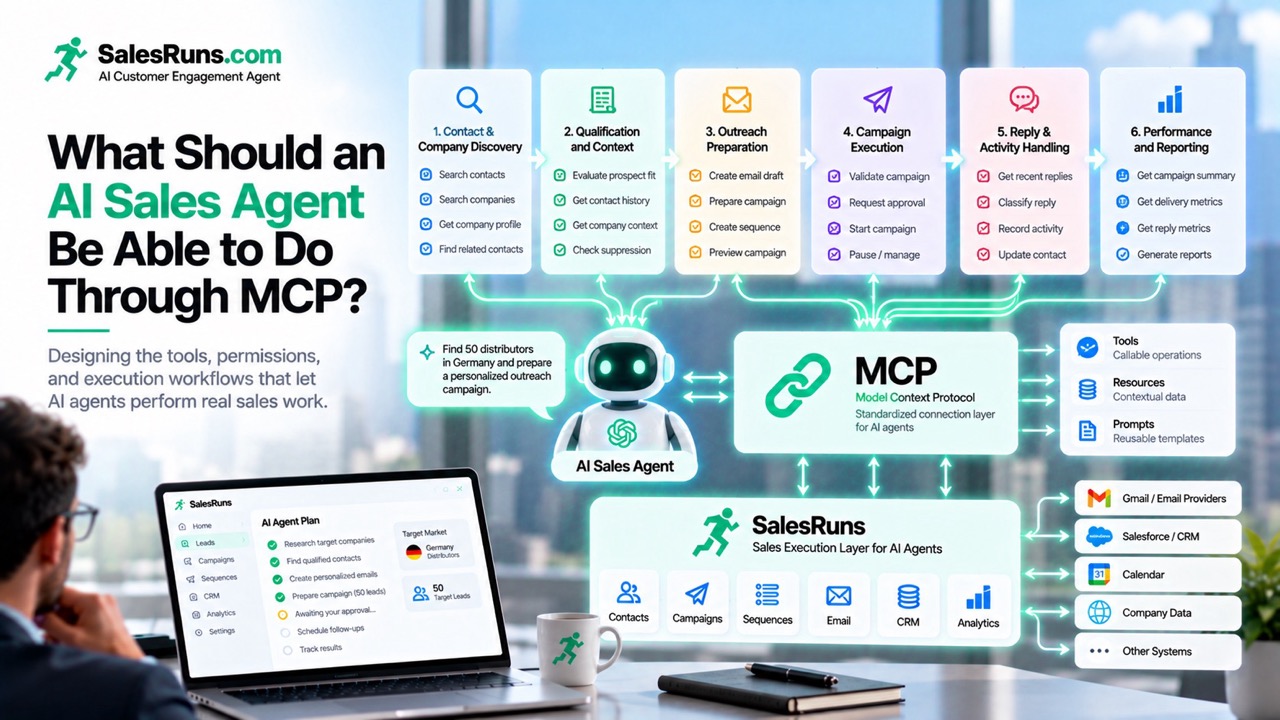
What Should an AI Sales Agent Be Able to Do Through MCP?
A Sales MCP server is not a list of API endpoints. It is a set of business capabilities that an agent can assemble into a complete workflow. This article covers the six capability groups a sales tool surface needs, why read, prepare, and execute must be separated, and how the system rather than the model enforces the rules.
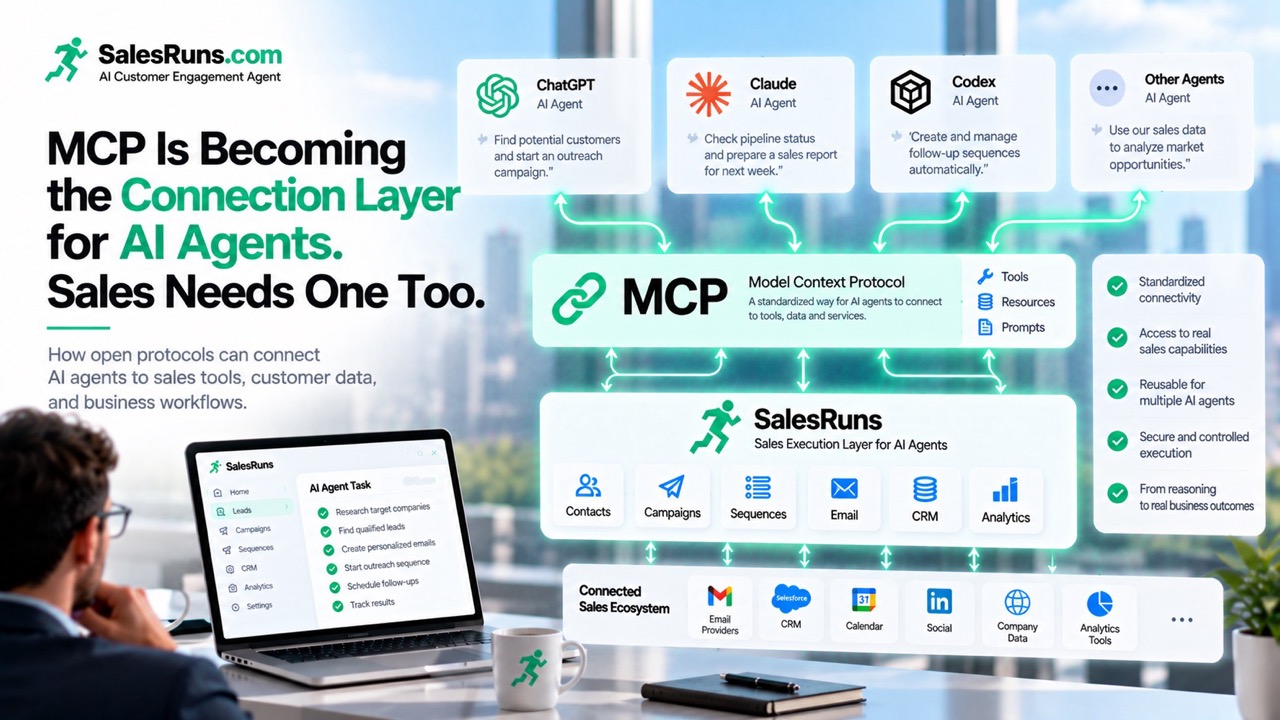
MCP Is Becoming the Connection Layer for AI Agents. Sales Needs One Too.
An AI agent can reason about a sales task perfectly and still be unable to send a single email, because reasoning is not connection. This article explains what the Model Context Protocol standardizes, what a sales MCP server could realistically expose, and why connectivity is becoming a distribution channel in its own right.
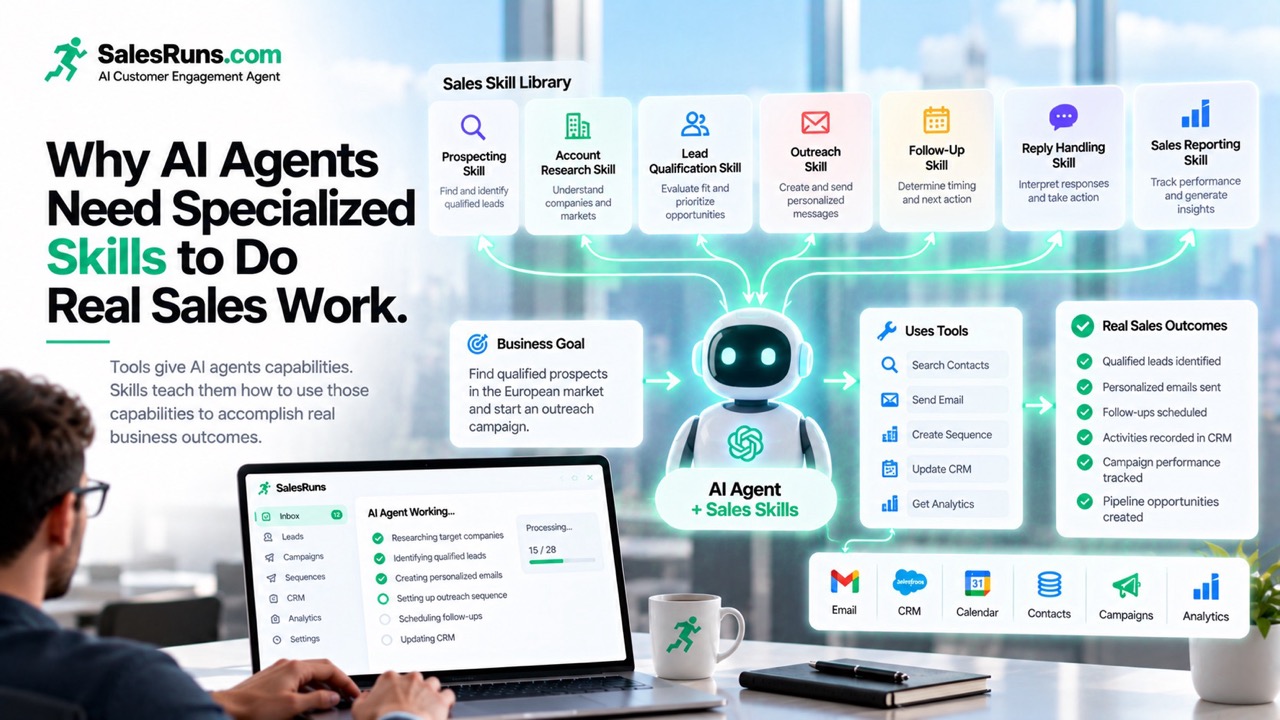
Why AI Agents Need Specialized Skills to Do Real Sales Work
An AI agent with a full sales stack can search contacts, send email, and update records, and still make every one of those calls badly. This article explains what an AI agent skill actually contains, why more tools do not equal more capability, and what a specialized sales skill layer would have to look like.
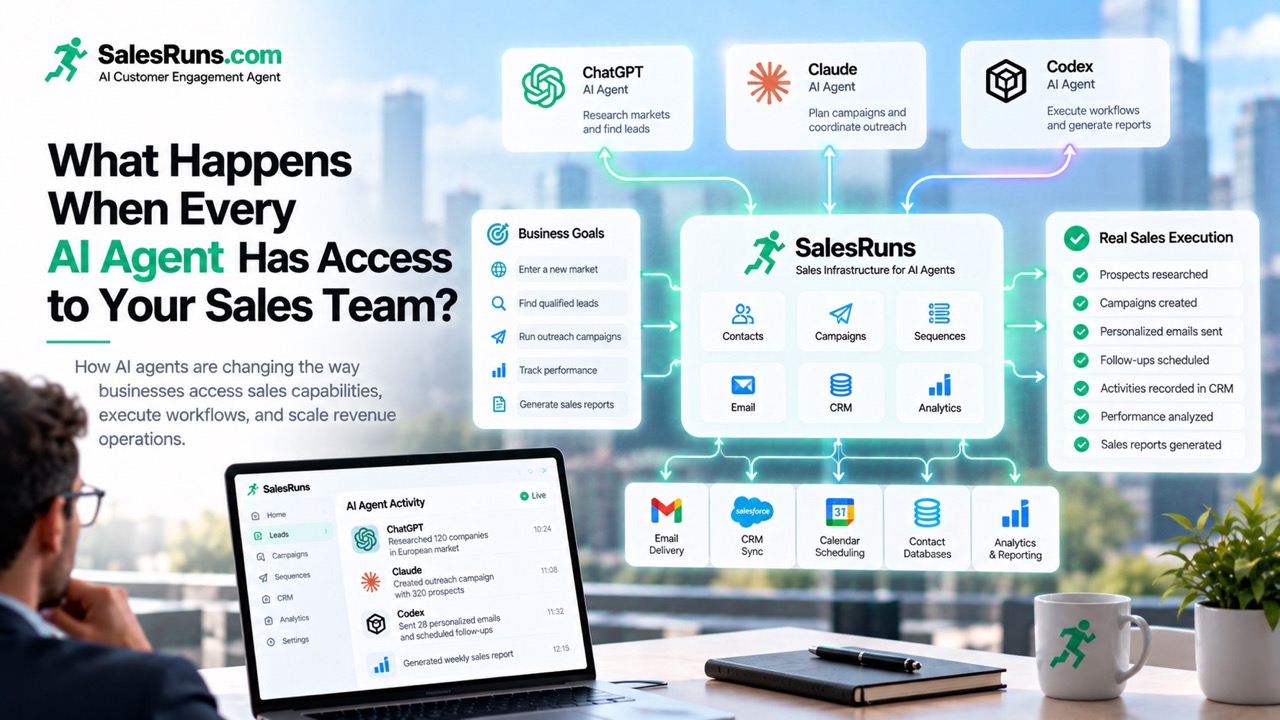
What Happens When Every AI Agent Has Access to Your Sales Team?
General-purpose AI agents are getting good at reasoning and orchestration, but they are not a contact database or a campaign engine. This article looks at what changes when those agents can reach authorized sales infrastructure through standardized interfaces, why access and autonomy are different things, and what SalesRuns is building toward as a sales layer other agents can use.
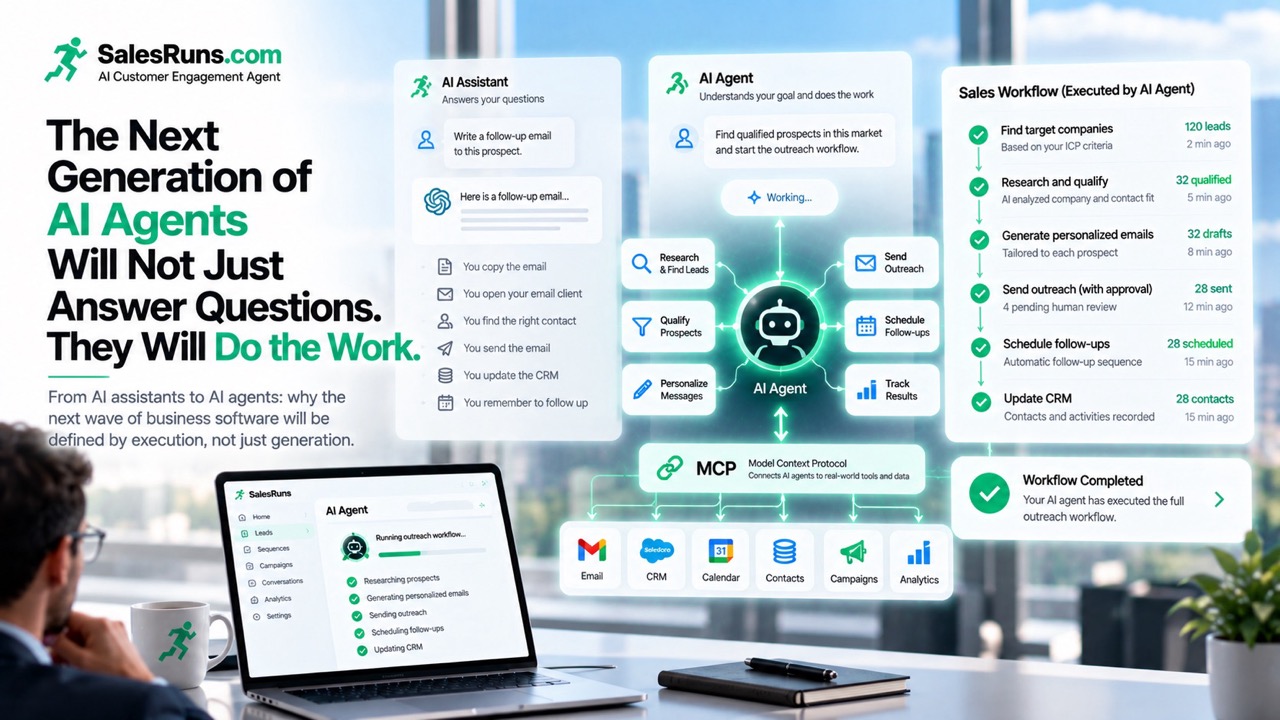
The Next Generation of AI Agents Will Not Just Answer Questions. They Will Do the Work.
The first generation of generative AI made information cheap to produce. The next generation is about execution: interpreting a goal, selecting tools, performing multi-step work, checking the result, and continuing. This article explains what an AI agent actually is, how agents differ from assistants, why tools alone are not enough, where the Model Context Protocol fits, why skills matter more than raw capability, and what it means for sales software to be built as infrastructure that agents can operate rather than only as an interface people click.
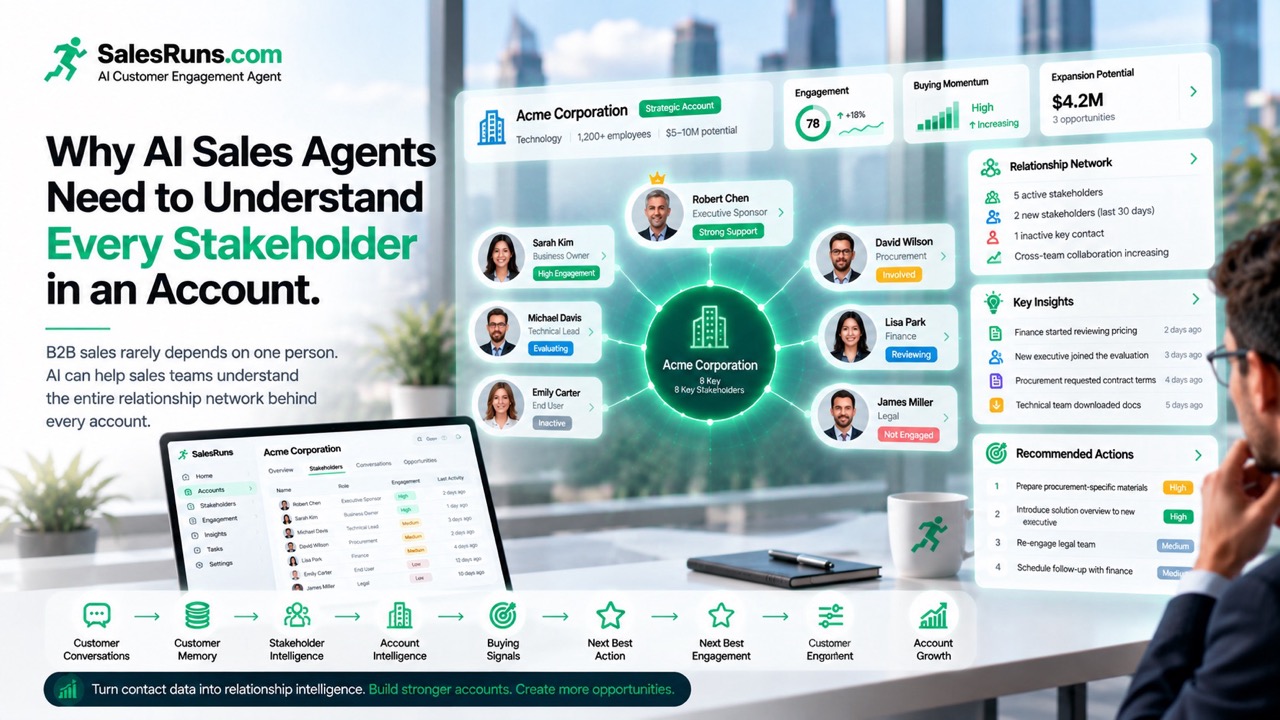
Why AI Sales Agents Need to Understand Every Stakeholder in an Account
Stakeholder Intelligence is the ability to understand the roles, relationships, engagement, influence, and interactions of the people inside a customer account. Here is how AI Sales Agents use account-level Customer Memory and Account Intelligence to map relationships, spot gaps, and recommend the Next Best Action.
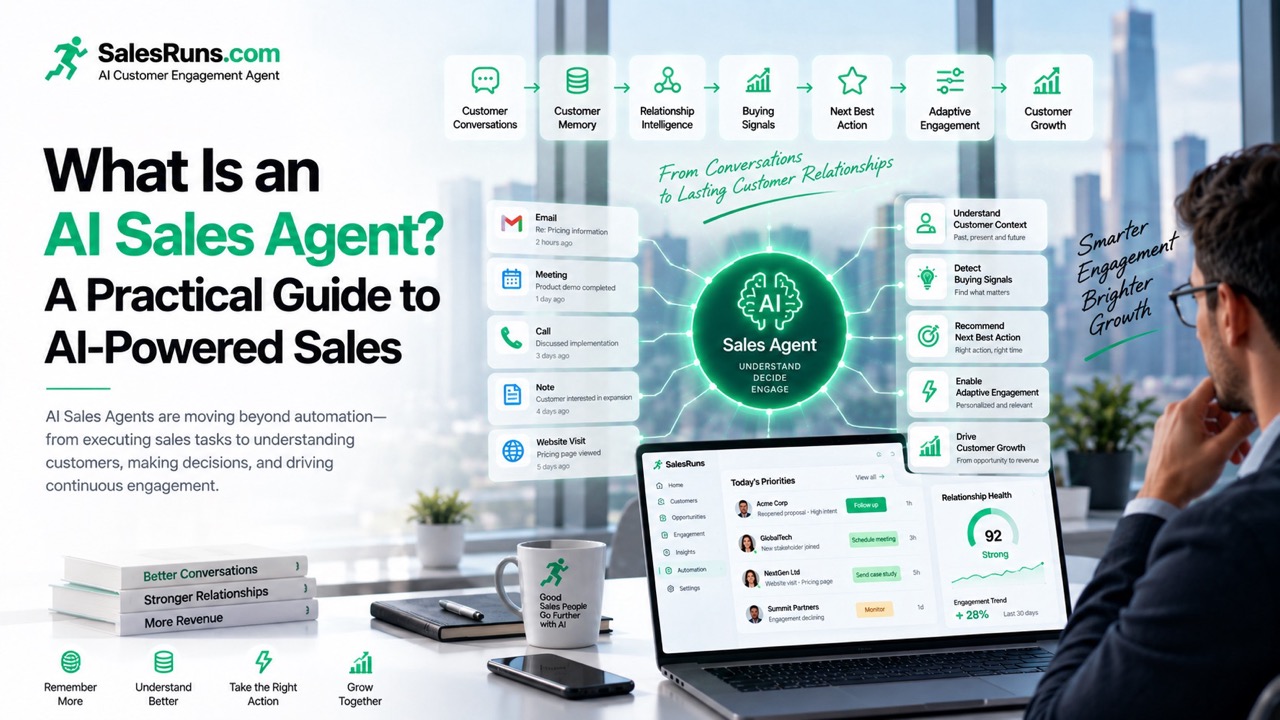
What Is an AI Sales Agent? A Practical Guide to AI-Powered Sales
An AI Sales Agent understands customer context, reads buying signals, recommends the next best action, and sustains engagement. Here is how it differs from CRM, sales automation, and AI assistants.
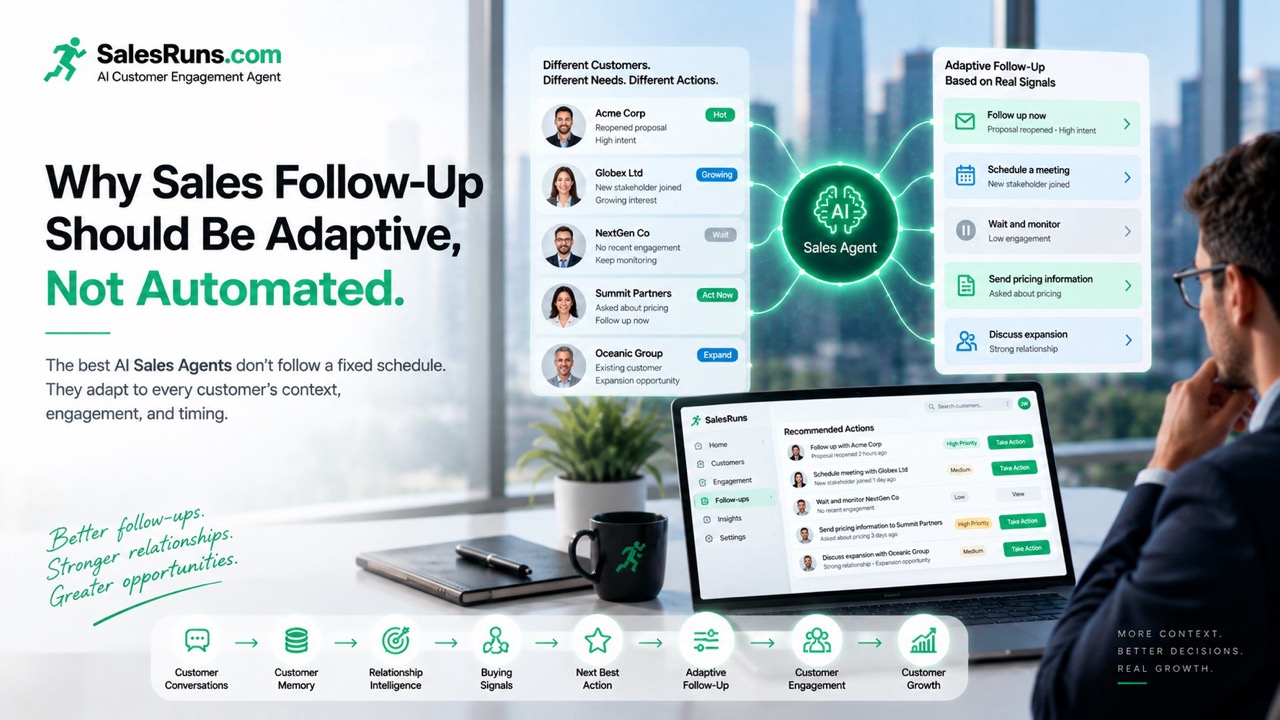
Why Sales Follow-Up Should Be Adaptive, Not Automated
A fixed sequence sends the same message on the same schedule to every customer inside it. Adaptive Sales Follow-up is an AI-driven approach that adjusts timing, content, channel, and action based on Customer Memory, Relationship Intelligence, and Buying Signals.
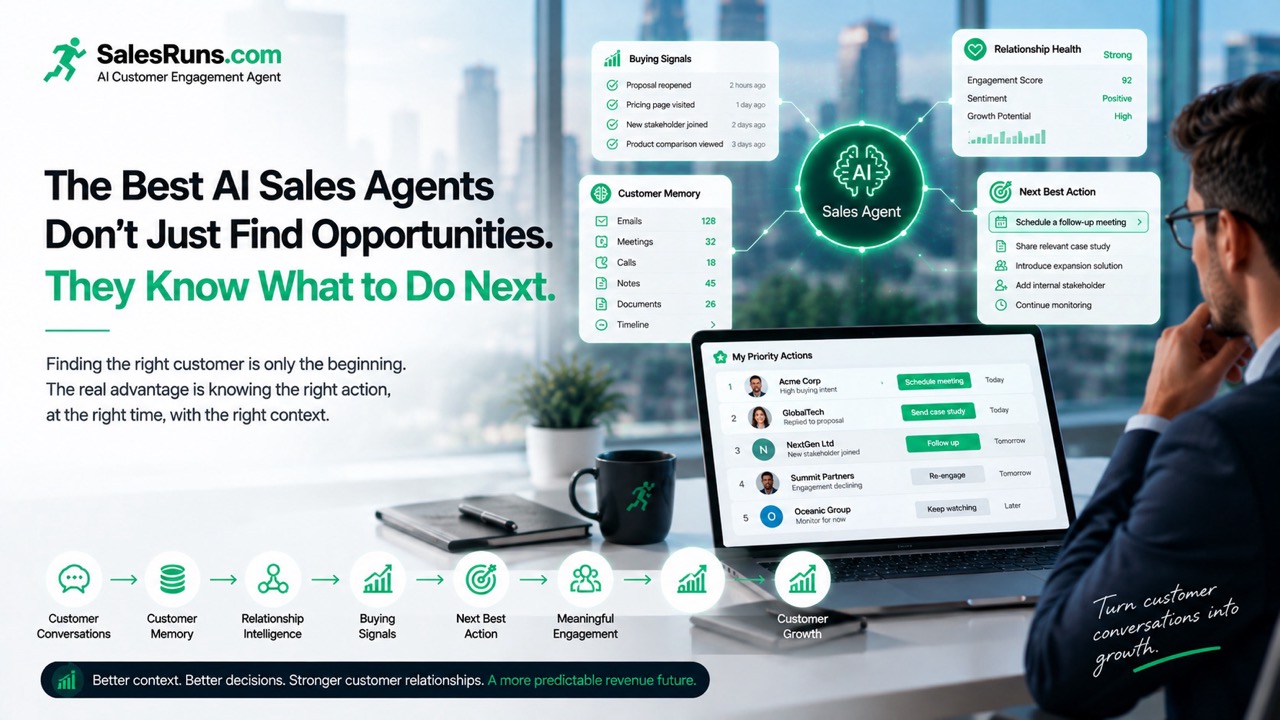
The Best AI Sales Agents Don't Just Find Opportunities. They Know What to Do Next.
Sales teams are not short on tasks, sequences, or notifications. They are short on decisions. Next Best Action turns Customer Memory and Relationship Intelligence into a specific recommendation for a specific customer, at a specific moment.
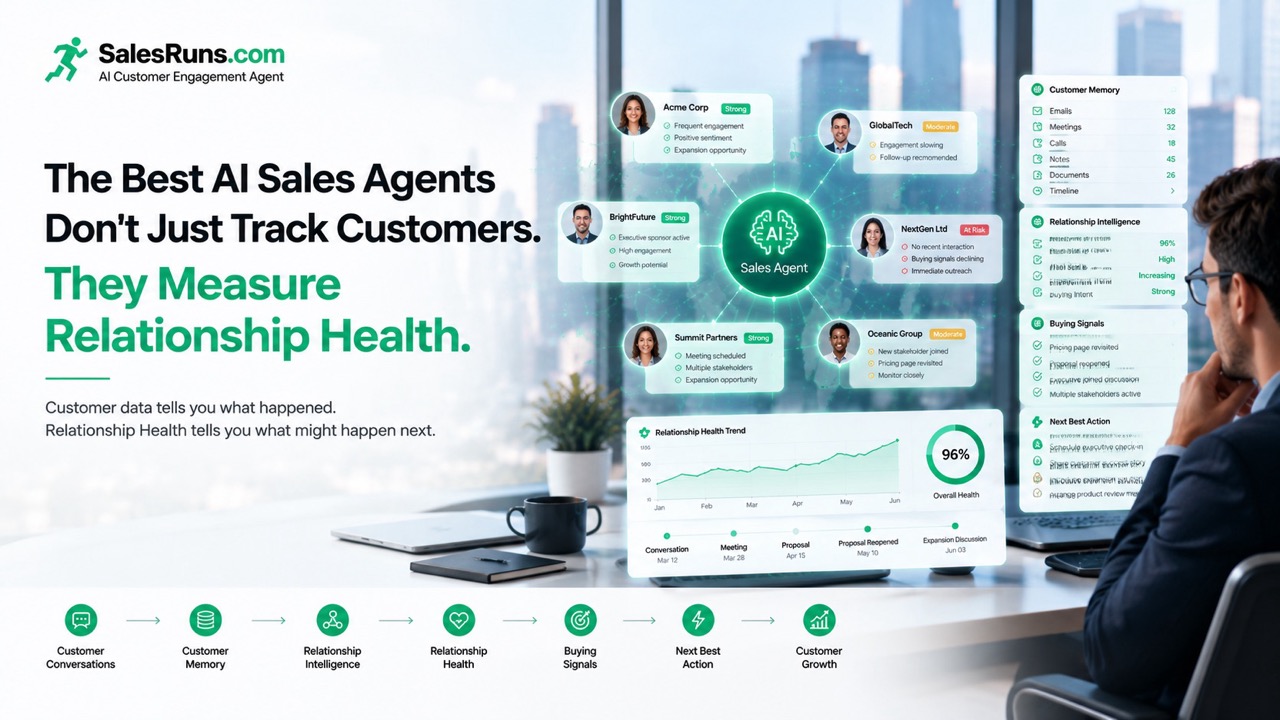
The Best AI Sales Agents Don't Just Track Customers. They Measure Relationship Health.
Two customers can generate identical revenue and look the same in a CRM — but one is warming up while the other is checking out. Traditional CRM systems record activities. They do not measure whether relationships are getting stronger or weaker. This article explains why Relationship Health is becoming the most valuable capability of modern AI Sales Agents, how Customer Memory and Relationship Intelligence make it measurable, and how SalesRuns turns relationship signals into Next Best Actions that drive sustainable revenue growth.
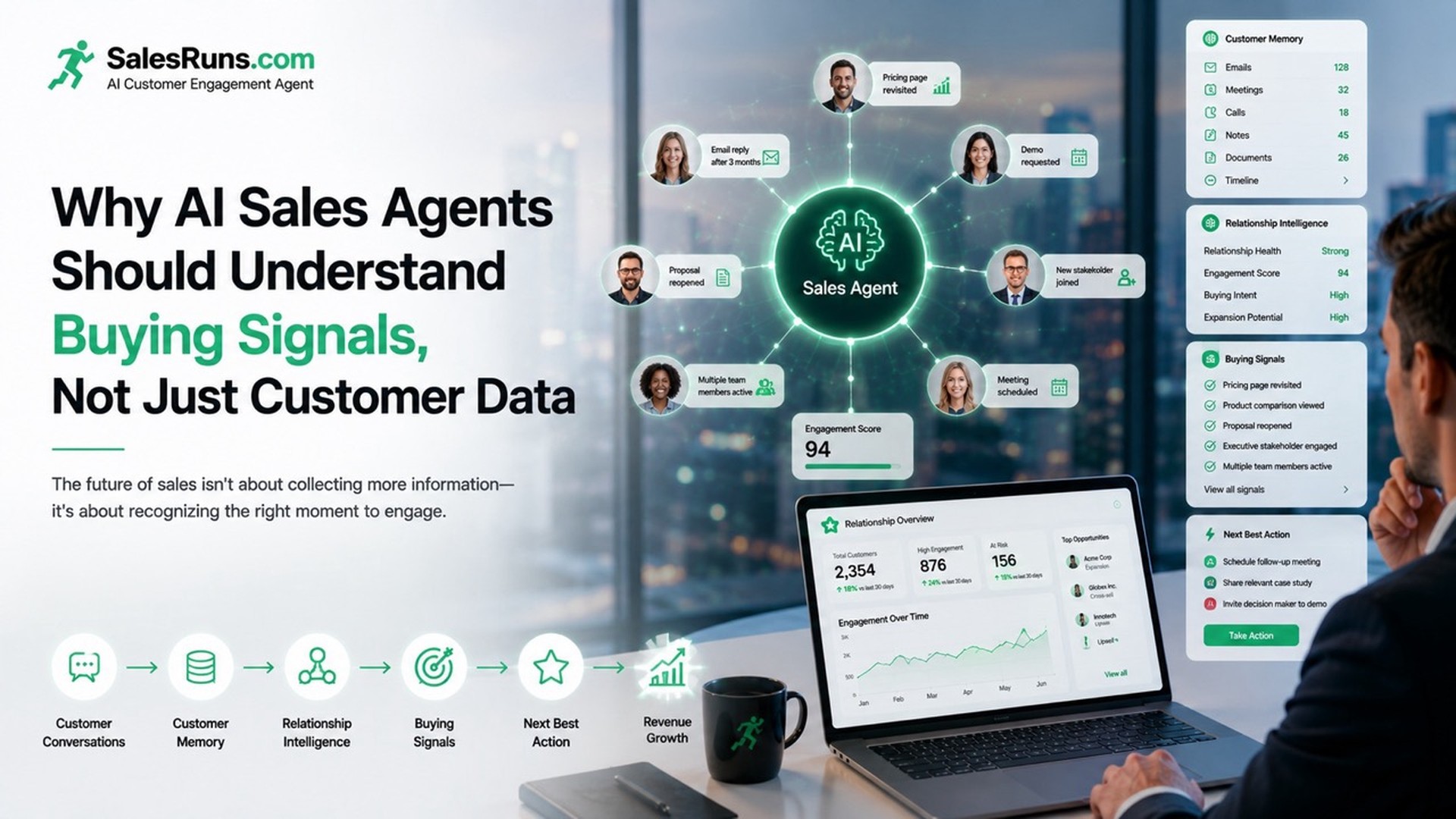
Why AI Sales Agents Should Understand Buying Signals, Not Just Customer Data
Most CRM systems store what customers did. Modern AI Sales Agents should understand what customers mean and what they're likely to do next. The difference between selling to prospects who are ready to buy and those who aren't comes down to one capability: recognizing buying signals in real time. This article explains why buying signals matter, how Customer Memory makes them detectable, and how Relationship Intelligence turns them into Next Best Actions that close more deals.
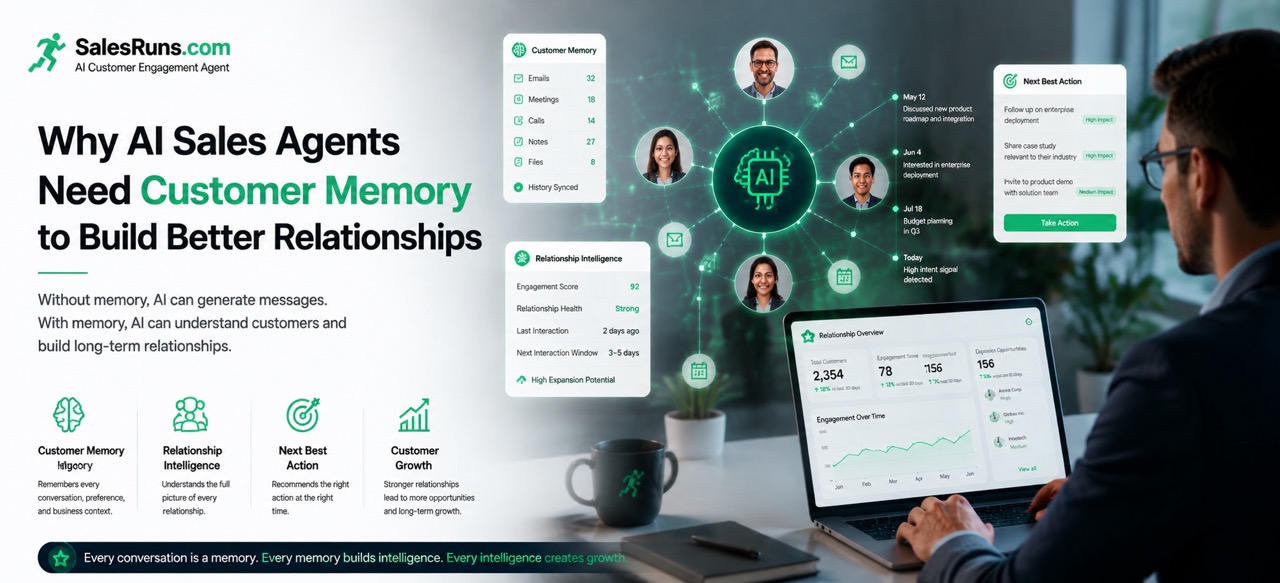
Why AI Sales Agents Need Customer Memory to Build Better Relationships
The first wave of AI sales tools focused on productivity — writing emails faster, automating follow-ups, scaling outreach volume. But productivity alone does not build relationships. The next generation of AI Sales Agents needs something most current systems lack: Customer Memory — the ability to retain context, understand relationship history, and recommend actions that actually strengthen customer connections over time.
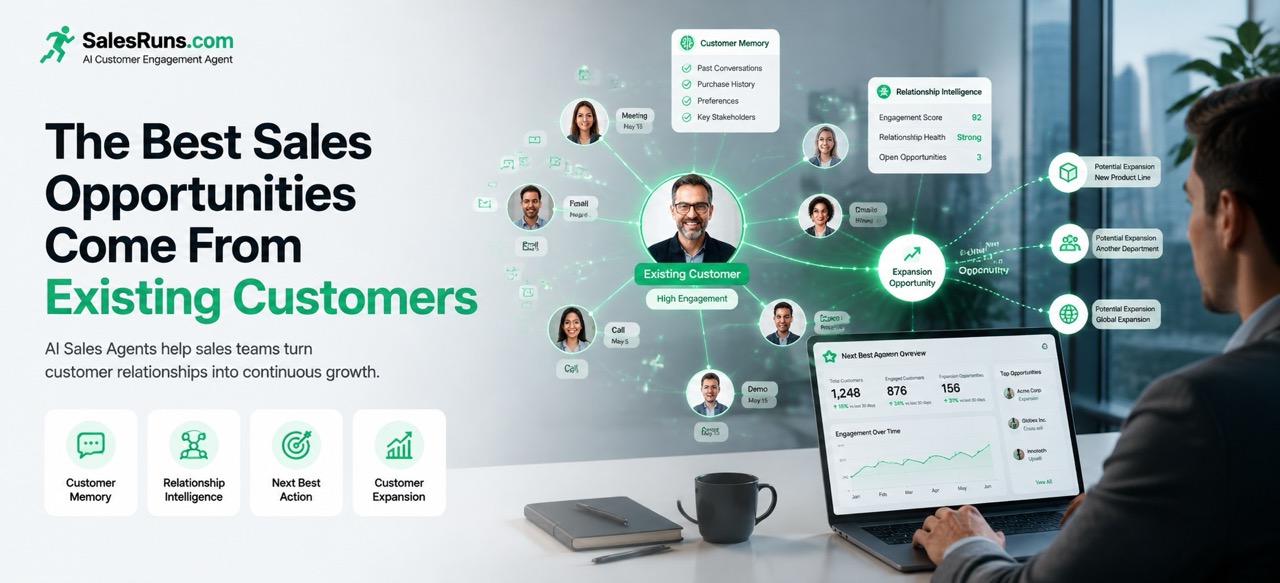
The Best Sales Opportunities Often Come From Existing Customers
Most companies chase new leads while sitting on a goldmine of expansion opportunities inside their current customer base. An AI Sales Agent uses Customer Memory and Relationship Intelligence to identify upsell signals, cross-sell readiness, referral potential, and the right moment to start an expansion conversation — turning existing relationships into compound revenue growth.
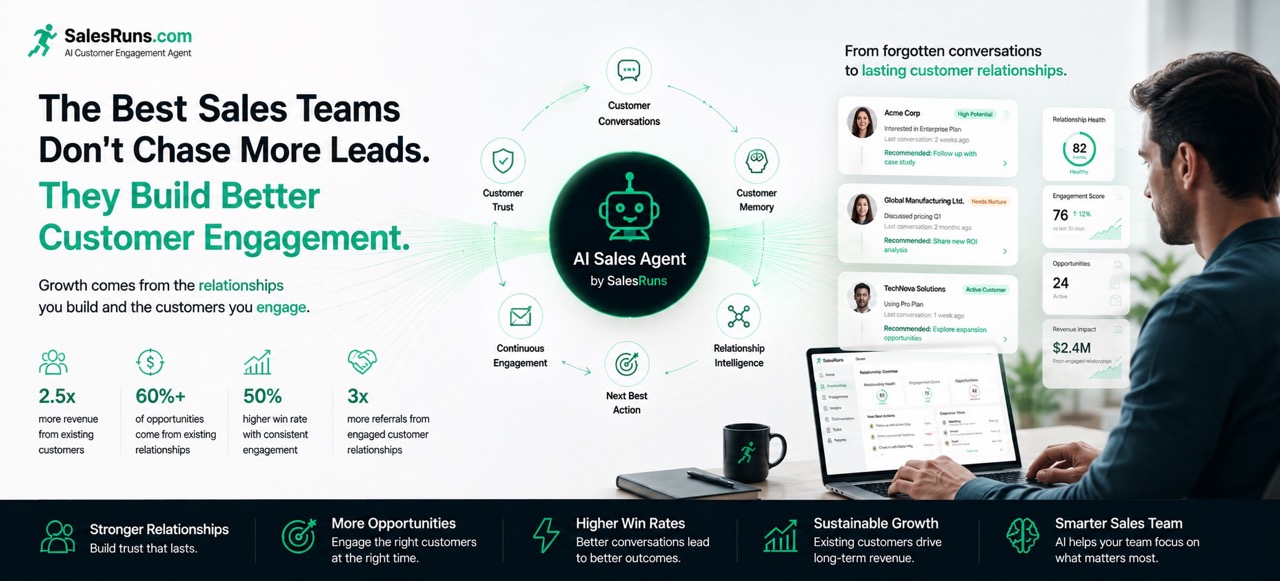
The Best Sales Teams Don't Chase More Leads. They Build Better Customer Engagement.
Most companies already have enough leads. The real problem is they cannot maintain meaningful customer engagement over time. AI Sales Agents help teams scale customer relationships through Customer Memory, Relationship Intelligence, and Next Best Action — turning forgotten conversations into lasting revenue.
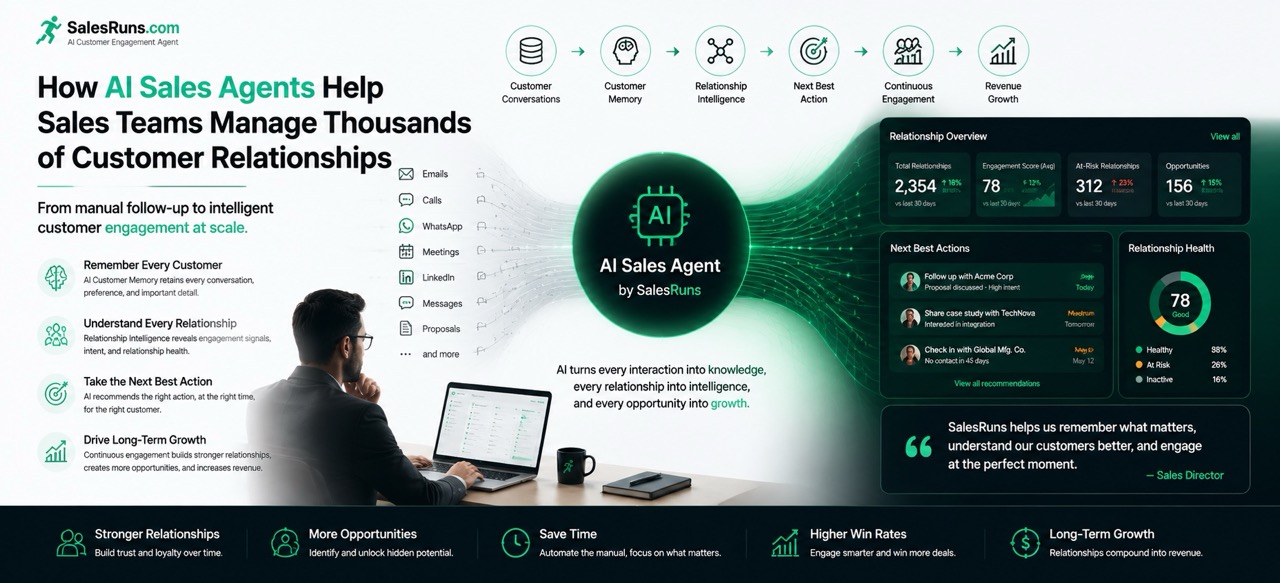
How AI Sales Agents Help Sales Teams Manage Thousands of Customer Relationships
AI Sales Agents help sales teams manage thousands of customer relationships by combining Customer Memory, Relationship Intelligence, and Next Best Action. Here is how they turn conversations into long-term growth.
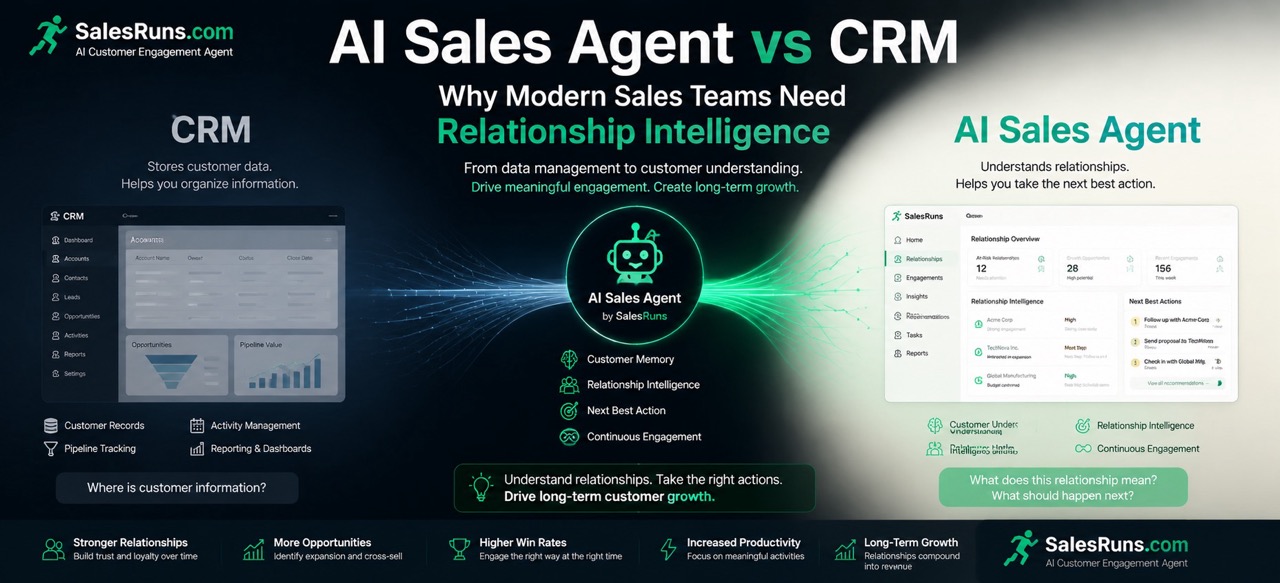
AI Sales Agent vs CRM: Why Modern Sales Teams Need Relationship Intelligence
CRM solved data management. The next generation of AI sales technology — AI Sales Agents like SalesRuns.com — solves the harder problem: understanding what a customer relationship means and what should happen next. This article defines AI Sales Agent, compares AI Sales Agent vs CRM, explains Relationship Intelligence and Customer Memory, and shows why modern sales teams need an AI Customer Engagement Agent on top of (not replacing) their CRM.
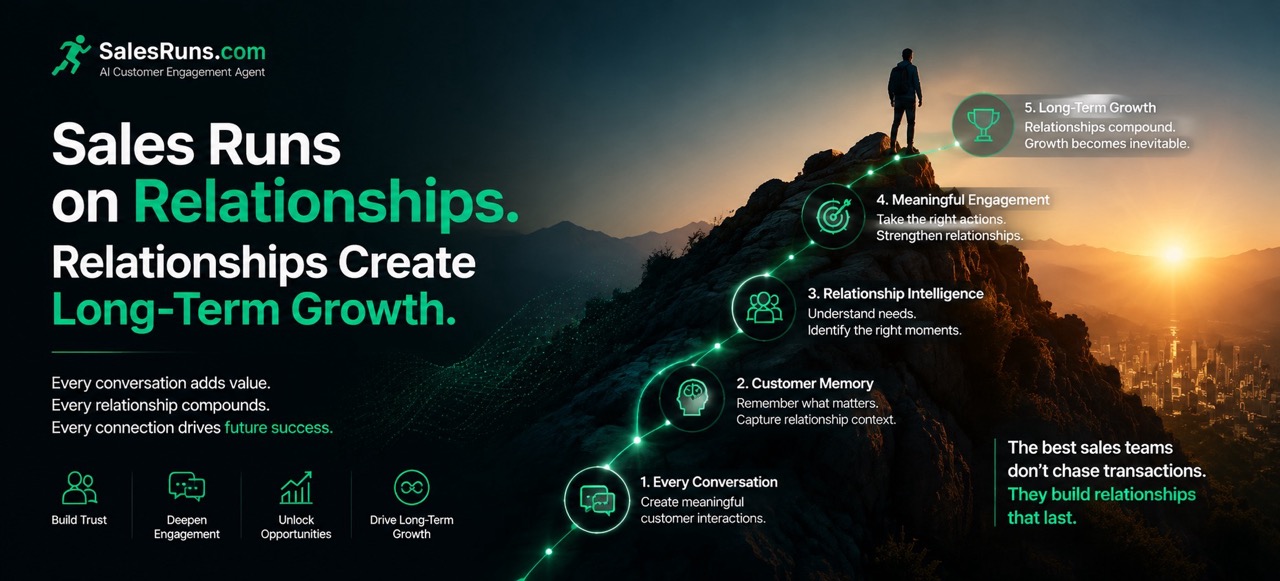
Sales Runs on Relationships. Relationships Create Long-Term Growth.
Sales doesn't grow through more messages. It grows through stronger relationships that compound over time. This article develops Ethan Davis's insight that 'sales runs on relationships, and relationships run on principles' into a broader SalesRuns perspective: relationships are not a sales activity, they are a business asset, and the companies that win next will be the ones who can remember, understand, and maintain every customer relationship at scale.
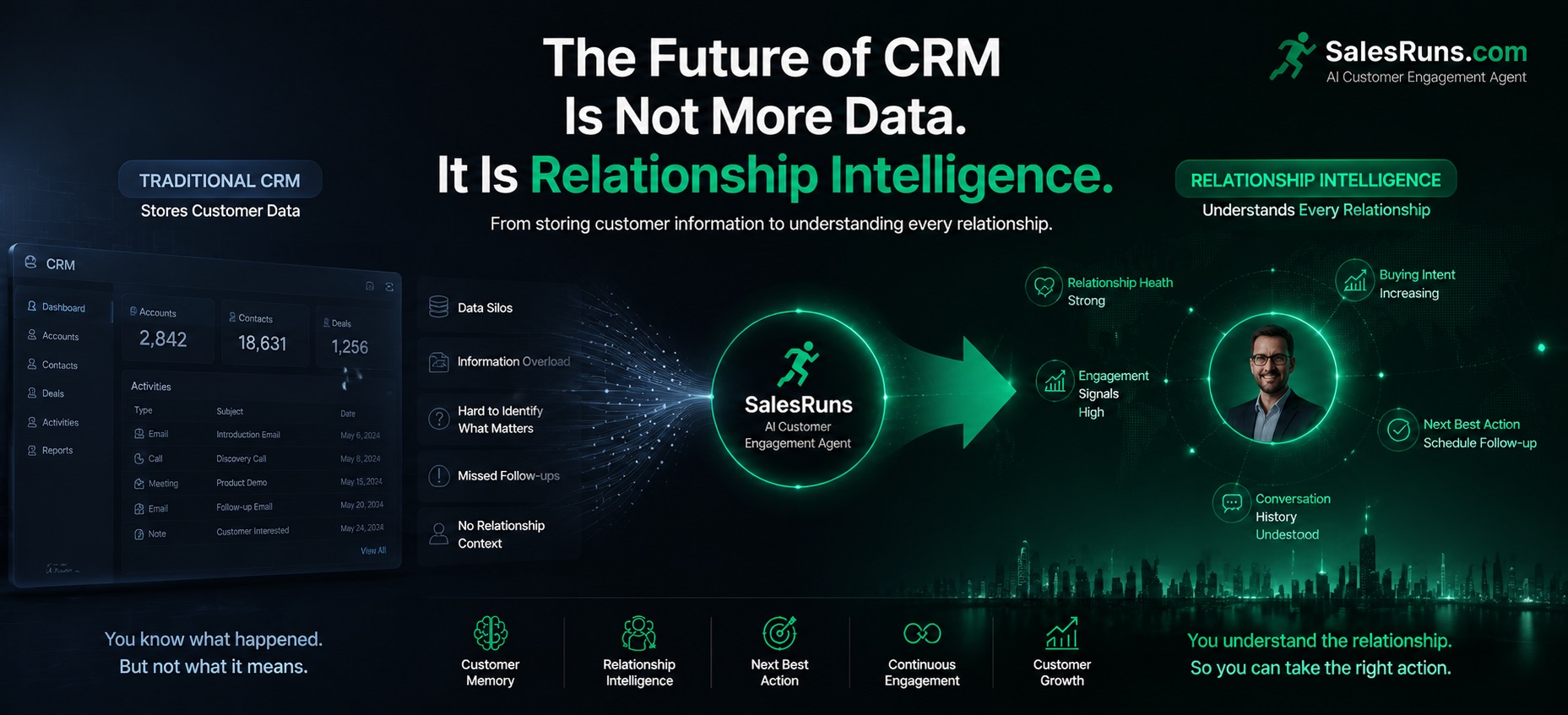
The Future of CRM Is Not More Data. It Is Relationship Intelligence.
Traditional CRM solved 'where is the customer data?' The question sales teams actually need answered now is different: what does this relationship mean, and what should we do next? This article introduces Relationship Intelligence as the next evolution beyond CRM, explains why data alone hits a ceiling, and shows how an AI Customer Engagement Agent like SalesRuns transforms stored records into actionable relationship understanding.
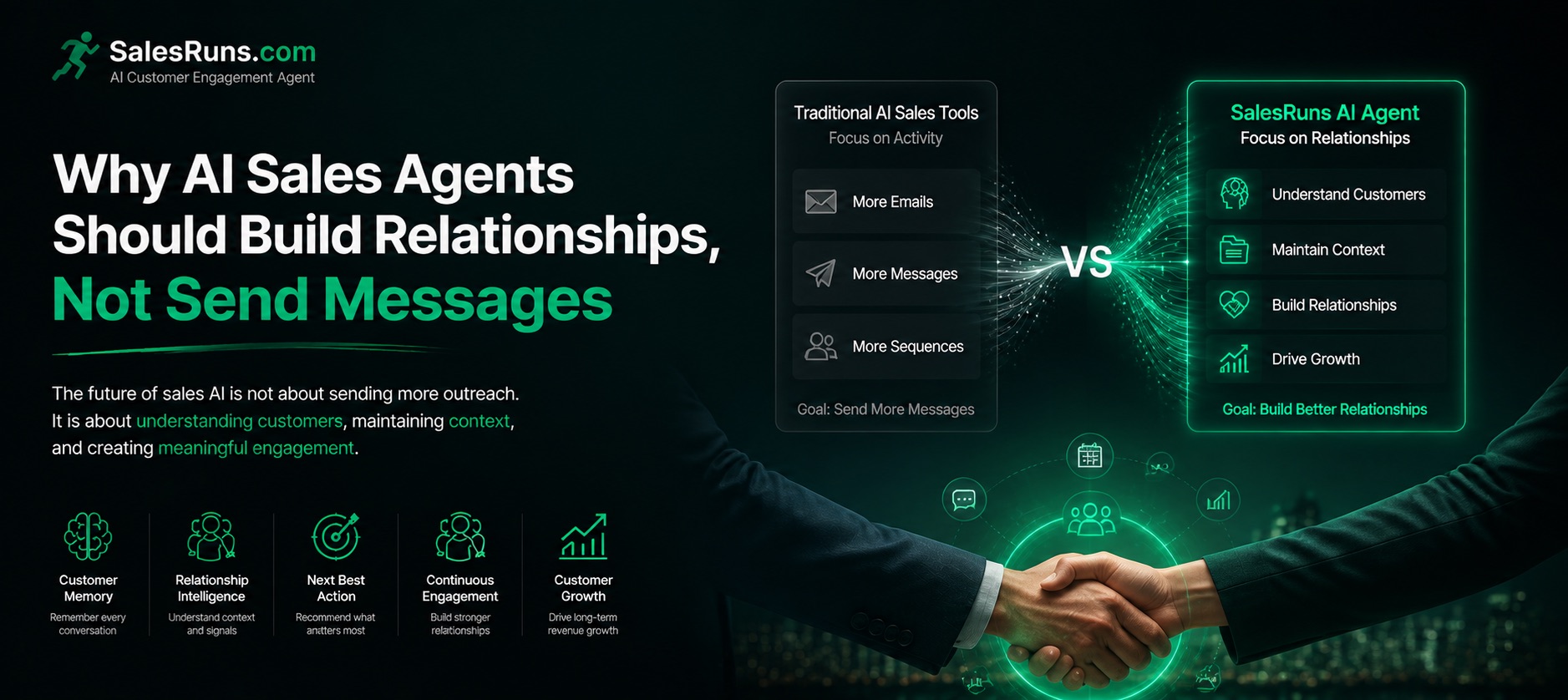
Why AI Sales Agents Should Build Relationships, Not Send Messages
Most AI sales tools are built to send more messages. SalesRuns takes a different position: the future of AI in sales is not volume, it is relationship intelligence. This article explains why message-first automation hits a ceiling, why personalization without memory is just templating, and what an AI Customer Engagement Agent actually does.
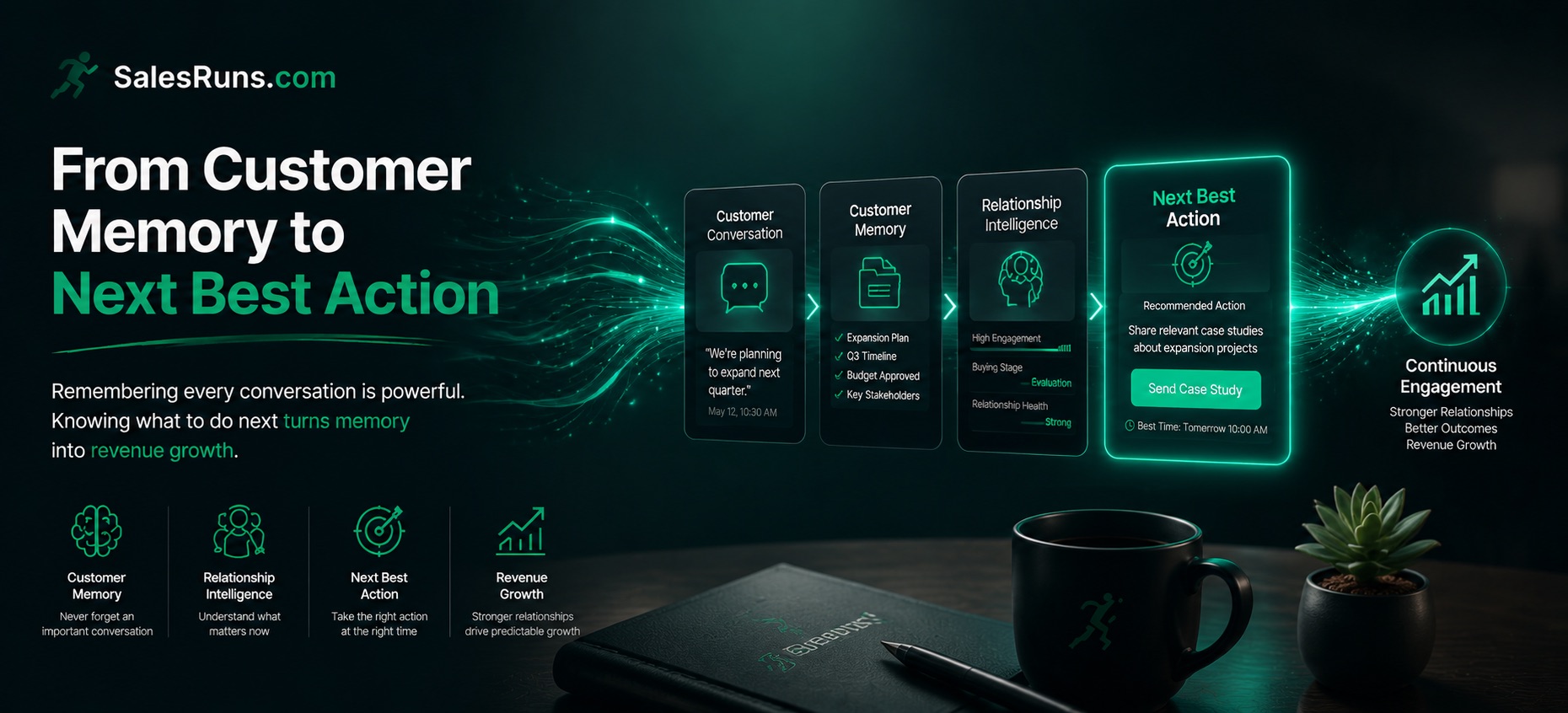
From Customer Memory to Next Best Action
Modern sales teams already have CRM records, email threads, meeting notes, and quotations sitting in half a dozen systems. The challenge is no longer collecting data. It is knowing what to do with it. This article explains why Customer Memory alone is not enough, what Next Best Action really means, and how SalesRuns.com turns accumulated context into a continuous stream of intelligent recommendations.
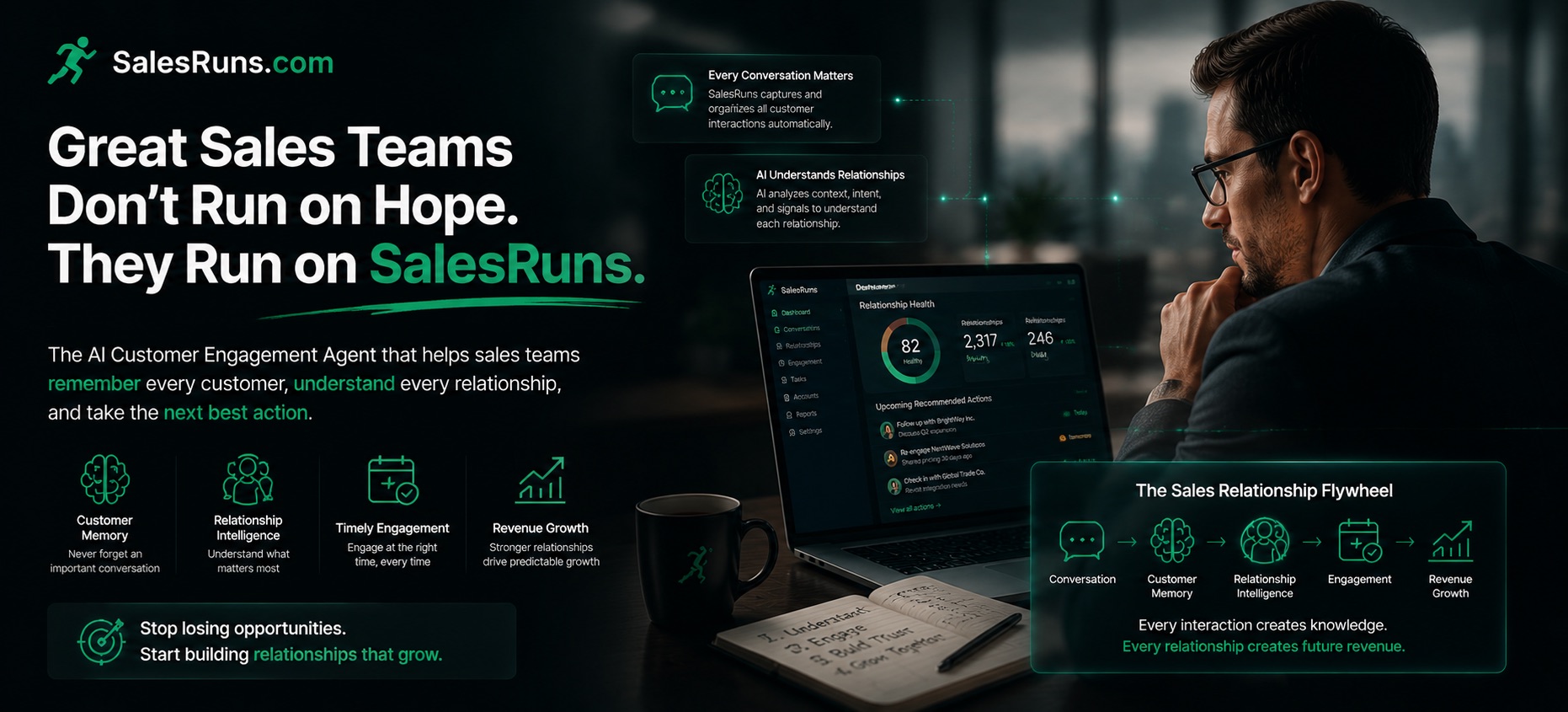
Great Sales Teams Don't Run on Hope. They Run on SalesRuns.
Most sales teams still operate on hope: hope that the rep remembers the conversation, hope the buyer replies at the right moment, hope the dormant opportunity wakes up. Products run on behavioral systems. Sales should run on one too. This piece borrows a sharp framing from a recent Reddit discussion and applies it to the relationship side of sales, then introduces SalesRuns.com as the AI Customer Engagement Agent that turns customer engagement into a system rather than a habit.
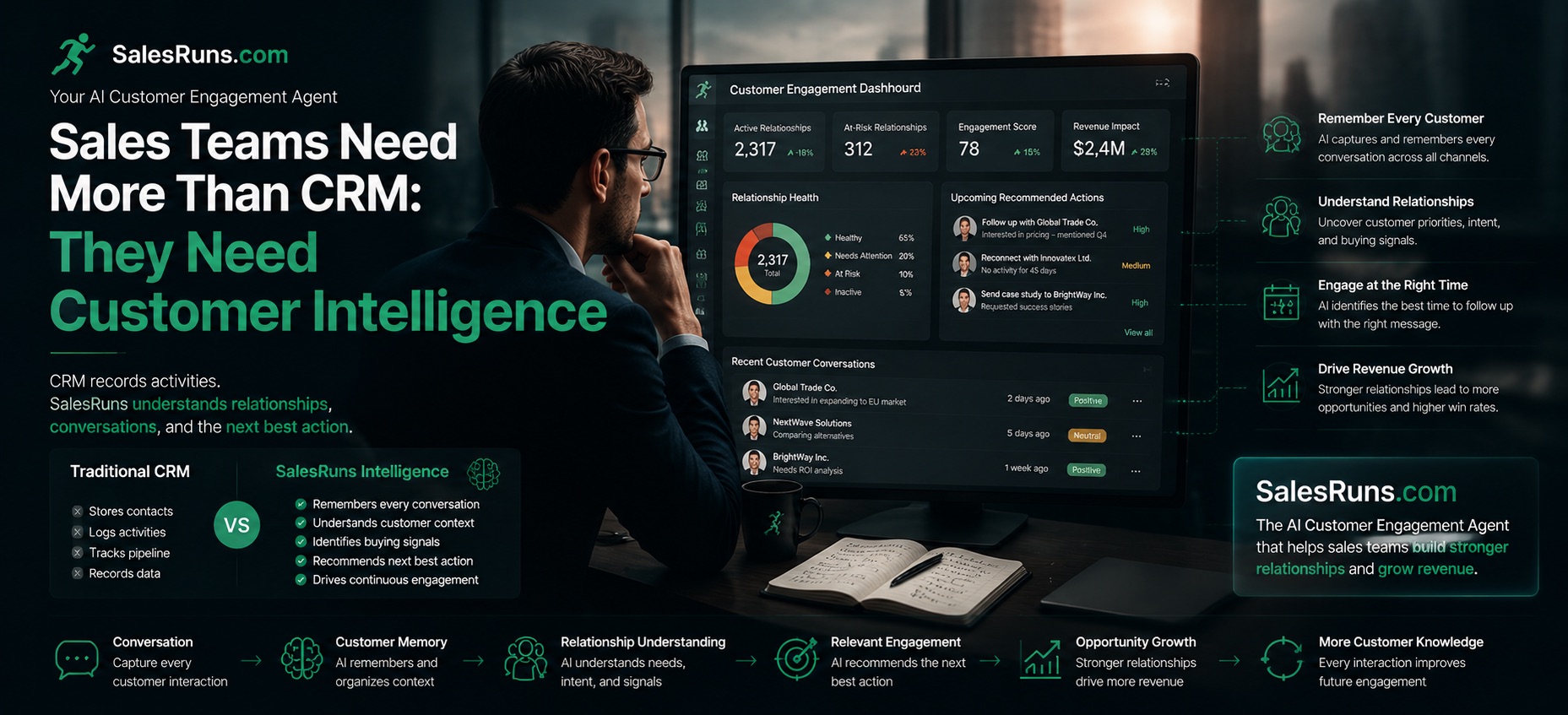
Sales Teams Need More Than CRM: They Need Customer Intelligence
Most sales organizations already track pipeline stages, contact details, and forecast numbers. The harder problem is the one nobody is reporting on: relationships losing momentum because the small details that kept them alive disappeared into someone's inbox. This piece borrows a product manager's framework from Justin Anovick on the LaunchPod podcast and applies it to the relationship side of sales. The result is a working definition of Customer Engagement Intelligence and the path from CRM to it.
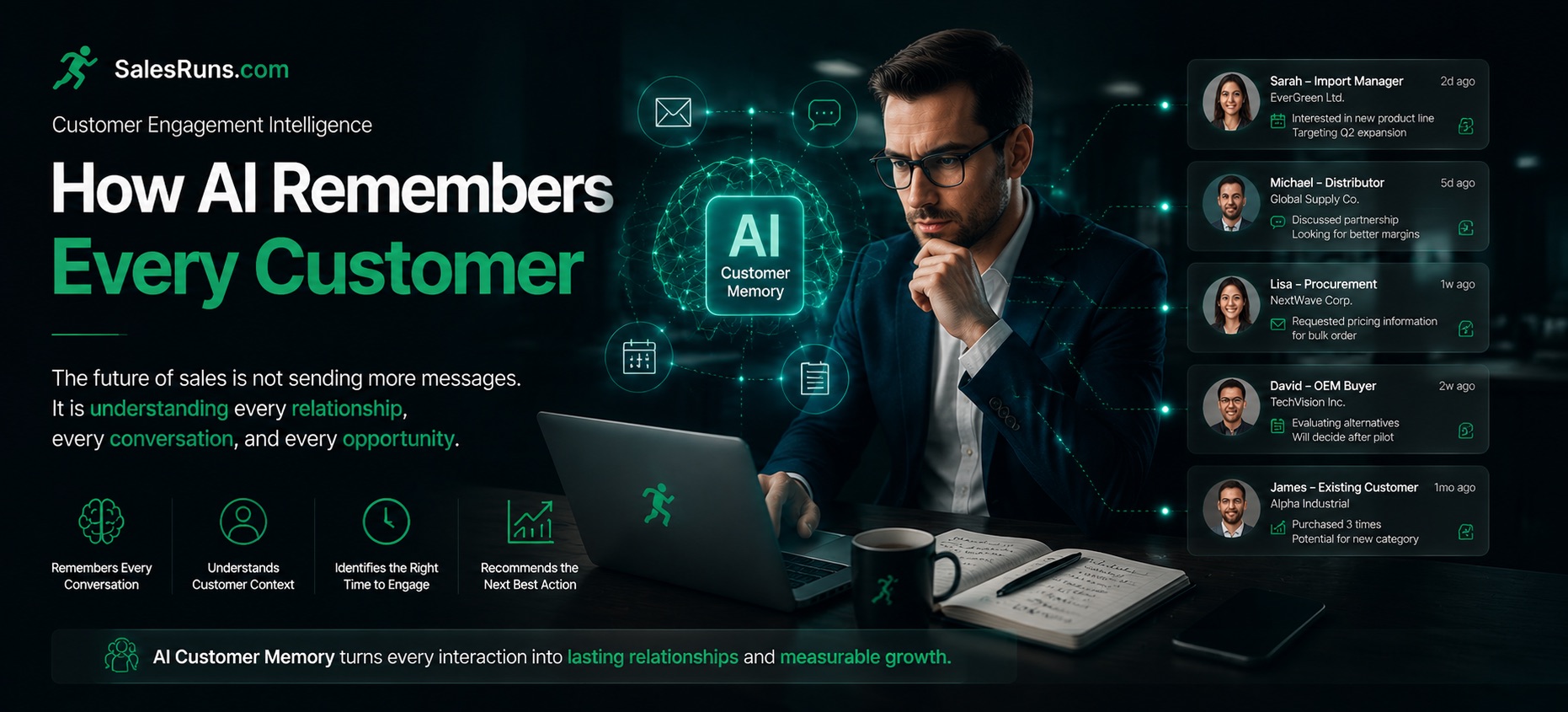
How AI Remembers Every Customer
Salespeople are great at building relationships. The problem is memory. As companies grow, the details that make a deal work — preferences, timing, past objections, quiet promises — quietly leak out of everyone's head. This piece looks at what Customer Memory actually means, why traditional CRM can't carry it alone, and how an AI layer helps teams hold onto the relationships they've already earned.
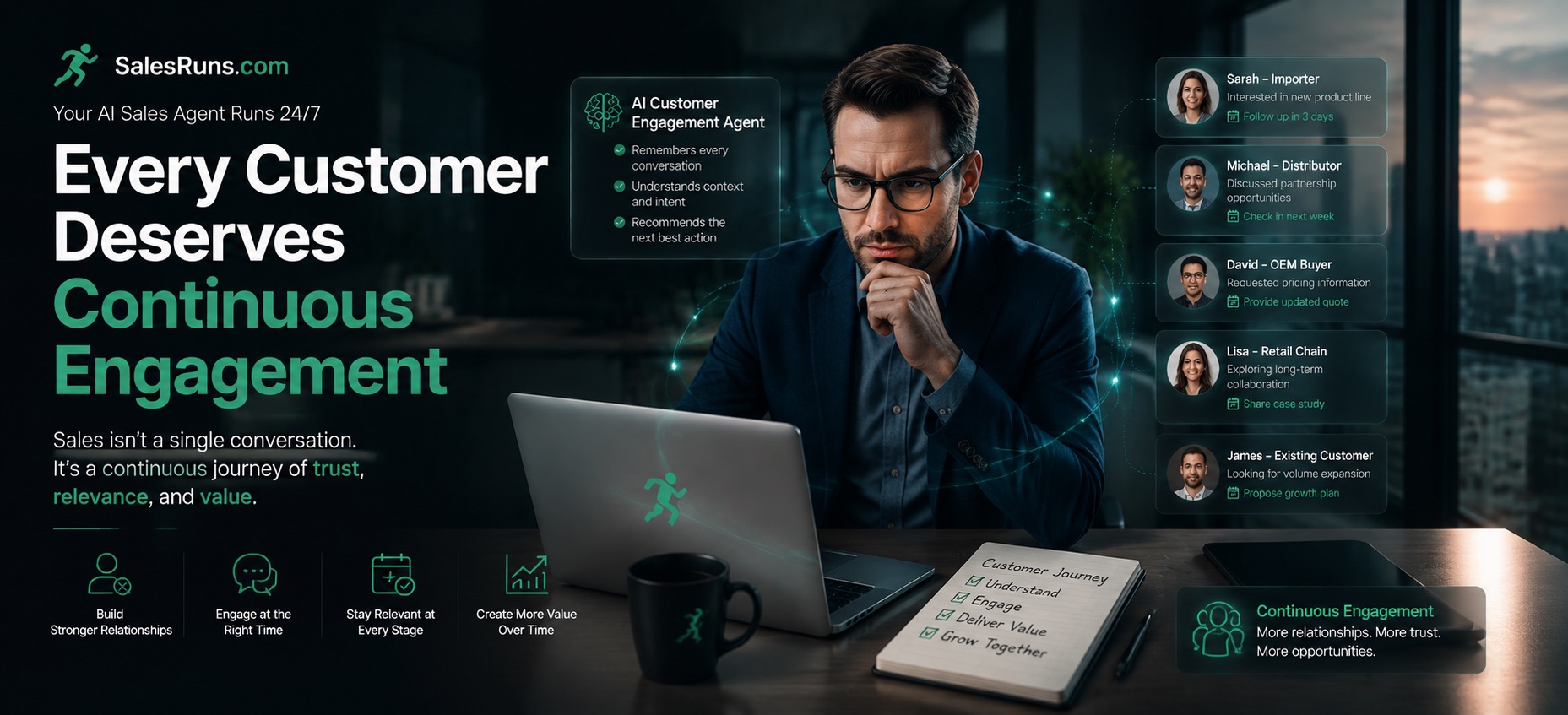
Every Customer Deserves Continuous Engagement
Most B2B sales processes are built around one-time outreach and isolated meetings. Real growth comes from continuous engagement: remembering every customer, understanding changing priorities, and showing up with relevance over time. Here's what that shift actually looks like in practice.
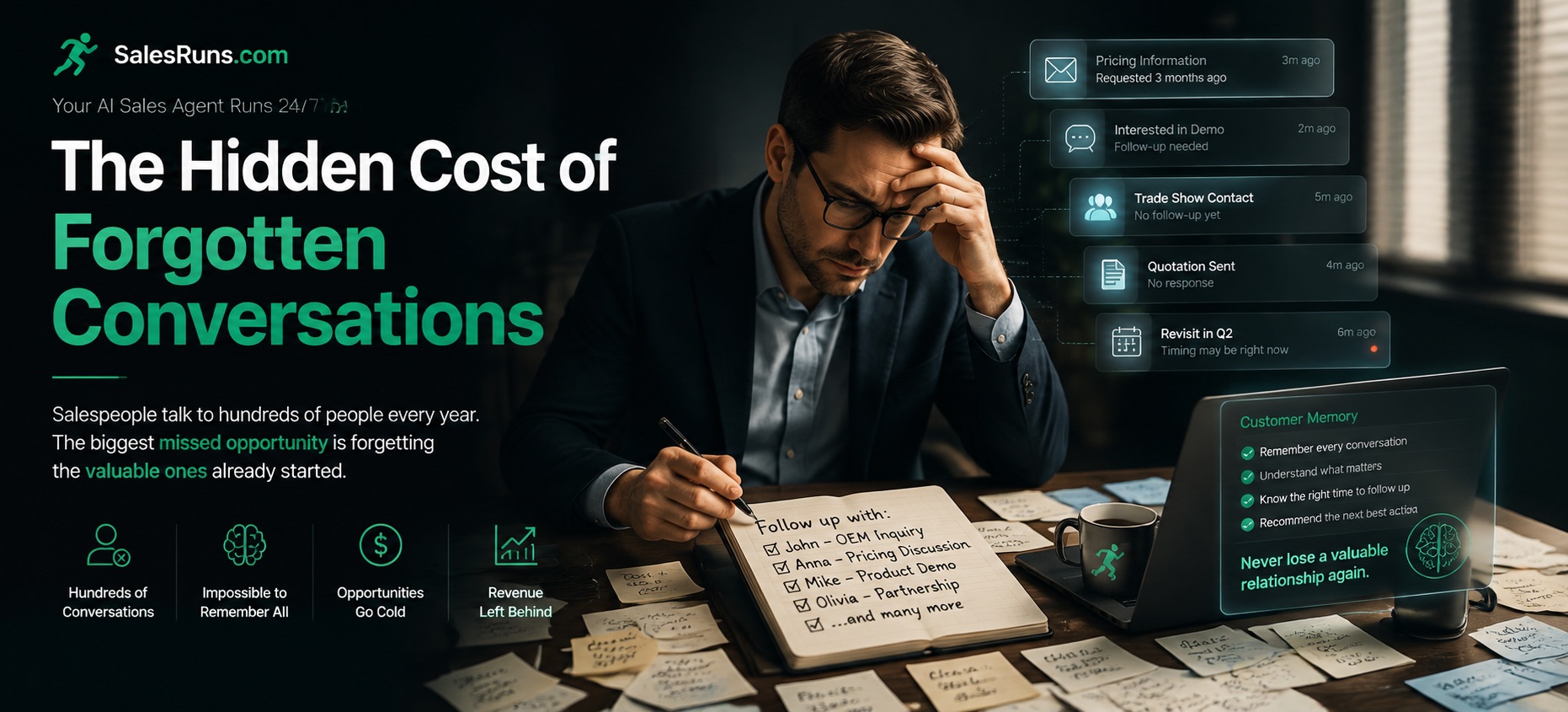
The Hidden Cost of Forgotten Conversations
Sales teams obsess over new leads, but the larger leak is the relationships they already have. This article explains the hidden revenue cost of forgotten conversations, and why the future of sales is memory, not more outreach.
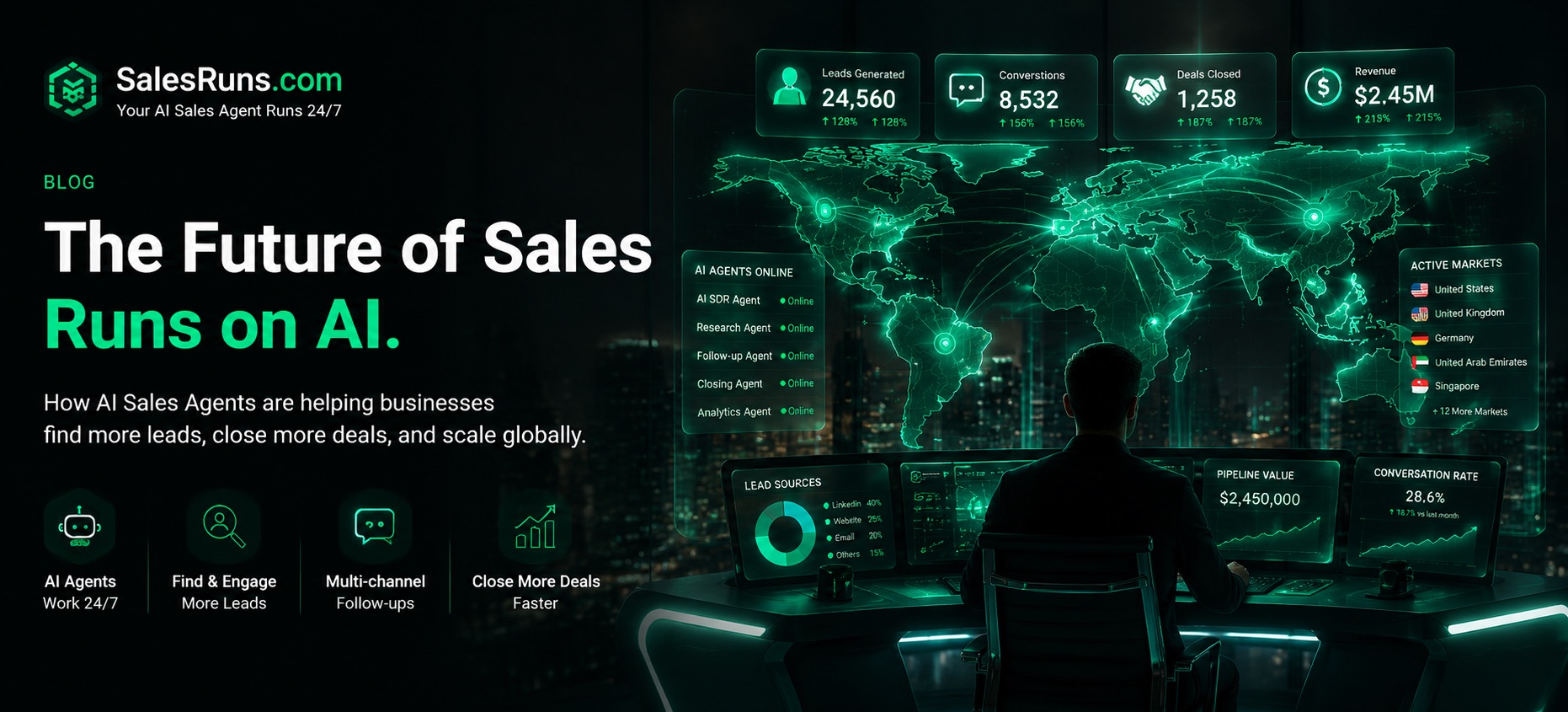
Build Your $100M AI Sales Empire in Minutes
Walk through all 12 missions of the AI Sales Empire simulation. See how a single founder turns 20 business cards into a global AI sales organization that closes $100M in annual revenue — without manual follow-up.
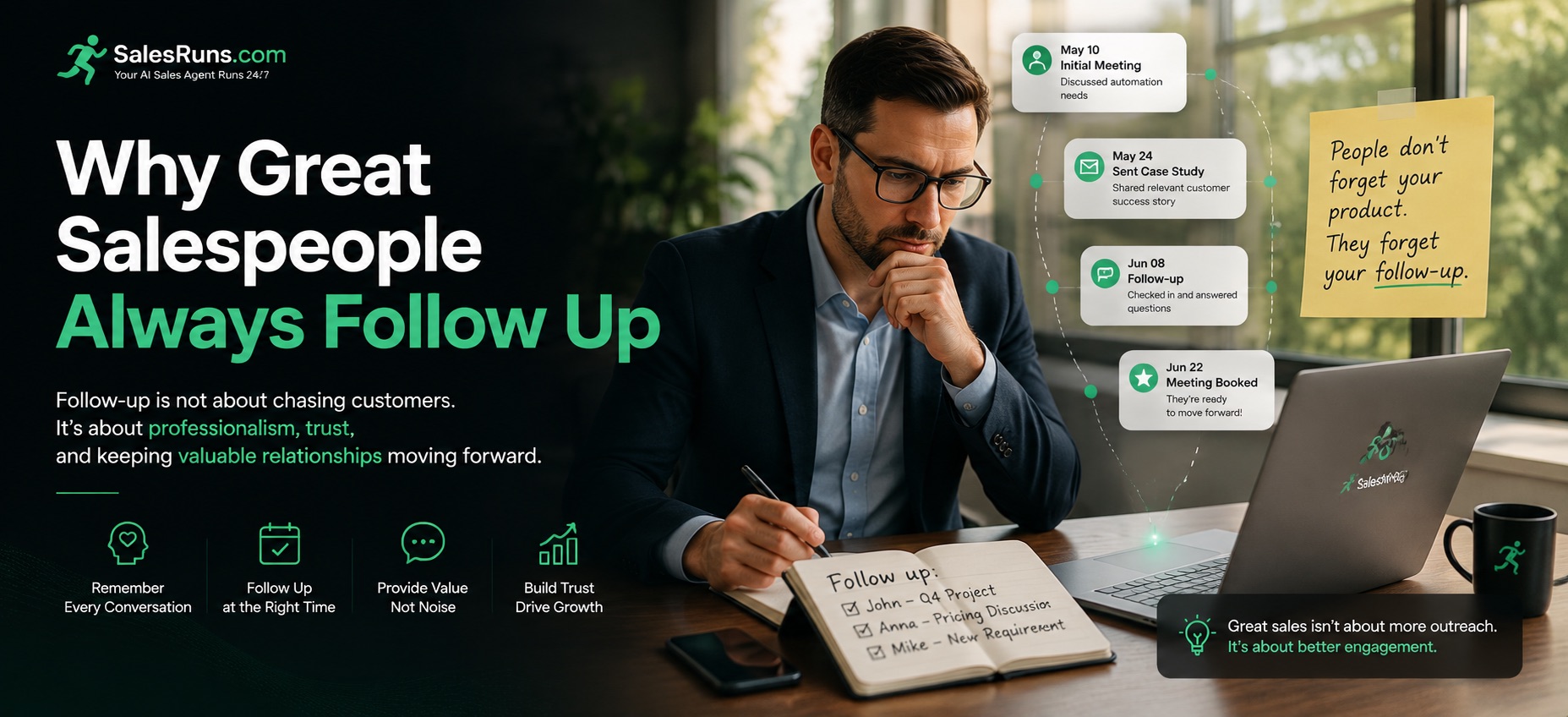
Why Great Salespeople Always Follow Up
Many salespeople associate follow-up with bothering customers. In reality, professional follow-up is a sign of respect, contextual memory, and timing. This article reframes follow-up as the foundation of modern customer engagement — and shows how AI can help sales teams do it better without sending more spam.
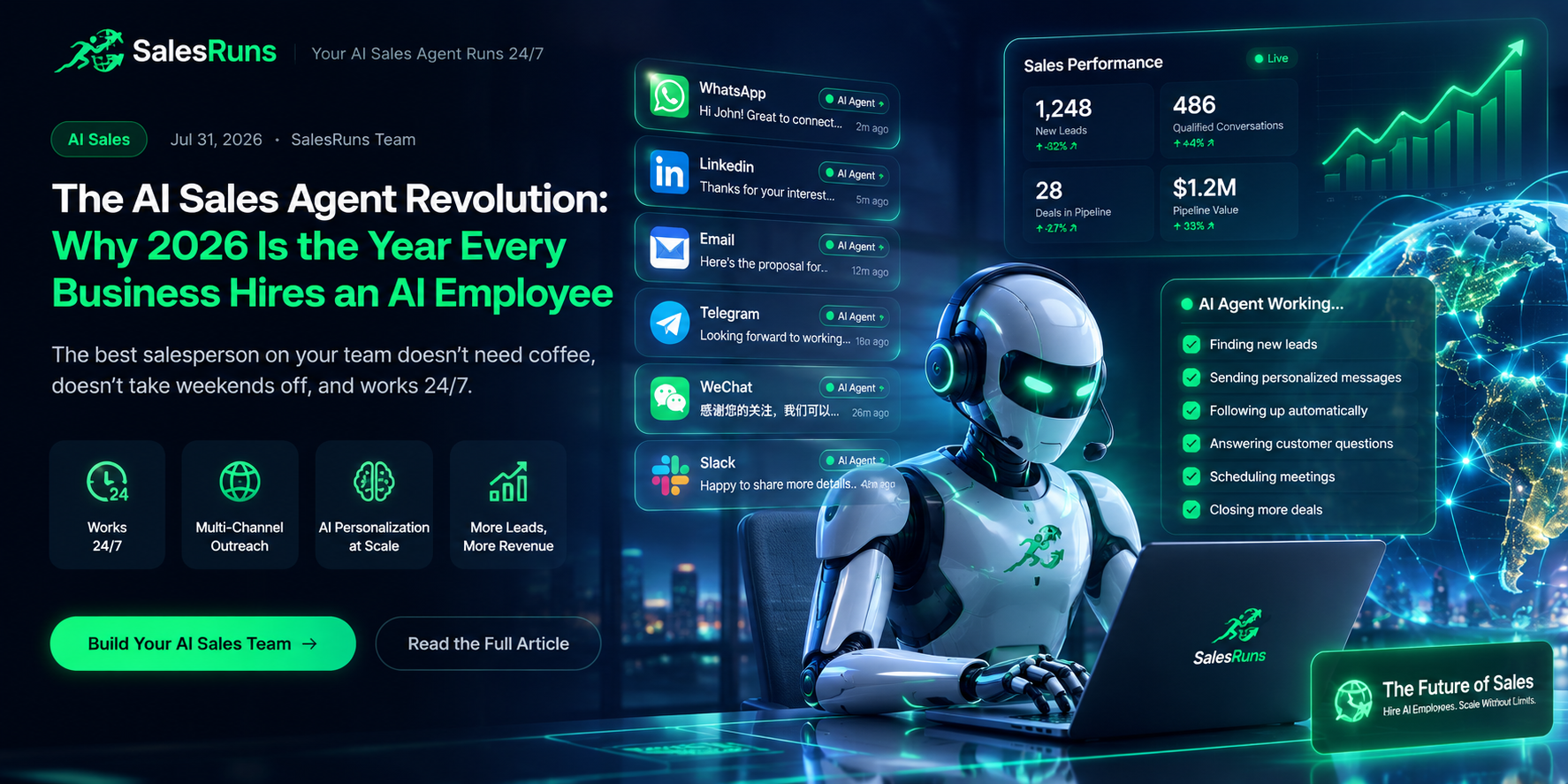
The AI Sales Agent Revolution: Why 2026 Is the Year Every Business Hires an AI Agent
How AI sales agents are transforming customer acquisition, replacing cold calling with intelligent multi-channel outreach, and why businesses that don't adopt will fall behind.
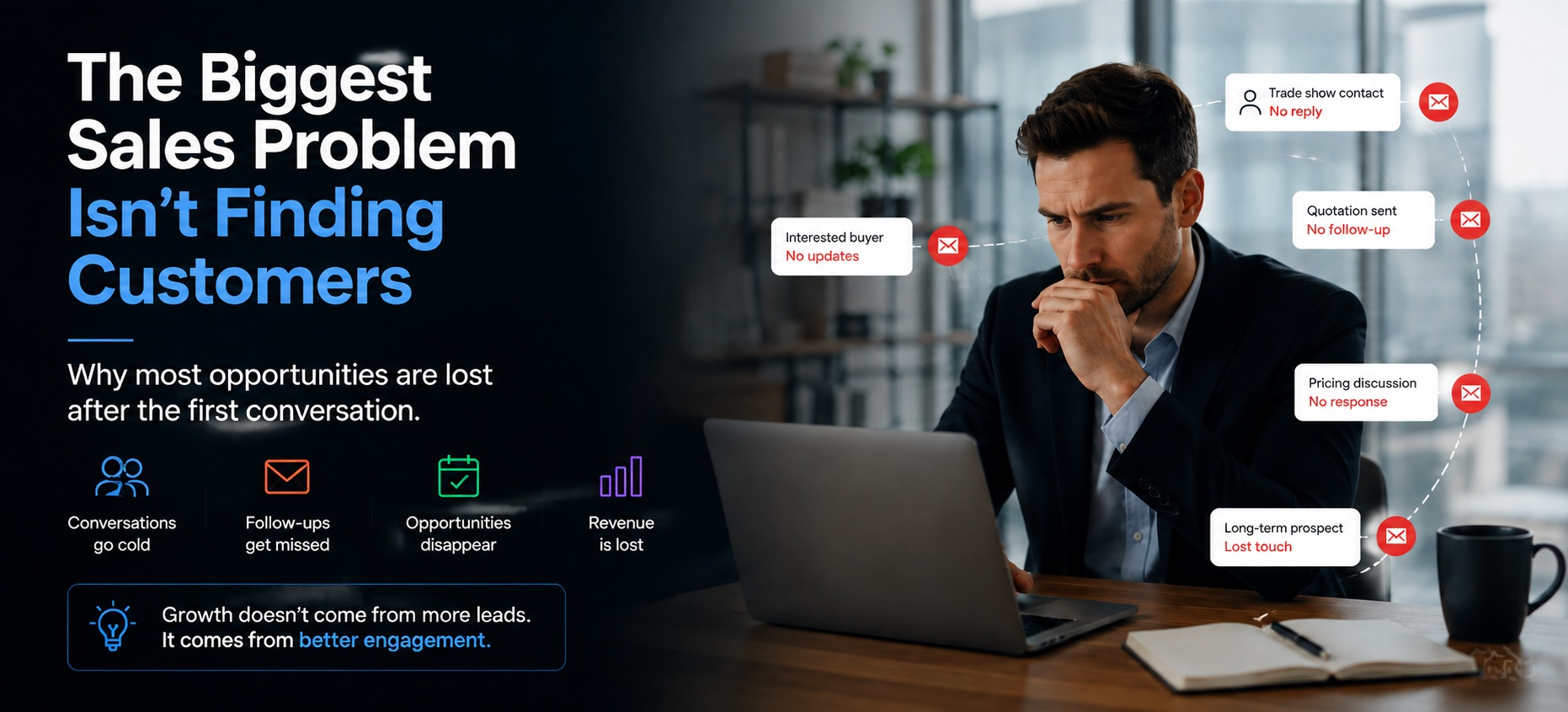
The Biggest Sales Problem Isn't Finding Customers
Most sales teams obsess over finding new leads — yet the biggest revenue leak isn't at the top of the funnel. It's in the relationships already in motion. Here's a new way to think about growth.