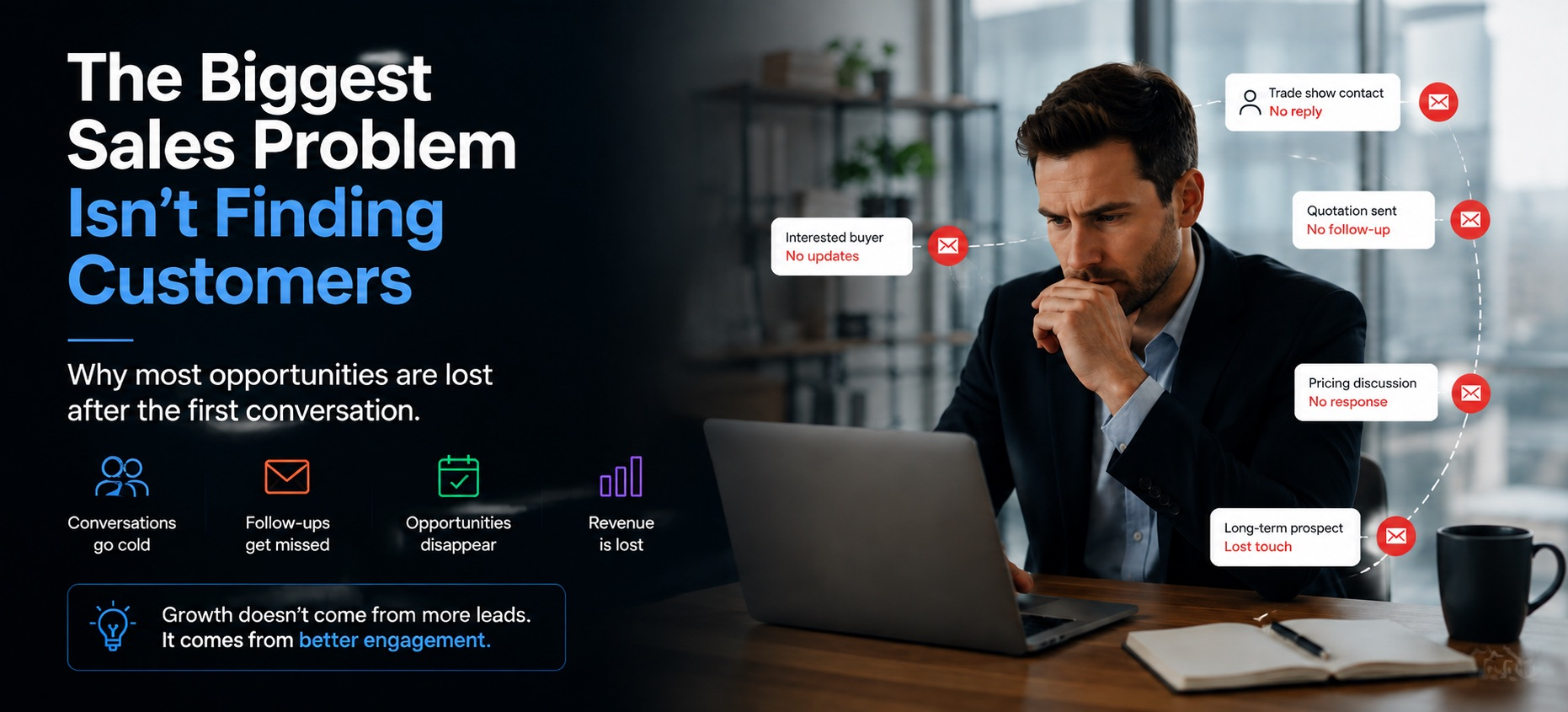
Walk through any modern B2B company's sales operation and you'll find the same story. The marketing team is spending heavily on demand generation. The SDR team is grinding through cold lists. The sales floor is staffed, the CRM is configured, the dashboards are green.
And yet, somewhere between the first conversation and the closed deal, the majority of qualified opportunities quietly disappear. Not because the leads were bad. Not because the pitch was wrong. Because nobody remembered to follow up — or nobody knew what to say when they did.
The Acquisition Obsession
There is a near-universal belief in B2B sales: more leads equal more revenue. Every quarter, executives demand more pipeline. Marketing is measured on MQLs. SDR teams are rewarded on activity — calls made, emails sent, conversations booked. The industry has built an entire software category around this idea. Lead databases. Intent signals. Cold email automation. LinkedIn scraping. Each tool promises the same thing — a bigger top of funnel. Hypothetical example: A mid-sized industrial equipment manufacturer spends $400,000 per year on lead generation. They generate 4,000 new contacts annually. Roughly 6% — about 240 — become qualified opportunities. From there, conversion to closed deals follows industry-standard rates. Now consider what happens after those 240 conversations happen.
The Forgotten Conversation
Salespeople are busy. Most B2B sales reps are juggling 60–120 active opportunities at any time. Each conversation contains nuances — a buyer's frustration with their current supplier, a comment about an upcoming product launch, a passing mention of a regional expansion.
These details are gold. They tell you exactly when to follow up, what to say, and what the buyer actually cares about. But in most organizations, they vanish the moment the call ends. They live in someone's memory for a week, get summarized into a vague CRM note, and then disappear entirely.
Three real-world scenarios
Trade show contact: A buyer walks the booth at a Hannover Messe. They ask about your new pump line and request a quote for their Lagos operation. The quote is sent. No reply. Three months later, they buy from a competitor who followed up with a regional case study.
Overseas buyer: A distributor in São Paulo asks about container lead times. Your sales rep promises to check and never returns. They find another supplier via Alibaba within a week.
Procurement manager: A multinational RFP arrives. Your team responds. They wait four weeks. By the time you follow up, the budget has been reallocated.
None of these opportunities were lost because of bad targeting or weak product. They were lost because the relationship stopped moving forward.
Why CRM Doesn't Solve This
Customer Relationship Management systems are designed to store records. They have fields for company size, contact name, last contacted date. They generate reports on pipeline velocity and conversion rates. But a CRM is not a memory. It cannot recall that the buyer at Acme Industries mentioned their factory was being expanded in Q3. It cannot remind your rep that three months ago, the prospect asked for a Portuguese-language technical datasheet. It cannot infer that a quote sat unopened because the procurement manager went on parental leave.
In other words, CRM captures facts but loses context. It was built for a world of structured data fields — not for a world of conversations.
The difference between a record and a relationship
A record is a snapshot. A relationship is a continuous thread. Modern B2B buyers expect the second. They expect the company they spoke with in January to remember their preferences in July. They expect an AI sales rep who said they'd send a quote by Friday to actually send it. The companies that win long enterprise sales cycles are not the ones with the biggest CRMs. They are the ones with the most continuous memory.
The Idea of Customer Memory
Customer Memory is a new layer sitting above the CRM. It captures not just the structured fields of an account, but the unstructured context of every conversation — emails, calls, meeting notes, product questions, objections, preferences. More importantly, it makes that context searchable and actionable. Imagine your sales rep receives a Slack notification six weeks after the last conversation: "Acme Industries — based on your last conversation, they mentioned switching from Chinese suppliers due to tariff concerns. They asked about your EU factory. A new EU regulation on industrial pumps goes into effect in Q4. Suggest reaching out with your EU-made product line and a regional case study."
That is not a hypothetical chatbot. That is the future of B2B sales — context that compounds over time, surfacing exactly the right information at exactly the right moment.
Why context compounds
Every conversation you remember adds a layer to your understanding of the buyer. Their industry trends, their internal politics, their seasonal timing, their preferred communication style — all of it is signal. The longer you engage, the smarter your next touch becomes. This is the opposite of cold outreach. Cold outreach is zero-context — every message is a fresh attempt. Continuous engagement is high-context — every message builds on what came before.
Why Continuous Engagement Compounds
Engagement compounds because trust compounds. A buyer who has heard from you once a month for six months knows you. They have read your insights, seen your product updates, watched your team respond to their requests. By the time they need a solution, you are the obvious choice — not because you outspent your competitors on ads, but because you were present.
The math of follow-up
Hypothetical scenario: Two reps contact the same 100 prospects. Rep A sends a single cold email. Conversion rate: 2%. They close 2 deals. Rep B sends a thoughtful monthly follow-up for six months, each message referencing the prior conversation. Conversion rate: 14%. They close 14 deals. The compounding effect of continuous engagement isn't magic — it's basic trust economics. Each touch adds a small probability that the next message will land. Multiply that probability across months and the difference becomes exponential.
The Customer Engagement Agent
This is the category that emerges from the logic above. A Customer Engagement Agent is not a chatbot. It is not a CRM. It is not a sales automation tool. It is an AI system that maintains every existing customer relationship, remembers every conversation, and recommends the next best action. It works across every channel where your buyers actually live — WhatsApp, Telegram, LINE, Slack, Discord, WeChat, WeCom, and Email. It never forgets a quote. It never misses a follow-up. It surfaces opportunities that would otherwise vanish into CRM notes. In the next article in this series, we will dive deeper into how Customer Engagement Agents are deployed in practice across B2B organizations. For now, the key insight is this: The future of sales is not more outbound. It is better ongoing engagement.
Key Takeaways
- Most B2B sales budgets are over-allocated to acquisition and under-allocated to engagement.
- The biggest revenue leak in modern B2B sales is in the relationships already in motion.
- CRM stores records; it does not maintain relationships. A new layer is needed.
- Customer Memory — searchable, structured context — is the missing layer.
- Continuous engagement compounds over time, while cold outreach starts from zero each touch.
- The Customer Engagement Agent is the next category of B2B sales software.
Frequently Asked Questions
Why is customer engagement more important than customer acquisition?
Acquisition produces one-time pipeline. Engagement compounds over time, turning existing conversations into long-term revenue. Most B2B deals don't close on the first contact — they close after months of trust-building.
Why do salespeople forget valuable opportunities?
Sales reps juggle 60–120 active opportunities at any time. Without a memory layer that captures unstructured context — buyer preferences, objections, follow-up timing — critical signals disappear within weeks.
What is Customer Memory?
Customer Memory is the persistent, searchable context of every customer interaction. It captures not just structured CRM fields but unstructured signals from emails, calls, meeting notes, and chats — making them actionable over time.
What is a Customer Engagement Agent?
A Customer Engagement Agent is an AI system that continuously maintains relationships with every existing customer, remembers every conversation, and recommends the next best action across multiple channels.
How is a Customer Engagement Agent different from a CRM?
CRMs are passive record systems. Customer Engagement Agents actively maintain relationships, surface follow-ups, and execute actions across channels. The difference is between storing data and maintaining context.
Can AI replace salespeople?
Not entirely. AI excels at maintaining continuous engagement, remembering context, and surfacing the right next action. Salespeople still own judgment, relationship building, and complex negotiation. The two together outperform either alone.
How often should sales teams follow up?
Continuous engagement outperforms periodic mass outreach. The cadence depends on the buyer's signals, but monthly check-ins with context — not templated blasts — produce the highest long-term conversion.