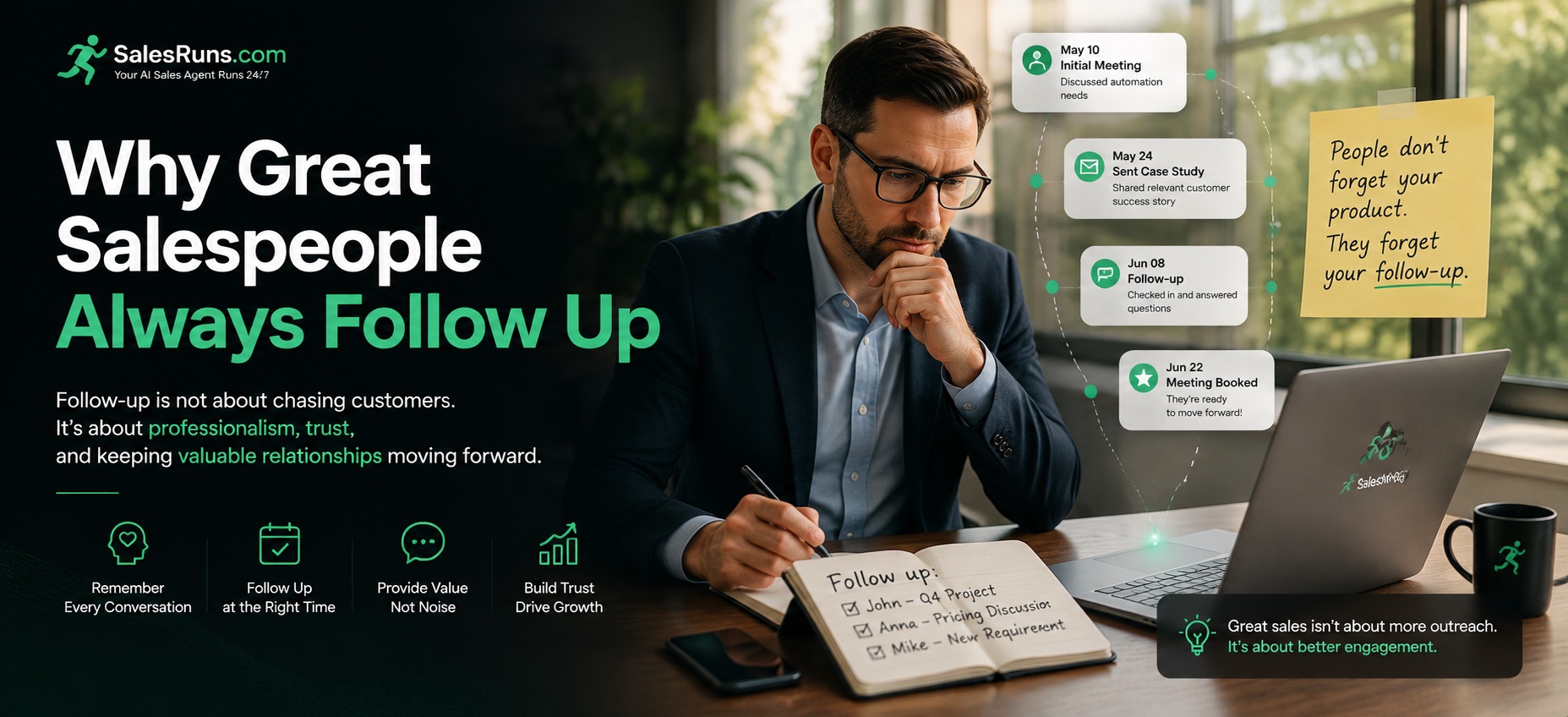
Walk into any B2B sales floor and ask a representative what they dread most. In nearly every region, in nearly every industry, the answer is the same: follow-up.
Not the first call. Not the demo. Not the negotiation. The follow-up. The moment after a conversation ends, a quote is sent, or a prospect says "we'll think about it." That is the moment most salespeople retreat, hoping the customer will somehow come back on their own.
But great salespeople do the opposite. They follow up. Not because they are pushy. Because they understand something the rest of the industry has forgotten — that a sales conversation is not finished when the meeting ends, and that the most valuable opportunities are the ones nobody else bothers to maintain.
Why Salespeople Avoid Following Up
Before we can fix follow-up, we have to understand why it is avoided in the first place. The reasons are not strategic. They are psychological. First, there is the fear of being annoying. Many reps have experienced a customer who visibly bristled at a second email. That one moment crystallizes into a rule: "don't push." The rep would rather lose a deal than risk being labeled as the kind of salesperson the buyer dislikes. Second, there is the fear of rejection. A follow-up that does not receive a reply feels worse than silence. It is an explicit confirmation that the buyer has moved on. Most salespeople would rather not know than confront that answer. Third, there is uncertainty about what to say. The conversation ended naturally. The quote was sent. What now? Without context, the next message is either a hollow "just checking in" or an obvious sales push — neither of which feels professional. Fourth, there is a lack of customer context. The rep genuinely does not remember the buyer's last comment. The CRM note says "discussed pricing." That is not enough information to write a meaningful follow-up.
All four of these barriers share a common root: the salesperson does not have a system that supports professional follow-up. They have the will. They do not have the tool.
Follow-up Is a Sign of Professionalism
Great salespeople follow up because they understand something the average rep does not: the buyer is busy. A buyer does not reply because they are dealing with internal approvals, evaluating alternatives, or simply not at their desk when the email arrives. None of these reasons mean the opportunity is dead. All of them mean the relationship needs another touch — one that respects the buyer's time. Professional follow-up is built on three principles. The first is memory. The rep remembers what the buyer said in the last conversation, what they care about, what their priorities look like. The second is timing. The rep knows when the next touch should arrive — not too soon, not too late, but exactly when the buyer is likely to be ready. The third is relevance. The rep brings something useful to the next conversation — a product update, a case study, a regulatory change that affects the buyer's industry. When those three principles are present, follow-up stops feeling like pressure and starts feeling like service.
The Difference Between Follow-up and Spam
Most people conflate follow-up with spam. They are not the same thing. Spam is one-to-many. It is sent without context, without memory, without any understanding of the recipient. Spam asks: "Will enough of these work?" Professional follow-up is one-to-one. It is built on the previous conversation. It uses the buyer's name, their company, the specific topic they were evaluating. It asks: "Does this person need another touch right now?" Consider the difference. A spammy follow-up sounds like: "Hi John, just checking in to see if you had a chance to review our proposal." A professional follow-up sounds like: "Hi John, based on our last conversation about your Q3 production expansion in Mexico, I thought you might want to see the EU tariff update that affects your component sourcing. Happy to walk through it next week if useful." The first message asks the buyer to do work. The second message provides value. The first message is forgettable. The second message is the reason the buyer replies.
Why Great Salespeople Remember Every Conversation
Memory is the foundation of professional follow-up. If you cannot remember what was discussed last month, you cannot write a meaningful message this week. In traditional sales operations, this memory lives in the head of the individual salesperson. It is captured — or not captured — in CRM notes. It is reinforced — or lost — through weekly pipeline reviews. It is shared — or hoarded — across team handovers. The result is that customer context is fragmented, temporary, and fragile. A rep leaves the company, and the relationships they built lose momentum. A buyer changes their priorities, and the rep finds out three months later when the deal stalls. A quote is forgotten, and a competitor who followed up with relevant context wins the business. This is the gap that Customer Memory fills. Customer Memory is the persistent, searchable, structured context of every customer interaction. It captures not just CRM fields — company name, deal stage, last contact date — but the unstructured signals from every email, call, and meeting: buyer objections, internal politics, seasonal timing, preferred communication style, competitive mentions. When that context is captured and surfaced at the right moment, the salesperson becomes dramatically more effective. They do not need to remember every conversation. The system remembers for them.
The Role of AI in Modern Follow-up
AI is changing what follow-up looks like in modern sales teams. But the goal is not to send more messages. The goal is to send better ones — and to send them at the right time. Three practical ways AI supports follow-up today. First, AI can remember conversations. Every call transcript, every email thread, every meeting note can be parsed, summarized, and indexed. The rep no longer needs to take detailed notes during a call. They can simply focus on the conversation, knowing the AI is capturing the context. Second, AI can suggest timing. Based on customer behavior — opens, replies, meetings booked — AI can recommend when the next touch should happen. Some buyers respond best on Tuesday mornings. Others prefer Friday afternoons. AI can identify these patterns automatically. Third, AI can generate personalized messages. The best AI tools do not write generic templates. They draft messages that reference the last conversation, surface relevant context, and propose a specific next step. The rep reviews, adjusts, and sends — usually in under two minutes. When these three capabilities work together, follow-up stops being a chore. It becomes the natural rhythm of the relationship.
From Follow-up to Customer Engagement
Follow-up is a tactic. Customer Engagement is the strategy. The best B2B sales teams have moved past thinking about individual follow-ups. They think about ongoing engagement — a continuous rhythm of value delivery that keeps the relationship warm, regardless of where the buyer is in the decision process. Continuous engagement compounds. Each touch that references prior context adds a layer of trust. Each update that is relevant to the buyer's industry reinforces your credibility. Each response that arrives within minutes — not days — signals that you are a partner, not a vendor. Over six months, a continuously engaged prospect is dramatically more likely to buy than a prospect who received three cold emails and one quote. The math is not subtle. A rep who maintains continuous engagement with 100 prospects closes roughly seven times more deals than a rep who sends a single cold email to the same 100 prospects.
Three Real-World Scenarios
Scenario 1: The Quotation That Sat Unread
Hypothetical example: An industrial equipment manufacturer in Guangzhou sends a quotation to a buyer in Lagos. The buyer does not respond. The rep marks the deal as "stalled" in the CRM and moves on. A professional follow-up would have looked different. Two weeks after sending the quote, the rep notices that the buyer's country announced a new import regulation. The rep sends a short note: "Hi Tunde — I saw Nigeria updated its industrial equipment import requirements last week. Our quote already complies, but I thought it might be useful context for your team. Happy to walk through the technical changes if helpful." The rep has not chased. The rep has served. The buyer now has a reason to reply, and the relationship has moved forward.
Scenario 2: The Trade Show Contact Who Said "Let's Talk Later"
Hypothetical example: At a Hannover Messe booth, a buyer from São Paulo expresses interest in a new pump line. They exchange business cards. The buyer says, "Send me some information, I'll think about it." Most salespeople send a product brochure and never follow up. Professional salespeople do something different. Two weeks later, they send a note referencing the buyer's specific use case — perhaps a question the buyer asked at the booth about Brazilian regulatory compliance. A month later, they share a case study of a similar manufacturer in Latin America. Three months later, they check in with a regional industry update. The buyer may not be ready to buy today. But when they are ready, the salesperson is the obvious choice — not because they pitched harder, but because they remembered.
Scenario 3: The Enterprise Customer Whose Timing Was Wrong
Hypothetical example: A multinational enterprise shows real interest in your solution. The procurement team is supportive. The budget cycle says Q2. Then Q2 passes and the budget is reallocated. The opportunity appears lost. A professional salesperson maintains the relationship anyway. They send quarterly updates. They share relevant case studies. They check in at industry conferences. They never ask for the sale — they simply stay present. Six months later, the buyer's company undergoes a strategic shift. A new initiative opens up. The buyer remembers the salesperson who kept showing up with useful information. They reach out. The deal that appeared lost is suddenly live again.
What Customer Memory Looks Like in Practice
Imagine your CRM is no longer a collection of static fields. Instead, it is a living memory of every customer relationship. When you open a customer record, you see not just the last contact date and deal stage. You see the last conversation summarized. You see the buyer's stated priorities. You see their objections, their competitors, their internal timelines. You see the moments they engaged and the moments they disengaged. Before you write a follow-up, the system suggests the best timing based on the buyer's response patterns. It drafts a message that references the last conversation. It flags opportunities that have gone cold and recommends next steps. This is not a hypothetical future. This is what Customer Engagement Agents are building today.
The Customer Engagement Agent
The next category of B2B sales technology is the Customer Engagement Agent — an AI system that does not just send messages, but maintains relationships. Unlike traditional sales automation tools, a Customer Engagement Agent does not optimize for volume. It optimizes for context. It remembers every conversation. It understands customer sentiment. It surfaces the next best action. It works across every channel where buyers live — WhatsApp, Telegram, LINE, Slack, Discord, WeChat, WeCom, Email. SalesRuns is one example of a company building in this new category. The SalesRuns Customer Engagement Agent helps B2B sales teams maintain every existing relationship, remember every conversation, and recommend the next best action — without requiring reps to send more messages or work longer hours.
Key Takeaways
- Follow-up is avoided because of psychological barriers — fear, uncertainty, lack of context — not because it is ineffective.
- Professional follow-up is built on three principles: memory, timing, and relevance.
- Spam is one-to-many and context-free; professional follow-up is one-to-one and context-rich.
- Customer Memory is the missing layer between CRM records and real relationships.
- AI can support follow-up by remembering conversations, suggesting timing, and drafting personalized messages — without sending more spam.
- Continuous engagement compounds over time, while cold outreach resets to zero on every touch.
- The next category of B2B sales technology is the Customer Engagement Agent.
Conclusion
Great salespeople follow up. They do it because they understand something the industry has lost sight of: relationships are not built in a single conversation. They are built in the second, third, and tenth — the touchpoints where you prove you remember, you care, and you are useful. The future of sales is not more aggressive outreach. It is intelligent, continuous, contextual relationship management. It is helping every salesperson become the kind of professional who never forgets a quote, never misses a follow-up, and always brings value to the next conversation. That future is not far away. It is being built right now — by teams who understand that follow-up is not a chore. It is the foundation of customer engagement.
Frequently Asked Questions
Why is follow-up important in sales?
Follow-up maintains the relationship between the first conversation and the final decision. Most B2B deals do not close on the first contact — they close after weeks or months of trust-building. Without professional follow-up, valuable opportunities quietly disappear into CRM notes.
How often should salespeople follow up?
There is no universal cadence. The best follow-up frequency depends on the buyer's signals — opens, replies, meeting bookings. The principle is: stay present without becoming intrusive, and always bring value with each touch.
What is the difference between follow-up and spam?
Spam is one-to-many and context-free. Professional follow-up is one-to-one, references the prior conversation, and provides value. Spam asks the buyer to do work. Follow-up serves the buyer.
Can AI help with sales follow-up?
Yes. AI can remember conversations, suggest the best timing, draft personalized messages, identify inactive opportunities, and recommend next best actions. The goal of AI is to make salespeople more professional, not to send more spam.
Why is customer memory important?
Customer Memory captures the persistent, searchable context of every interaction. Unlike a CRM, which stores records, Customer Memory maintains relationships — surfacing the right context at the right moment so the salesperson always knows what to say next.