Most sales teams obsess over the next conversation. Who should we call next? Which lead do we chase? But the bigger opportunity isn't always a fresh name in a new spreadsheet. A lot of revenue is already sitting in the conversations you've had — the meetings that didn't close, the quotes that went quiet, the buyers who politely said "not now."
The problem isn't that customers walked away. The problem is that we walked away first.
Sales Is No Longer a Transaction
Traditional sales thinking is tidy. Find customer. Contact customer. Close customer. Three steps, a clean pipeline diagram, a forecast on a slide. It worked in a world where buyers had fewer options, less information, and longer buying windows.
That world doesn't exist anymore.
A buyer today talks to four vendors before they talk to you. They compare specs on their phone. They ask peers in private Slack groups. They ghost you for three weeks, then ask a question on a Friday at 4pm. None of that fits a linear funnel.
Here's the part that hurts: most sales organizations still measure success in transactions closed. They run quarterly reviews against quota. They celebrate signed contracts. They don't celebrate the second conversation that never happened with the customer who would have bought in eight months.
But that's where modern revenue actually lives. In the conversations that didn't close — yet.
Customers Are Relationships, Not Records
Open any CRM and you'll see rows. Lead name. Company. Deal stage. Last activity date. The rows look tidy because data is tidy. But a relationship isn't a row.
A relationship has texture. It has the call where the buyer mentioned their daughter just started college. It has the email they sent at midnight asking about a configuration option. It has the silence after a quote — not because they said no, but because something else came up and they forgot to reply.
When we store a customer as a record, we strip all that away. We keep the contact, the stage, the dollar value. We lose the story.
And then we wonder why deals stall.
What Continuous Customer Engagement Means
Continuous engagement isn't a new campaign or a new cadence. It's a different posture.
It means treating every customer interaction as one thread in a longer conversation — a conversation that doesn't end when a meeting wraps or a quote goes out. The conversation continues through helpful follow-ups, timely information, and a working memory of what mattered to the buyer the last time you spoke.
Concretely, continuous engagement looks like this:
- Sharing an article the buyer would actually care about — not the one your marketing team queued up.
- Following up on a comment they made three weeks ago, before they have to remind you they mentioned it.
- Knowing that they're entering a busy season and adjusting outreach timing accordingly.
- Remembering they prefer Friday morning emails, not Tuesday afternoon.
- Checking in after a quarter ends — not to push, but to understand what changed on their side.
None of that is exotic. None of it requires a new tool on its own. What's hard is doing it consistently across hundreds or thousands of customers, with a sales team that turns over every few years.
Why Companies Lose Relationships Over Time
When a company is small, the founders remember everything. They know Sarah in procurement is on maternity leave. They know Michael the distributor prefers phone calls. They know David the OEM buyer hates PDF attachments.
That memory is the company's secret weapon. It closes deals that should have been lost and recovers customers who should have churned.
Then the company grows. New reps come in. Founders stop touching deals. The institutional knowledge that lived in people's heads starts leaking out the door.
Six months later, a new rep calls Sarah — who's back from leave — and has no idea she ever existed in the system. The rep introduces the company like it's their first time meeting. Sarah's quiet for a second, then says, "We've been buying from you for four years."
That's the moment you realize: human memory was never going to scale. It was always going to be the bottleneck.
Customer Memory: The Foundation of Modern Sales
If relationships are the asset, then memory is the infrastructure.
Customer Memory is the persistent record of every meaningful interaction a company has had with a buyer — the questions they asked, the objections they raised, the timing of their last purchase, the topics they care about, the colleague they referred you to in the second meeting.
It sits underneath everything: the CRM record, the conversation transcripts, the WhatsApp messages, the trade show badge scans, the quotes that went cold. Customer Memory stitches them together into something usable.
Without it, every rep starts from zero. With it, every rep starts from context.
Here's a small example. A rep opens a record two months after the last contact. With Customer Memory, they see: "Buyer mentioned budget cycle in November. Asked about bulk pricing for Q2. Hasn't responded to last three follow-ups." That's not a row. That's a roadmap for the next conversation.
How AI Enables Continuous Engagement
AI gets a lot of hype, most of it deserved. But the version that's actually useful for customer engagement is the quiet one.
A useful AI engagement agent does five boring things:
- Remembers every conversation across email, call, WhatsApp, and meeting notes — without the rep having to type it in.
- Surfaces the relationships that are about to go cold, the ones that deserve a check-in this week, not next quarter.
- Recommends the next best action based on the customer's history — a relevant article, a follow-up question, an introduction.
- Drafts personalized outreach that doesn't sound like outreach — because it references things the buyer actually said.
- Keeps relationship continuity intact when a rep leaves, a customer changes roles, or a deal goes quiet.
Notice what's not on that list: blasting more messages. AI engagement isn't about sending more. It's about sending the right one — and knowing when not to send anything at all.
From Customer Management to Customer Intelligence
There's a difference between managing customers and understanding them. CRM was built for management. The next generation of sales tooling is built for intelligence.
Picture the difference.
Three short scenarios show what this looks like in practice.
A manufacturer meets an overseas buyer at a trade show. The buyer is interested but says timing isn't right. Under the old model, that buyer goes into a list and gets a generic "just checking in" email three months later, then disappears. Under the continuous engagement model, the manufacturer remembers what the buyer said about their distribution plans, sends a relevant case study when a similar customer wins in that market, and checks in six months later with a concrete reason to talk.
A distributor purchased products once, three quarters ago. They've gone quiet. A rep notices the distributor's region is opening a new retail channel — flagged by the AI engagement agent from public news. The rep reaches out not to push another order, but to share a market insight and ask whether the new channel changes their product needs. That conversation uncovers a six-figure reorder.
A customer requested pricing information eight weeks ago, then disappeared. The old approach: forget them or send a desperate discount email. The continuous approach: notice they went quiet, check whether their stated reason (a hiring freeze) has changed, and reach back out only when there's something genuinely relevant to bring.
Same customers. Same CRM. Different outcomes, because the team remembered what was actually going on.
From Contact Management to Relationship Intelligence
The future of sales isn't a faster dialer or a cleverer email template. It's a system that takes every conversation you've already had and turns it into something a future rep — or a future version of you — can actually use.
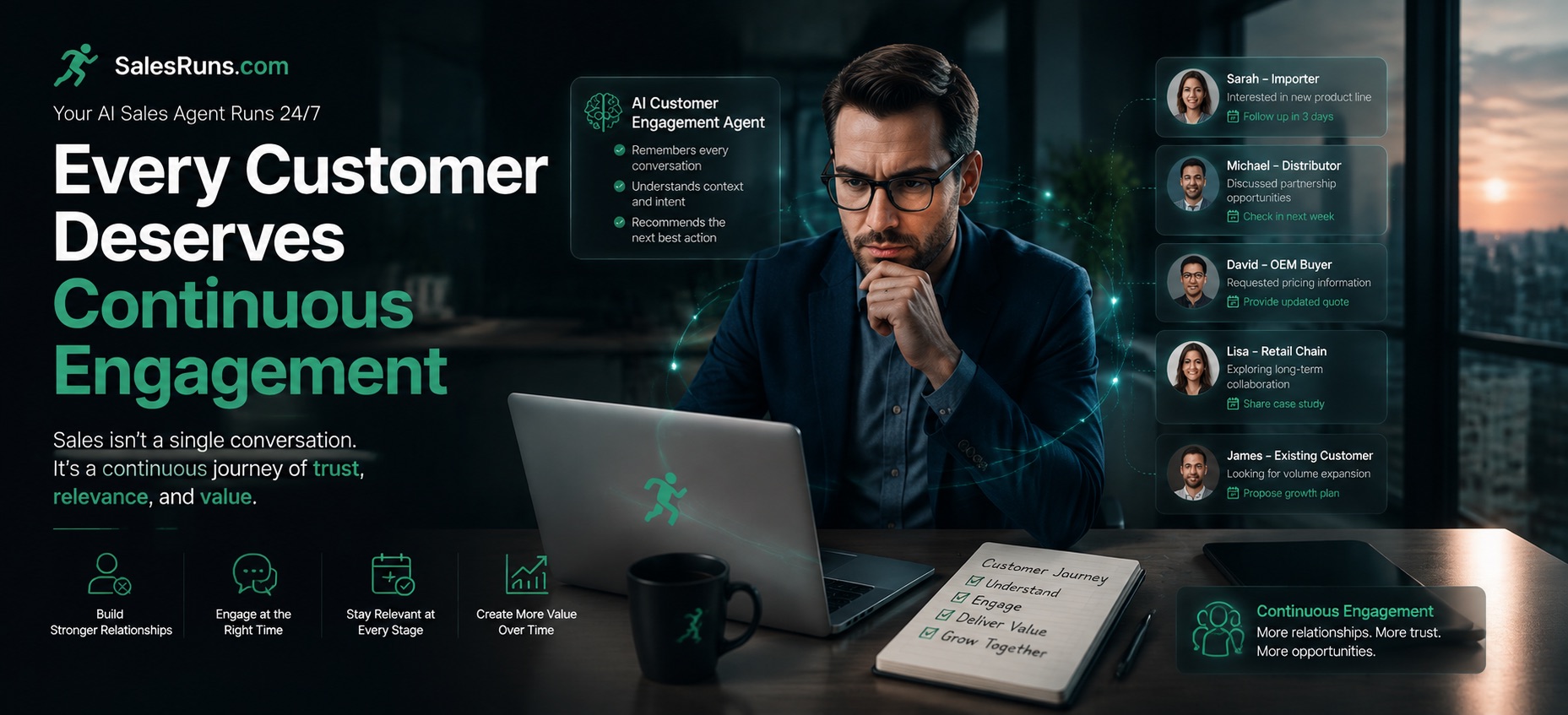
That's what an AI Customer Engagement Agent does. It remembers the conversation you had with Sarah in October. It knows Michael the distributor prefers calls on Wednesdays. It flags that David the OEM buyer asked about a feature your team shipped last month. It tells your newest rep what to say in the next email before they spend twenty minutes drafting it.
SalesRuns is built around that idea. Not as a feature, but as the whole point. Sales runs on relationships. Relationships run on memory. And memory, at scale, runs on AI.
The companies that figure this out first won't just close more deals. They'll keep the customers they already have, and grow them, year after year, without starting over every quarter.
- Continuous engagement treats customers as relationships, not pipeline rows.
- Human memory is the bottleneck as companies grow — even the best reps can't remember every buyer.
- Customer Memory stitches conversations, quotes, and signals into a usable record.
- Useful AI in sales surfaces the right next action, it doesn't blast more emails.
- The shift from contact management to relationship intelligence compounds revenue over time.
What is continuous customer engagement?
Continuous customer engagement is the practice of maintaining meaningful, relevant interactions with customers over time — across their buying cycle, not just during a single transaction. It blends timely follow-ups, useful information sharing, and an awareness of the customer's evolving priorities.
Why is customer engagement important in B2B sales?
B2B buying cycles are long, and most decisions involve multiple stakeholders and changing conditions. Continuous engagement keeps your company present and useful between buying moments, which is when most of the actual revenue work happens. Customers rarely buy after a single touch.
How is customer engagement different from lead generation?
Lead generation is about finding new contacts. Customer engagement is about deepening the relationships you already have. Both matter, but engagement compounds: every interaction adds context and trust, while new leads start from zero.
Can AI improve customer relationships?
Yes — when AI is used to remember context and surface relevance, not just automate outreach. An AI engagement agent can track conversation history, flag at-risk relationships, and suggest next-best actions that feel personal because they're based on what the customer actually said.
What is a Customer Engagement Agent?
A Customer Engagement Agent is an AI system that maintains relationship continuity across every channel — email, calls, messaging, meetings. It remembers previous conversations, identifies important moments, and helps the team act on the next best action before a customer goes cold.