The hardest part of sales today isn't finding customers. It's keeping the ones you've already talked to.
A pipeline report can tell you how many deals are open, what stage they're in, and what your forecast looks like next quarter. It can't tell you that the buyer who said "let's revisit this next quarter" is exactly one month from that moment right now. It can't tell you that the distributor you onboarded last year has gone quiet because their competitor just switched suppliers. And it can't tell you which conversation from a CES meeting six months ago is sitting in a single rep's memory, untouched.
A recent LaunchPod conversation with Justin Anovick made me think about why. His argument was about how product teams run their work. The thing that struck me wasn't the product angle. It was how cleanly the same discipline applies to the relationship side of sales, where most teams are still flying blind.
The New Challenge of Modern Sales
Sales used to be a numbers game. Reach more prospects. Make more calls. Close more deals. The math worked because buyers moved slowly and the gap between vendors was bigger than the gap between reps.
That math doesn't hold anymore.
Buyers today talk to four or five vendors before they talk to you. They do their own research on their phone. They check references in private Slack groups. They ghost you for three weeks and then ask a sharp question on a Friday afternoon. By the time your CRM shows a deal in the "Negotiation" stage, the buyer has already mentally chosen between you and a competitor in the elevator on the way to the meeting.
The practical effect: the lever that drives growth is no longer how many new prospects you reach. It's whether the conversations you've already had are still moving forward.
That shift breaks most sales organizations. They're built to count activities and report on pipeline stages. Nobody has a dashboard for "relationships losing momentum" or "conversations that quietly died last month."
The numbers back this up. Most forecasting misses come not from leads that were never qualified, but from deals that looked healthy in the CRM and then quietly went dark. The activity log said "last touched last Tuesday." The relationship said something different, and the rep didn't have a way to read it.
Why CRM Alone Is Not Enough
CRM did a great job at one thing: turning a salesperson's contact list into a shared database. Contacts, accounts, deal stages, activity logs. That was transformative in 2005. It's still the foundation most teams run on.
It is also, by design, a system for recording what happened. Not what it meant. Not what should happen next.
A note in the CRM might say: "Buyer mentioned budget cycle in November." That's a fact. It doesn't capture that the buyer's tone was upbeat, that their CFO had just approved a new line item, that the comment came in the last two minutes of a long call when the buyer was tired. None of that nuance survives in a contact record. And nuance is where deals live.
Justin Anovick's framework on LaunchPod was about how product teams run their work with discipline: clear visibility, measurable outcomes, continuous improvement. The same logic applies to customer relationships. A CRM shows you the rows. It doesn't show you the relationship. To see the relationship you need a different layer of intelligence on top.
Here's the practical split:
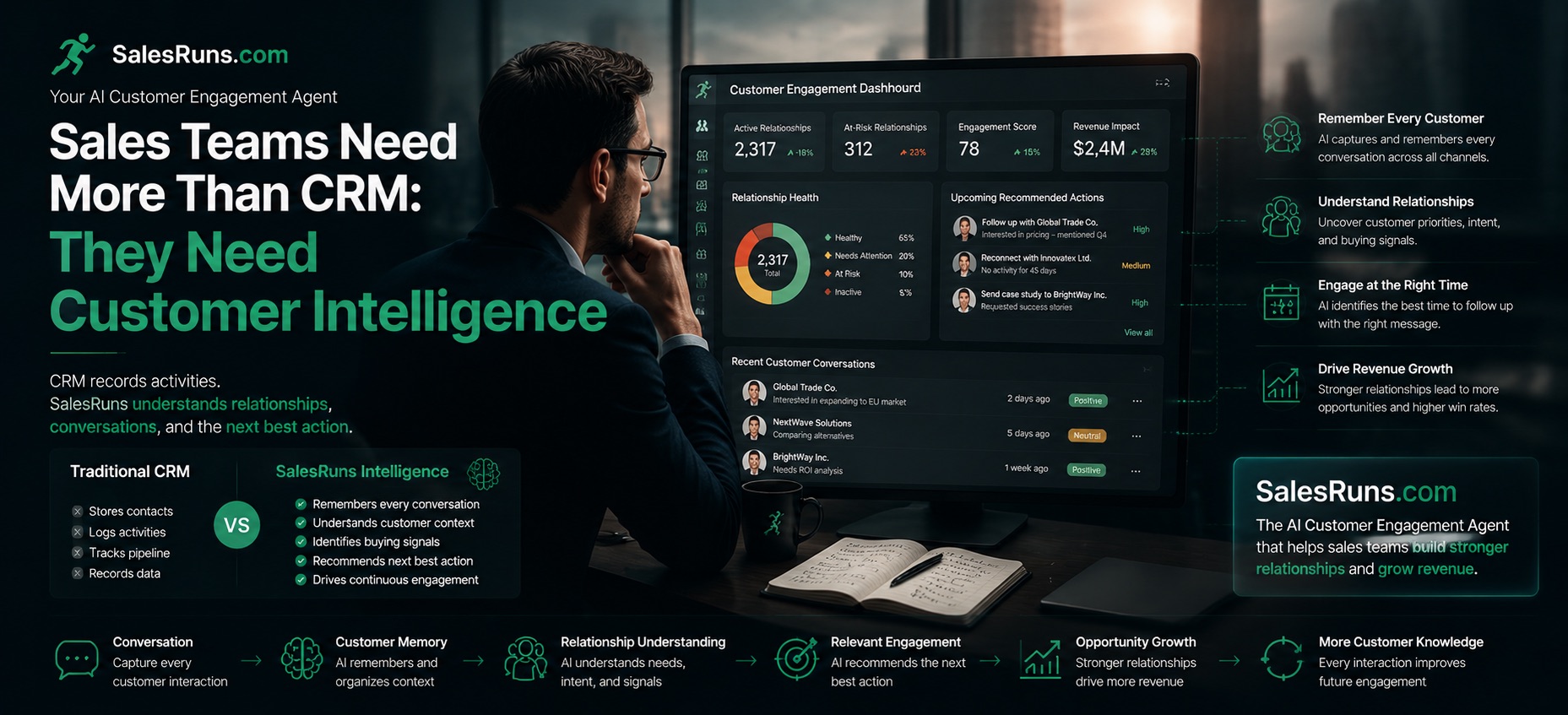
- Traditional CRM stores contacts, logs activities, tracks deal stages, and produces reports for managers.
- Customer Intelligence understands conversation history, customer priorities, buying signals, relationship health, and timing.
- One is a record. The other is a model of the relationship.
Sales runs that mistake the two pay the price quietly, in deals that stall for reasons nobody can articulate, and in forecasts that surprise everyone at quarter end.
Borrowing Justin Anovick's product discipline makes the gap sharper. A good product team runs on visibility: what's working, what's not, what's about to break. They measure outcomes, not just activity. They iterate based on what users actually do. A sales team running only on CRM has none of those for the relationship side. The pipeline view tells you about deals. It tells you almost nothing about the people inside them.
From Customer Records to Customer Intelligence
Customer Intelligence is the layer above the CRM that turns what the CRM stores into something a rep can act on.
Concretely, it covers the things the CRM usually misses:
- Conversation history, including the tone and the small asides, not just the meeting outcome.
- Customer priorities as they shift across quarters, so a follow-up reflects what matters this month, not last quarter.
- Buying signals, the moments where intent actually showed up, like a hiring spree, a competitor switch, or a quiet budget approval.
- Relationship health, a working score that says "this account is warming up" or "this one has gone cold" before the renewal date.
- Timing, the right moment to re-engage, not the next open slot in the rep's calendar.
None of this replaces the rep. It just gives the rep what they used to have in their head when the company was small enough to remember every customer. As the pipeline grows, that memory stops scaling. Customer Intelligence is how it scales.
There is a useful boundary to draw here. Customer Intelligence is not a replacement for judgment. A model can flag that a relationship is going cold, but it can't decide whether the right move is a phone call, a case study, or a six-month pause. It can prepare the rep to walk into the next conversation already knowing what matters. The actual conversation still belongs to the human.
The Hidden Value Inside Every Conversation
Most sales organizations already have the raw material for Customer Intelligence. It's just sitting in inboxes, transcripts, WhatsApp threads, and forgotten notes.
Think about what a single conversation captures. The email asks what problem the customer is solving. The meeting confirms who the decision-makers are. The quote tells you what the objections are, and where the price resistance shows up. The follow-up after silence tells you what made the momentum stop.
That data already exists. The challenge isn't collecting more of it. The challenge is turning it into action. A rep who can read every conversation before their next call walks in already knowing what matters. A rep who can't, walks in cold and starts over.
Three short scenarios show what the difference looks like.
A company meets 300 potential buyers at CES. Under the old model, those names go into a spreadsheet and most of them go cold within ninety days. With Customer Intelligence, every meaningful exchange gets captured, not as a generic note but as the actual questions buyers asked and the products they lingered over. Six months later, the sales team reaches out to the right ones with the right context, and the follow-up rate more than doubles.
A buyer says "let's revisit this next quarter." Traditional sales files the opportunity under inactive and forgets it. Customer Intelligence remembers the exact statement, the buyer's stated trigger, and recommends the right moment to reconnect, ideally a week before the buyer's own deadline, not three months after it's already passed.
A distributor purchased twice last year, then went quiet. The CRM marks them as inactive. Customer Intelligence notices the distributor's region just opened two new retail channels, connects that to the distributor's stated growth plan from a year-old meeting, and surfaces them as a high-priority reactivation. The rep reaches out not with a generic discount but with a relevant market insight. The account reopens.
Same customers. Same CRM. Different outcomes, because one team had memory and the other didn't.
How AI Creates Continuous Customer Engagement
Customer Intelligence doesn't happen without a working memory layer. The reason it works now, and didn't five years ago, is that the AI layer underneath got good enough to be useful without being intrusive.
A well-built AI engagement system does five things, all quietly:
- Listens across channels, including email, call, and chat, and pulls out the moments that matter without asking the rep to type them in.
- Connects the dots between events. A buyer's public LinkedIn move, a hiring announcement, a quiet three-month gap. Then links them to the customer's history.
- Surfaces the relationships about to go cold before they actually go cold.
- Drafts a next message that references what the buyer actually said, not what your template thinks they care about.
- Keeps continuity when a rep leaves, when the buyer changes roles, or when a deal goes silent for a quarter.
None of that replaces the rep. The rep still has to make the call, run the demo, close the deal. AI just makes sure the rep walks in already knowing what matters.
It's worth pausing on what "augment" actually means here, because the AI-in-sales conversation is full of grand claims and quiet failures. The honest version: AI is excellent at the parts of sales humans are bad at. Holding context across hundreds of conversations. Catching the small signal that a deal is slipping. Suggesting the right moment to re-engage. None of that replaces a rep's judgment. None of it requires a rep to give up ownership of the relationship either. The division of labor that tends to work in practice is straightforward: AI suggests, the rep decides, the customer experiences a person who remembers.
SalesRuns and the Future of Relationship Intelligence
SalesRuns is built around exactly that idea. Not as a feature on a checklist, but as the entire point of the product.
The bet is simple. The hardest part of B2B sales is no longer finding customers. It's keeping the customers you already have, and growing them over time, without starting over every quarter. To do that at scale, you need Customer Intelligence that listens across every channel, remembers the small details, and surfaces the next best action at the right moment. You need it to live above the CRM, not inside it.
An AI Customer Engagement Agent should help sales teams remember every conversation, identify relationship changes, and prepare personalized communication. It should suggest next-best actions based on what the customer actually said, not what your last email template assumed they care about. It should be transparent, with every surfaced insight showing its source, and additive, never authoritative. The AI suggests. The rep decides.
That's the work. Not finding more cold leads. Not blasting more automated messages. But helping companies maintain the relationships they've already worked hard to earn, and create a flywheel where every interaction improves the next one.
The flywheel in practice is unglamorous and pays off slowly. A rep uses the system to remember a small detail from a six-month-old call. The buyer notices. The buyer comes back with a sharper question. The rep has the answer. The next conversation goes better than the last. Six quarters later, that single account is the difference between a flat year and a record one. None of that shows up in any weekly pipeline report. All of it shows up in revenue.
- Modern sales growth comes from moving existing relationships forward, not from reaching more prospects.
- CRM is a record of activities. Customer Intelligence is a model of the relationship.
- Every conversation already contains the raw data needed to understand a customer; the challenge is turning it into action.
- An AI Customer Engagement Agent augments reps by holding context, not by blasting more messages.
- The flywheel runs from conversation through memory, understanding, engagement, trust, and back to more knowledge about the customer.
What is Customer Engagement Intelligence?
Customer Engagement Intelligence is the discipline of turning scattered customer interactions across email, calls, and meetings into a working model of the relationship. It combines conversation history, customer priorities, buying signals, and relationship health into something a rep can act on, on top of the data the CRM already stores.
Why is CRM not enough for modern sales teams?
CRM is excellent at recording contacts, activities, and deal stages. It is not designed to understand the relationship itself. The signals that decide whether a deal moves forward live in the tone of a call, the small asides in an email, and the context that connects last quarter's conversation to this one. CRM records those signals but doesn't model them.
How can AI improve sales follow-up?
AI can listen across email, call, and chat without the rep having to log anything by hand. It surfaces the relationships about to go cold, drafts a next message that references what the buyer actually said, and keeps continuity when a rep leaves or a deal goes quiet. The result is faster, more relevant follow-up without sending more spam.
What is a Customer Engagement Agent?
A Customer Engagement Agent is an AI system that maintains relationship continuity across every channel. It remembers previous conversations, identifies important moments, recommends the next-best action, and helps the team prepare personalized communication. It augments the rep; it does not replace them.
How does SalesRuns help sales teams?
SalesRuns is built as an AI Customer Engagement Agent. It captures conversations across channels, organizes them into Customer Memory, identifies relationship changes, and surfaces the next-best action at the right moment. The goal is to help sales teams maintain existing relationships and create a flywheel where every interaction improves the next one.