Every sales leader has a version of the same quiet worry. A deal that looked healthy in the pipeline report goes dark for three months. A rep leaves and forty relationships restart from scratch. A buyer who said "let's revisit next quarter" never hears from the company again, until the competitor calls them in week eleven. None of these failures are dramatic. They are just slow, invisible, and quietly expensive.
The common thread is not bad effort. The common thread is that the team was running on hope.
Sales Cannot Run on Hope Alone
Hope is not a strategy, but most sales organizations quietly rely on it. They hope the rep remembers the conversation from two quarters ago. They hope the buyer will reply at the right moment. They hope the dormant opportunity returns on its own. They hope the important follow-up isn't buried under fifty unread emails.
The hope is reasonable. A small team can keep a lot in their heads. The founder remembers the buyer's daughter's college plans. The rep remembers the distributor prefers phone calls on Wednesdays. The team remembers who said what at the last trade show. That memory is the company's real CRM, and it works.
Until it doesn't.
When the company grows past a few hundred relationships per rep, the memory stops scaling. The new rep opens a dormant account and sees a generic note. The customer feels like a stranger. The next email sounds like a first email, not a continuation. The relationship quietly resets.
The shift isn't loud. There is no single moment when hope stops working. It just stops paying for itself, slowly, in deals that stalled for reasons nobody can articulate, in forecasts that surprise everyone at quarter end, in renewals that didn't happen because nobody remembered to call. The cost of hope is the revenue that never appears.
The idea has been framed cleanly: "Sales runs on hope. Products run on behavioral systems." The point is sharp and uncomfortable. Products have activation funnels, retention loops, and onboarding flows engineered to produce predictable outcomes. Sales has a pipeline view and a weekly forecast call. The asymmetry is the problem.
Why Sales Needs Behavioral Systems
Behavioral systems are what turn effort into outcomes. They replace "who remembers to do this" with "the system knows this needs to happen." They make good behavior the default, not the lucky exception.
Modern sales has parts of this already. Cadence tools remind reps to send the next email. Sequencing software ensures no prospect slips through the cracks on day three or day seven. Dashboards surface the deals that haven't moved in 30 days. None of this is the same as a behavioral system, but it's the scaffolding one would build on.
What's missing is the relationship layer. The cadence tool doesn't know that the buyer mentioned a budget cycle in November. The dashboard doesn't know which conversation from a trade show six months ago still has momentum. The sequence doesn't know that the buyer's role just changed. Each tool does its job. None of them hold the relationship.
There's a useful parallel here with how product teams think about retention. A good product doesn't trust that users will remember to come back. It builds activation flows, re-engagement triggers, and lifecycle messages that make retention the default rather than the lucky outcome. Sales deserves the same engineering discipline. The customer relationship deserves the same intentional design.
That's the gap SalesRuns.com is built to close. Not by replacing any of those tools. By being the layer above them that actually understands the relationship.
SalesRuns: The AI Customer Engagement Agent
SalesRuns is an AI Customer Engagement Agent. The phrasing is deliberate. It is not a CRM. It is not a sales engagement platform. It is not another sequencing tool. It is the relationship intelligence layer that modern sales teams need above their existing stack.
What does that mean in practice? It means SalesRuns turns sales from this:
"Who remembers to follow up?"
Into this:
"The system understands which relationship needs attention."
Concretely, SalesRuns.com helps sales teams remember every customer conversation, understand every relationship, identify the right engagement moment, recommend the next best action, and continuously grow customer relationships. None of that requires the rep to type in another field. or the manager to build another report. The system holds the context the human team can no longer hold in their heads.
There's a quiet reason this matters more than it used to. Buyers today interact with sales across more channels and over longer time horizons than they did even a few years ago. A single enterprise relationship might span a year of WhatsApp threads, two in-person meetings, four quotes, six follow-up emails, and a chance encounter at a trade show. No individual carries that picture. The system has to. SalesRuns is built to be that system.
The bet behind SalesRuns is straightforward. The hardest part of B2B sales is no longer finding customers. It's keeping the ones you already have and growing them over time. To do that at scale, you need a layer that listens across every channel, remembers the small details, and surfaces the next best action at the right moment. That layer is SalesRuns.
From CRM Records to Customer Intelligence
SalesRuns does not throw out the CRM. The CRM still does the work it was always good at: storing contacts, tracking deal stages, logging activities. That work matters. SalesRuns sits on top of it.
What SalesRuns adds is the layer the CRM was never designed to hold. The context between records. The fact that the buyer mentioned a CFO pushback in the last two minutes of a long call. The signal that the buyer's region just opened two new retail channels. The small aside about a daughter's college plans that, six months later, becomes the reason the rep calls back at the right moment.
CRM tells you what happened. SalesRuns helps you understand what to do next. Both are needed. Confusing the two is how forecasting surprises happen and how opportunities quietly disappear.
The difference matters in concrete ways. A CRM can tell you that an account hasn't been touched in 28 days. SalesRuns can tell you that the silence matters because the account's stated fiscal planning starts in three weeks. A CRM can flag a stalled deal. SalesRuns can identify whether the stall is a buying signal, a relationship problem, or just a quiet quarter. A CRM stores the contact. SalesRuns surfaces the next move. The rep still has to make the call, but they make it armed with context that would have been impossible to gather manually across a thousand accounts.
Three short scenarios make the difference tangible.
A company meets hundreds of buyers at CES. The CRM gets a long list of contacts and the conference badge scans. SalesRuns captures the actual exchanges: the questions each buyer asked, the products they lingered over, the language they used. Six months later, the sales team reaches out to the right buyers with the right context. The follow-up rate more than doubles.
A buyer says "let's revisit this next quarter." The CRM marks the opportunity as inactive and moves on. SalesRuns remembers the exact statement, the buyer's stated trigger, and recommends the right moment to reconnect. The rep follows up a week before the buyer's own deadline, not three months after the moment has passed.
A sales manager is responsible for thousands of prospects. The dashboard shows the open deals. SalesRuns shows something different: which relationships are warming up, which are about to go cold, which quiet accounts deserve a check-in this week, and which are best left alone. The manager's attention goes where it actually matters.
None of these scenarios involve magic. They involve the same small details the rep would have remembered when the company was small enough. The difference is that the system holds them now, and the system doesn't quit, change roles, or take a vacation.
How SalesRuns Creates Continuous Engagement
Continuous engagement is not a campaign cadence. It's a posture. It means every customer interaction creates context, every piece of context improves the next interaction, and the relationship compounds over quarters instead of resetting every cycle.
SalesRuns creates that posture through six connected steps. Each one feeds the next. Each one depends on the one before. Together they form a continuous engagement workflow.
None of this replaces the rep. The rep still runs the meeting, builds the trust, closes the deal. SalesRuns makes sure the rep walks into each interaction already knowing what matters. The conversation gets better because the rep is more prepared. The relationship gets stronger because the timing is right. The numbers follow.
There is a practical change in how a rep's week looks with SalesRuns. The rep still has calls to make and emails to send. The difference is what the rep walks into. Instead of opening a CRM tab and re-reading the last three notes, the rep opens SalesRuns and sees the customer's last conversation summarized, the buyer's stated priorities for the quarter, the relationship health, and the next action the system recommends. The first fifteen minutes of every call shifts from re-orienting to actually engaging. That compounds across a week.
Without SalesRuns, a typical rep's day starts with triage. Which deal needs a follow-up email today. Which account went quiet and might be at risk. Which of the 200 contacts they haven't talked to in a month deserves attention. That triage eats the first hour of every morning and it's mostly guessing. With SalesRuns, the morning starts with a ranked list of the five relationships most likely to move this week, the reason each one surfaced, and a draft message grounded in the actual history. The rep spends that first hour on the conversations that matter, not on deciding which ones to have.
Building the Sales Relationship Flywheel
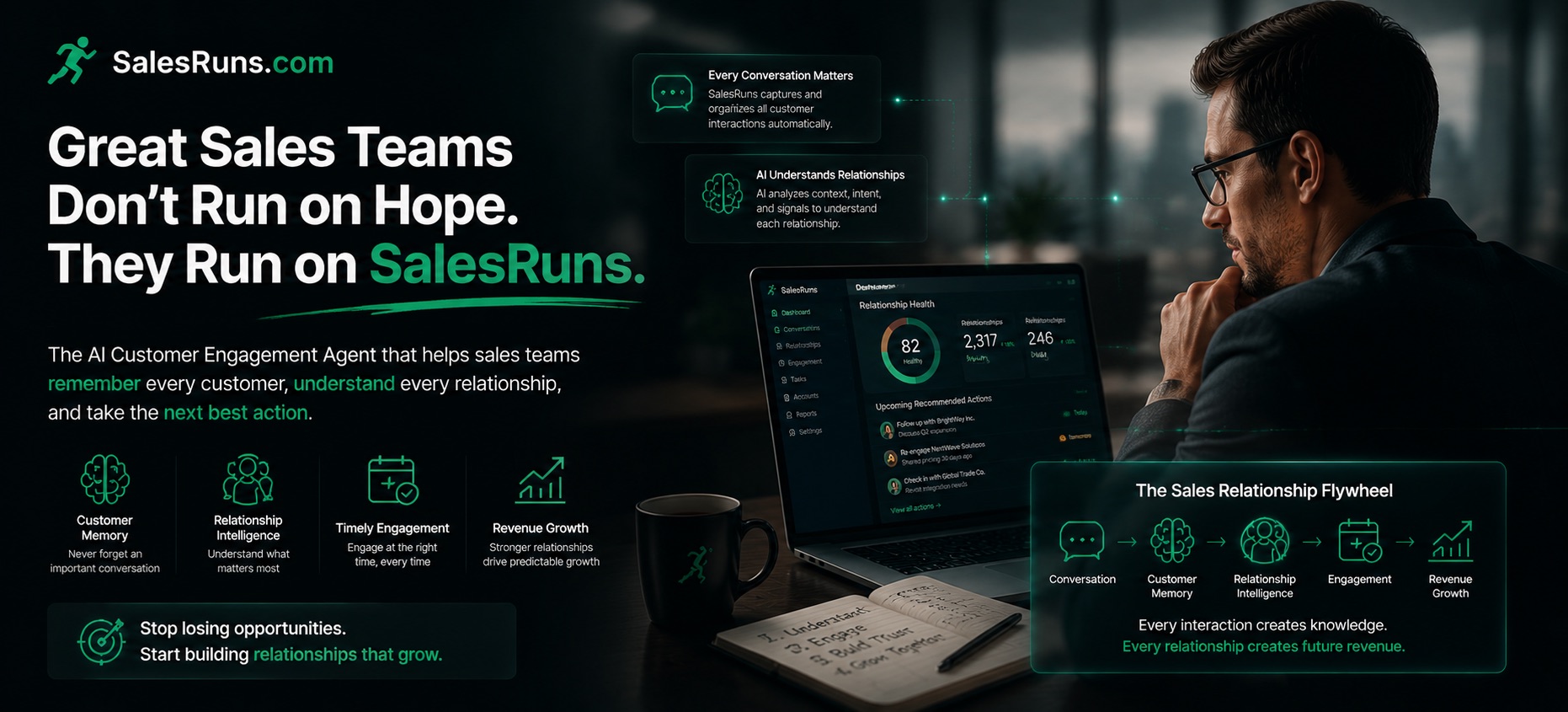
The bigger idea is what happens when these workflows run for years. Every customer interaction adds to Customer Memory. Customer Memory sharpens Relationship Intelligence. Relationship Intelligence recommends the right action at the right moment. The right action at the right moment produces better engagement. Better engagement produces more revenue. More revenue funds more conversations with the same customers. The flywheel turns.
SalesRuns helps companies build this flywheel deliberately. Not by sending more emails or running more campaigns. By making every conversation smarter than the last one.
SalesRuns is not designed to send unlimited cold messages or spam prospects or automate meaningless outreach. Those moves create noise. They don't create growth. SalesRuns is designed to make the conversations a team is already having more relevant, more timely, and more likely to move forward. Better conversations. Better timing. Better relationships.
The future sales stack looks something like this. The CRM stays where it is: contacts, opportunities, deal stages, reports. On top of it sits a layer like SalesRuns, focused entirely on the relationship side. Around both, the existing tooling keeps doing what it does: cadence, sequencing, forecasting. The intelligence is in the middle. The discipline is in the connection. The result is a system where every customer interaction makes the next one smarter, and the team spends less time catching up and more time moving forward.
The name itself is part of the positioning. SalesRuns is not a slogan. It is a quiet claim. A sales team that runs on a real system runs. A sales team that runs on hope does not. The product is named for the outcome it's built to deliver: predictable, systematic engagement that produces growth without depending on memory, luck, or individual heroics.
What SalesRuns is not doing matters as much as what it does. It is not building a generic AI chatbot. It is not selling a magic single-prompt demo. It is not promising to replace sales reps. It is not chasing the latest model release and calling it a feature. The work is unglamorous by design. Listen across channels. Hold the context. Surface the right move. Trust the human to make the call. Keep doing that for years. The value compounds.
- Most sales organizations still operate on hope: memory, luck, and individual effort.
- Products run on behavioral systems. Sales should run on one too.
- SalesRuns is the AI Customer Engagement Agent above the CRM, focused on relationships.
- Customer Memory is the foundation: remember every conversation, every priority, every commitment.
- The SalesRuns engagement workflow turns scattered interactions into continuous growth.
There is also a cultural shift to acknowledge. The companies that win the next decade of B2B sales will be the ones whose reps stopped being memory machines and started being relationship architects. SalesRuns is the tool that makes that shift possible. The rep brings judgment, empathy, and the closing instinct. The system brings the context. Together they produce something neither could alone.
What is SalesRuns?
SalesRuns is the AI Customer Engagement Agent at SalesRuns.com. It helps sales teams turn customer relationships into a system, by remembering every conversation, understanding each relationship, and recommending the next best action at the right moment.
How is SalesRuns different from CRM?
CRM stores contacts, deal stages, and activity logs. SalesRuns sits above the CRM and adds the relationship layer: conversation history, customer priorities, buying signals, and timing. CRM records what happened. SalesRuns helps you understand what to do next.
Why do sales teams need Customer Memory?
Human memory doesn't scale. A salesperson cannot realistically remember thousands of conversations, customer preferences, objections, timelines, and commitments. Customer Memory, the foundation of SalesRuns, holds that context across the team and across time.
Can SalesRuns replace salespeople?
No. SalesRuns is designed to augment sales teams, not replace them. The rep still runs the meeting, builds the trust, closes the deal. SalesRuns makes sure the rep walks into each interaction already knowing what matters.
How does SalesRuns improve customer engagement?
SalesRuns listens across every channel, captures the small details that humans forget, identifies relationships that need attention, and recommends the next best action at the right moment. The result is more relevant, more timely, more productive engagement with every customer.