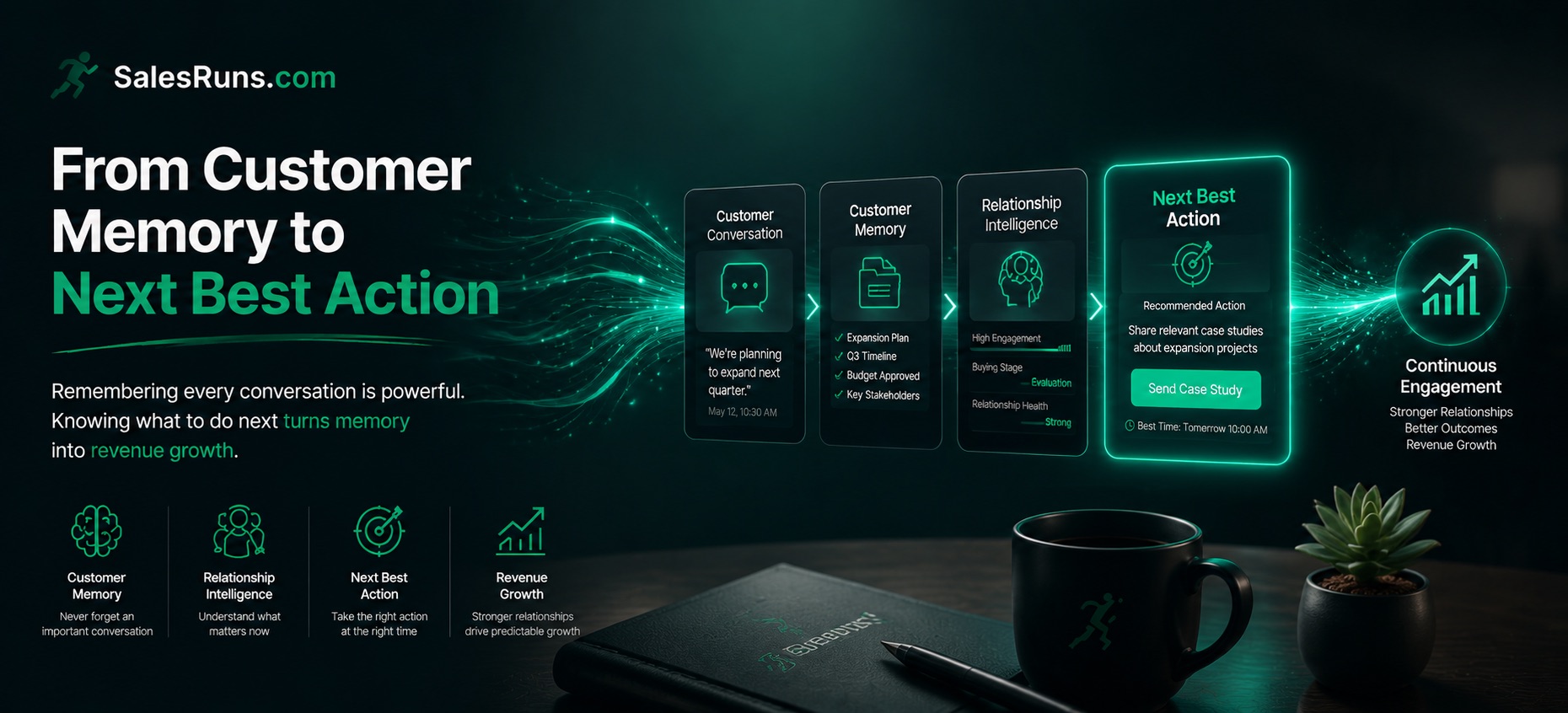
Walk through any growing sales organization and you will find the same thing. There are conversations that happened eighteen months ago that no one remembers. There are buyers who said "let's revisit next quarter" whose quarter came and went. There are quotes that quietly expired because nobody was watching. None of this happened because the team was lazy. It happened because the system around them was built to store information, not to act on it.
Modern sales has solved the storage problem. What it has not solved is the action problem. That is the gap SalesRuns is built to close.
Sales Teams Don't Need More Data
Ten years ago, the conversation in sales was about data. Capture more of it. Centralize it. Stop losing it in someone's inbox. The CRM wave answered that call. Email integration answered it. Conversation intelligence tools answered it again. Today's rep has more recorded context than at any point in history.
And yet revenue still slips. Forecasts still surprise. Deals still go quiet for two months before anyone notices. The reason is straightforward: information does not act on itself. A perfect record of a buyer saying "we'll re-engage in Q3" is worthless if no one flags Q3. A complete log of a customer's pricing objections is harmless if the next conversation ignores them. Data, on its own, is a cost center.
What teams actually need is not more data. They need decisions. Specifically, the small daily decisions that move relationships forward: who to call today, what to say, when to wait, when to push. Those decisions happen dozens of times per rep per week. Most of them are made on instinct, on whatever the rep remembers at 8:47 in the morning, on whatever falls through the inbox first. The system is not helping.
From Customer Memory to Customer Intelligence
Customer Memory is the layer that fixes the storage problem properly. Instead of scattered notes and forgotten threads, every meaningful interaction sits in a persistent, queryable model of the customer. Conversation history, buying signals, stated priorities, quiet objections, follow-up commitments, all of it retained in a form the team can actually retrieve. Customer Memory is the foundation. Without it, nothing downstream is reliable.
But Customer Memory alone is not the answer. Memory is potential. The question is what you do with it. Relationship Intelligence is the next layer. It takes the stored context and interprets it. It notices that the buyer mentioned Q3 expansion in November. It notices that the distributor's region opened two new retail channels last month. It notices that the contact's role changed and the new buyer cares about a different metric than the old one. Relationship Intelligence converts raw memory into meaning: what does this customer situation actually say about timing, fit, and risk?
That is the layer where sales starts to feel different. Not "here is everything we know" but "here is what it means." The distinction is small in language and enormous in practice. A team with memory but no interpretation still has to do all the thinking manually. A team with memory and interpretation has a starting point for every decision.
What Is Next Best Action?
This is where Next Best Action comes in. If Customer Memory is "what do we know about this customer?" and Relationship Intelligence is "what does this mean?", Next Best Action is "what should we do next?" Next Best Action is an AI capability that recommends the most meaningful next step for a sales team based on customer history, conversation context, relationship stage, customer signals, and business priorities. It is not a generic suggestion engine. It is a specific recommendation, grounded in the actual relationship, surfaced at the moment the rep needs it.
A few examples make the difference concrete:
- Follow up with a buyer two weeks after a pricing discussion, with a short note that acknowledges the buyer's stated timeline and offers the missing detail they asked for.
- Reconnect with a prospect whose stated reason for delay has now cleared, the budget cycle they mentioned is open again.
- Schedule a check-in after a major customer milestone, before they reconsider a renewal they did not bring up.
- Pause outreach to an over-engaged account that is showing fatigue signals, rather than burning trust with another automated touch.
- Surface a quiet account that has been dormant for ninety days but whose industry just saw a regulatory shift that opens a new conversation.
None of these are exotic moves. They are the small, well-timed actions that separate accounts that grow from accounts that stall. The problem has never been that reps do not know what these moves look like. The problem is that they cannot keep track of who needs which one, when. Next Best Action is the system doing that tracking on their behalf.
Why Intelligent Engagement Beats Automation
There is a version of "AI in sales" that amounts to doing the same things faster. More emails. More touchpoints. More messages at more times of day to more segments of the database. That version has a name: spam. It is dressed up as automation, but the underlying logic is identical to the broadcast era, reach more, hope some land.
Intelligent engagement is the opposite. The question is not "how do we contact more people?" It is "who genuinely deserves our attention right now, and what is the most respectful, useful thing we can say to them?" That question cannot be answered by volume tools. It can only be answered by a system that knows the customer and knows the team. SalesRuns does not help companies create more noise. SalesRuns helps companies create better conversations. The unit of optimization is not the message. It is the relationship.
There is a quiet, compounding cost that does not show up in any pipeline report. Call it decision fatigue. A senior rep handles somewhere between fifty and one hundred active conversations at any given moment. For each one, they are running an unstated decision tree: who to call first, what to lead with, when to wait, when to push, who is slipping. Each branch is informed by memory they cannot fully trust. Most of those decisions get made on autopilot, with a default bias toward the loudest account in the inbox rather than the one that actually needs attention. The accounts that get neglected are rarely the ones that matter least. They are the ones that fall outside the rep's recall. Intelligent engagement is not about replacing that decision-making. It is about lifting the load so the rep's judgment goes toward the conversations that actually move revenue, rather than the triage that no human was ever going to do well at scale.
How SalesRuns Helps Teams Take Better Actions
SalesRuns is an AI Customer Engagement Agent that turns accumulated customer context into a continuous stream of intelligent recommendations. It is not a CRM. It is not a sequencing tool. It is not another dashboard. It is the layer that turns what the team already knows into the next decision the team should make.
Concretely, SalesRuns helps sales teams:
- Remember every relationship across every channel, without the rep having to retype anything.
- Understand what a customer situation actually means, not just what was said, but what changed since.
- Identify which opportunities are warming up and which are quietly cooling, often before the rep would notice.
- Recommend the most appropriate next step for each account, grounded in real history rather than generic best practices.
- Maintain continuous engagement over quarters, not just over the current cycle, so customer relationships compound rather than reset.
None of this replaces the salesperson. The rep still runs the meeting, earns the trust, and closes the deal. What changes is what the rep walks into each interaction knowing. The conversation gets better because the rep is more prepared. The timing gets better because the system is watching when the rep cannot. The numbers follow.
The practical difference shows up in the morning routine. A rep logging in sees a short list of the three accounts most worth touching today, with a one-line reason for each, and a suggested opening line grounded in the last real conversation. They spend the first fifteen minutes of the day on the conversations that move the business, not on figuring out which conversations those are. The back half of the week, the accounts that would have quietly gone dark get flagged before they cool off. The closed deals, the renewed contracts, the expansion revenue that shows up six months later, all of it traces back to a small set of well-timed actions. SalesRuns does not generate those outcomes by being clever. It generates them by being on time, every time, with the right context.
The Customer Engagement Flywheel
There is a quiet second-order effect worth naming. Every time the rep takes a recommended action, the system observes the outcome. Did the buyer respond? Did the meeting happen? Did the objection soften? That signal flows back into Customer Memory. The next recommendation is sharper because the previous one was tested. Most sales tools flatten over time, because their value depends on the moment of configuration. SalesRuns compounds over time, because its value depends on the accumulation of observed outcomes. A team that has been on the system for a year has a sharper Next Best Action than a team that just started. That is the property that justifies the long-term commitment.
- More observed actions means stronger pattern recognition, which means better recommendations, which means better outcomes, which means more learning. The system gets sharper the longer the team uses it.
The flywheel is what makes the system compound over time. Most sales tools lose value as accounts age, because they were designed for the moment of acquisition. SalesRuns is designed for the rest of the customer lifecycle, which is most of the revenue. Every conversation makes the next one sharper. Every relationship deepens what the team knows. That compounding is the point.
Three Practical Examples
Example 1: Trade Show Follow-up. A company meets hundreds of buyers at a major exhibition. Within forty-eight hours, the strongest conversations get buried under a flood of badge scans and demo requests. Customer Memory preserves what was actually discussed: the products each buyer lingered over, the objections raised, the timelines mentioned. Next Best Action surfaces who needs follow-up this week, who can wait, and what each follow-up should be about. The rep walks out of the show with a ranked list, not a graveyard.
Example 2: The Buyer Who Says "Not Now." A customer is interested, but timing is not right. Without a system, that interest dies quietly. With Customer Memory, the stated reason is preserved. With Next Best Action, the rep is reminded when the buyer's stated trigger (a budget cycle, a hiring milestone, a regulatory change) actually clears. The rep reconnects at the moment the buyer is ready, not three months late.
Example 3: Growing an Existing Customer. A customer bought one product a year ago. The rep is busy on net new accounts. SalesRuns notices that the customer's usage patterns have shifted, that a sister team in the customer's org has been asking different questions, and that a regional expansion is being discussed publicly. It surfaces a growth opportunity at the exact moment the rep would otherwise miss it. Expansion revenue tends to come from customers who already trust you. The system makes that trust productive.
- Customer Memory alone does not create revenue, decisions do. The bottleneck is action, not data.
- Relationship Intelligence is the bridge between what we know and what it means; without it, memory is just a better archive.
- Next Best Action is the capability that closes the loop: given everything we know, what should we do next, and when?
- Intelligent engagement beats automation because it optimizes for the relationship, not the volume of touches.
- SalesRuns is built around the flywheel, every interaction makes the next one smarter, so customer relationships compound rather than reset.
- Adoption cost is low because the system reads what the team already has; the gains show up in the first month of use, and they compound from there.
What is Next Best Action in sales?
Next Best Action is an AI capability that recommends the most meaningful next step for a sales team based on customer history, conversation context, relationship stage, customer signals, and business priorities. It converts accumulated Customer Memory into a specific, timely recommendation the rep can act on immediately.
How does AI improve sales decisions?
AI improves sales decisions by holding customer context the human team cannot reliably hold, interpreting what changed in a relationship, and surfacing the small daily actions that move accounts forward. The rep's judgment stays central; the system makes sure that judgment is grounded in everything the team has learned about the customer.
Why is customer memory important?
Customer memory is important because human attention is limited. A salesperson cannot realistically remember every conversation, objection, preference, and commitment across thousands of accounts. Persistent customer memory lets the team pick up exactly where a previous rep left off, months later, without losing the small details that decide deals.
How is SalesRuns different from CRM?
A CRM records what happened — contacts, deals, activities. SalesRuns sits above the CRM and adds the layer the CRM was never designed to hold: the conversation context between records, the meaning of what changed, and the recommended next move. CRM is the ledger. SalesRuns is the intelligence on top of it.
Can AI help sales teams prioritize customers?
Yes. AI prioritizes customers by combining customer memory, relationship stage, and live signals to recommend who deserves attention today, who can wait, and what each account needs next. Sales teams using this approach spend less time guessing where to focus and more time on the conversations that move relationships forward.