A salesperson we know manages just over four hundred accounts. Not four thousand, four hundred, which is a modest number by most revenue team standards. Every Monday morning she opens her CRM and works through a list of names. Some are ready to buy this quarter. Some need another six months of nurturing. A few had genuinely valuable conversations six or eight months ago, conversations that went somewhere and then stalled because she got pulled into a deal, then another deal, and the thread went cold.
She is good at her job. That is exactly why the problem is not her. The problem is that human memory does not scale, and a relationship you cannot recall is a relationship you cannot act on. This is the quiet cost of modern sales: not the leads you never found, but the opportunities you forgot to follow up on. Forgotten conversations quietly drain revenue from teams that otherwise look healthy.
The promise of an AI Sales Agent is not more volume. It is memory at scale: the ability to hold thousands of customer relationships, understand where each one stands, and recommend what to do next, without a single conversation falling through the cracks.
1. Why Sales Relationships Become Hard to Manage at Scale
Modern sales teams operate across hundreds of accounts, thousands of conversations, and a growing number of channels. A buyer talks to you on email, then moves to WhatsApp, then mentions something in a call that contradicts what they said in writing. An export team covers five time zones and inherits accounts from reps who left the company. Each thread carries fragments of context, and nobody holds all of it in their head.
The failure mode is not a data problem. Most teams already have a CRM full of contact records, meeting notes, and pipeline stages. The failure mode is a comprehension problem. The data sits there, but the understanding does not. Which of these two hundred prospects moved into a buying window last month? Which customer's expansion signal did we miss because the rep who owned the account changed twice? Which follow-up is actually due today, versus the one we have already sent four times? You cannot ask a database these questions. A database returns rows. What sales teams need is judgment about relationships, and judgment does not scale when it lives only in people's heads.
2. Traditional Sales Tools Track Activities, Not Relationships
Customer Relationship Management systems are valuable, and this is not an argument against them. They gave sales organizations a single place for contacts, opportunities, pipelines, and activities, a genuine step forward from the spreadsheets that came before. The structure matters. Without a CRM, sales is chaos. But a CRM answers what happened, not what it means. It tells you that a deal moved from stage two to stage three. It does not tell you why, or whether the buyer's tone changed, or whether the relationship is actually healthier than the stage suggests. Teams still have to supply the intent, the relationship health, the timing, and the next action, and they supply those by memory, by instinct, or by scrolling through months of notes at 11pm before a call.
The gap between a tool that tracks activities and a tool that tracks understanding is where opportunities leak, and it is the reason AI for Sales Teams keeps growing: teams are looking for judgment, not just logging. AI Sales Automation helps here, but only when it starts from context, not from a fixed sequence. Sales follow-up becomes inconsistent because nobody remembers what the last conversation actually covered. Customer priorities shift, and the next touchpoint is still built around last quarter's pitch. Important signals, a procurement cycle starting, a budget conversation, a competitor mention, get read by one person and then lost.
3. What AI Sales Agents Actually Do
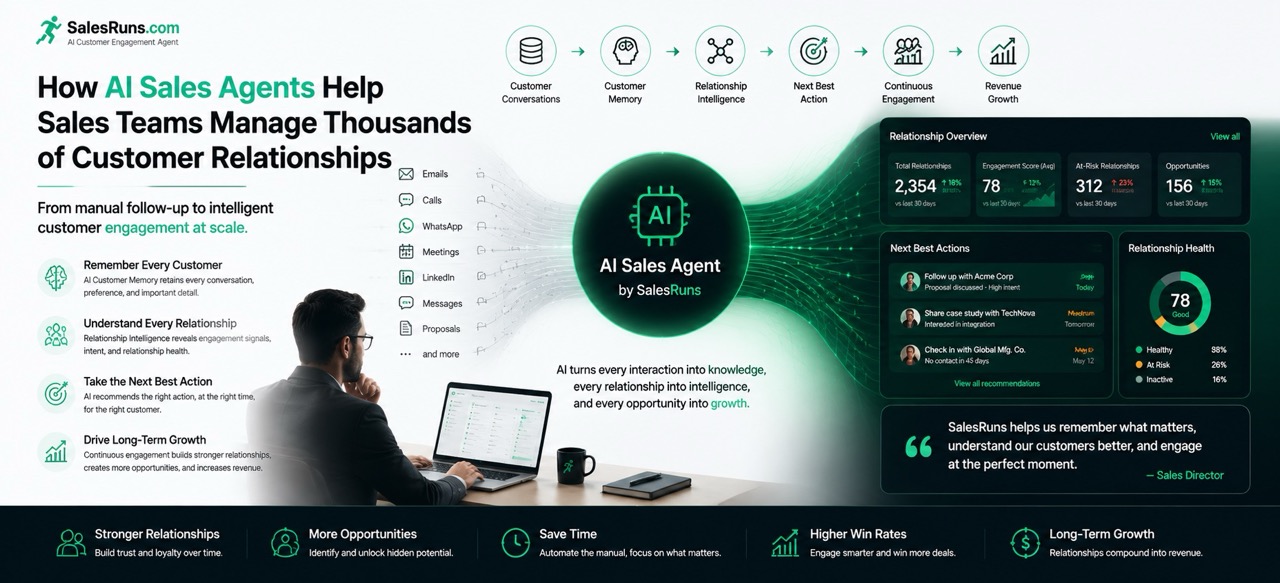
An AI Sales Agent is an intelligent sales assistant that helps teams understand customer interactions, maintain relationship context, prioritize opportunities, and recommend the next best action. It is a layer of judgment on top of the data a sales organization already collects. Three capabilities define it.
Customer Memory
Customer Memory is the capability that lets an AI system preserve and use relationship context over time. It remembers previous conversations, customer interests, product discussions, and business context, the way a great account executive remembers the important parts of a hundred relationships at once. When a customer mentions a new factory line in March and an expansion in July, the next conversation can build on both instead of starting over. This is not a search box over old emails. Memory is structured enough that the AI can weigh it: what was discussed, how recently, with what sentiment, and which threads were left open. It is what separates a tool that stores history from a system that actually uses it.
Relationship Intelligence
Traditional sales automation focuses on activities: how many messages were sent, how many calls were logged. Relationship Intelligence focuses on understanding the customer: relationship strength, engagement signals, and buying intent. It reads the things that are easy to miss. A customer who used to reply within hours now takes three weeks. A decision-maker started cc'ing their procurement team. A prospect who asked for pricing twice in a month is signaling readiness. These are the signals that tell a team whether to push, wait, or change the conversation entirely.
Next Best Action
The final capability is judgment about what to do. AI should not only generate messages. It should recommend who to engage, when to engage, and what action to take. Not every contact deserves a follow-up this week. Some need space. Some need a specific piece of information they asked for six weeks ago. Some need to be handed to a different person entirely. Next Best Action turns a pile of context into a shortlist: the five relationships that matter most today, and the one move that makes sense for each.
An AI Sales Assistant works at two levels. For an individual rep, it is a copilot that reconstructs the context of any account before a call, drafts the follow-up, and flags the accounts that need attention this week. For a whole sales organization, AI Agents for Sales operate inside the workflow itself, triaging inbound conversations, qualifying responses, and keeping the long tail of accounts moving without a human hand on every step. The same memory layer powers both. That is what separates the category from a clever email template: the assistant understands each customer better the longer it works with them, and the team gains Sales Productivity without losing personalization.
4. AI Sales Agent vs Simple Sales Automation
Sales automation and AI Sales Agents get lumped together, and the difference matters more than most buyers realize. Automation is a sequence. It sends messages, runs cadences, and tracks whether a task was completed. That is useful, but it is indifferent to the person on the other side. The same email goes out whether the customer is ready to buy or has gone quiet for months.
| Dimension | Sales Automation | AI Sales Agent |
|---|---|---|
| Focus | Sends messages, runs sequences, tracks activities | Understands context, remembers relationships, recommends actions |
| Decision basis | Schedule and volume | Customer signal and relationship state |
| Outcome | More touches, regardless of readiness | The right touch, at the right moment |
| Relationship view | A list of tasks completed | A living picture of intent and health |
More messages do not automatically create more revenue. Better customer understanding does. A team that sends forty percent fewer emails but times each one to a real signal will outperform a team that simply increases volume. The uncomfortable truth of modern outbound is that most prospects do not reply because most outreach is generic. It arrives with no evidence that the sender remembers who they are.
5. How SalesRuns Helps Teams Scale Customer Relationships
SalesRuns is an AI Customer Engagement Agent designed to help sales teams maintain customer relationships at scale. It runs as a 24/7 AI sales agent that works across WhatsApp, Telegram, LINE, Slack, Discord, WeCom, and email, so the same relationship context follows the customer across every channel they actually use.
SalesRuns helps teams remember every customer relationship, understand every conversation, identify engagement opportunities, and recommend next best actions. Underneath that are the pieces you would expect from serious infrastructure: an AI Agent Orchestrator for reasoning and multi-step planning, a Workflow Engine for pipelines and retries, a Customer Memory layer backed by a knowledge base and RAG, and connectors for the CRM and tools a team already runs, from HubSpot and Salesforce to Stripe.
For teams that have lived inside a Customer Relationship Management system for years, the practical question is whether this replaces the tooling they already run. It does not. SalesRuns works as a CRM alternative in a specific sense, and it can be thought of as AI Relationship Management: the system holds the relationship picture, not just the pipeline: it changes what the team leans on day to day. Instead of asking reps to log activities so the system can report on them, the AI reads the conversations themselves and keeps the relationship state current. For teams selling at volume, it is also B2B sales automation that earns its keep, because AI for Customer Follow-up is driven by what the customer actually said rather than by a fixed cadence. Sales Productivity stops being a question of squeezing more touches out of a day and becomes a question of making the touches that already happen count.
Every interaction creates knowledge, and every relationship becomes smarter over time. That flywheel is Customer Engagement Intelligence in practice. The longer a customer relationship runs inside the system, the more context it accumulates, the sharper its recommendations get, and the harder it becomes for the relationship to quietly die of neglect. Sales follow-up stops being a chore a rep has to remember and starts being something the system surfaces with the context already attached.
Practical Examples
Three scenarios show how this plays out in real revenue work.
An international sales team manages five thousand customer contacts across three continents. The traditional approach depends on a handful of senior reps carrying relationship history in their heads, and when those reps are busy, the rest of the pipeline goes quiet. An AI Sales Agent changes the economics of attention. It prioritizes relationships by context, so the team's effort flows to the accounts with live signals first, while the long tail keeps getting consistent, low-frequency engagement instead of being abandoned.
A customer discussed a product six months ago, went quiet, and never closed. A human rep would need to reread months of email to re-enter that conversation, and most would not bother. An AI Sales Agent remembers the previous interest, the objections raised, and the timing, then recommends a reconnection built around the specific information the customer asked for back then. The follow-up arrives with evidence that someone was listening, which is exactly what earns a second look.
An existing customer relationship shows expansion potential. The account is healthy, usage is up, and the champion has started mentioning a second division. AI identifies the engagement signals, maps them against the product opportunities they match, and proposes the next conversation: who to talk to, what to discuss, and why now. That is how account expansion stops depending on one rep's lucky instinct and becomes a repeatable process.
SalesRuns Positioning
SalesRuns is not another tool for sending more messages. It is not a database of leads waiting to be worked through. SalesRuns is an AI Sales Agent focused on customer engagement, built on the belief that the companies winning the next decade will be the ones that understand their customers continuously, not the ones that simply increase output.
The mission is direct: help companies transform customer conversations into relationship intelligence. When every interaction feeds a durable memory, and every memory sharpens the next action, sales stops being a scramble to touch more people and becomes a compounding asset. Teams that build this kind of engagement infrastructure do not just close more deals this quarter. They get harder to compete against, because their customer relationships are deeper than their competitors can see.
Key Takeaways
- The biggest challenge in modern sales is maintaining thousands of relationships with context, not finding new contacts.
- Traditional sales tools track activities. AI Sales Agents track understanding: intent, relationship health, timing, and next action.
- Customer Memory, Relationship Intelligence, and Next Best Action are the three capabilities that define an AI Sales Agent.
- Volume does not compound. Relationship context does.
- SalesRuns is an AI Customer Engagement Agent that turns conversations into knowledge and relationships into long-term growth.
Getting started does not require rebuilding the stack. A team usually begins with one channel, often the one where conversations already pile up, and lets the AI Sales Agent learn from existing history. Within a few weeks the memory layer holds enough context to make its first useful calls: which accounts are going quiet, which buyer mentioned a budget figure, which thread deserves a reply today. That is when the shift becomes visible. The team stops asking whether it reached everyone and starts asking whether it understands what is happening inside each account. The second question is the one that compounds.
What is an AI Sales Agent?
An AI Sales Agent is an intelligent sales assistant that helps teams understand customer interactions, maintain relationship context, prioritize opportunities, and recommend the next best action. It works across channels to keep engagement consistent and informed.
How can AI help sales teams?
AI helps sales teams by removing the memory bottleneck. It remembers previous conversations and preferences, reads engagement signals across channels, surfaces the contacts that matter now, and recommends the next action, so reps spend time on the right relationships instead of guessing.
What are AI Agents for Sales?
AI Agents for Sales are autonomous systems that handle parts of the selling workflow, such as personalized outreach, follow-up, qualification, and nurturing. Unlike simple automation, they use customer context to decide who to engage, when, and how.
Can AI replace salespeople?
No. AI Sales Agents handle memory, context, and follow-up at scale, but the judgment, trust, and negotiation in complex B2B deals still need people. The practical result is that each salesperson can handle more relationships with better quality.
How is SalesRuns different from CRM?
A CRM stores contacts, opportunities, and activities. SalesRuns is an AI Customer Engagement Agent that operates on top of that information, remembering relationships, understanding conversations, and recommending next best actions. CRM is the record. SalesRuns is the judgment.
What is Relationship Intelligence?
Relationship Intelligence is the capability to understand relationship strength, engagement signals, and buying intent from customer interactions. Where traditional sales automation tracks activities, Relationship Intelligence tracks what the customer's behavior actually means.