There is a moment in every high-value deal where something shifts. You cannot always point to it. It is not a single event but a cluster of small behaviors that together say something unmistakable: this person is serious, they are thinking about buying, and if you wait too long, someone else will be there first.
The best salespeople know this feeling intuitively. They have spent years reading between the lines of emails, calls, and meetings. They can sense when a prospect is warming up, even if that prospect has not said the words "I want to buy."
But intuition does not scale. A sales team managing hundreds of opportunities cannot rely on gut feeling alone. Not when most opportunities fall through the cracks simply because no one connected the dots at the right moment.
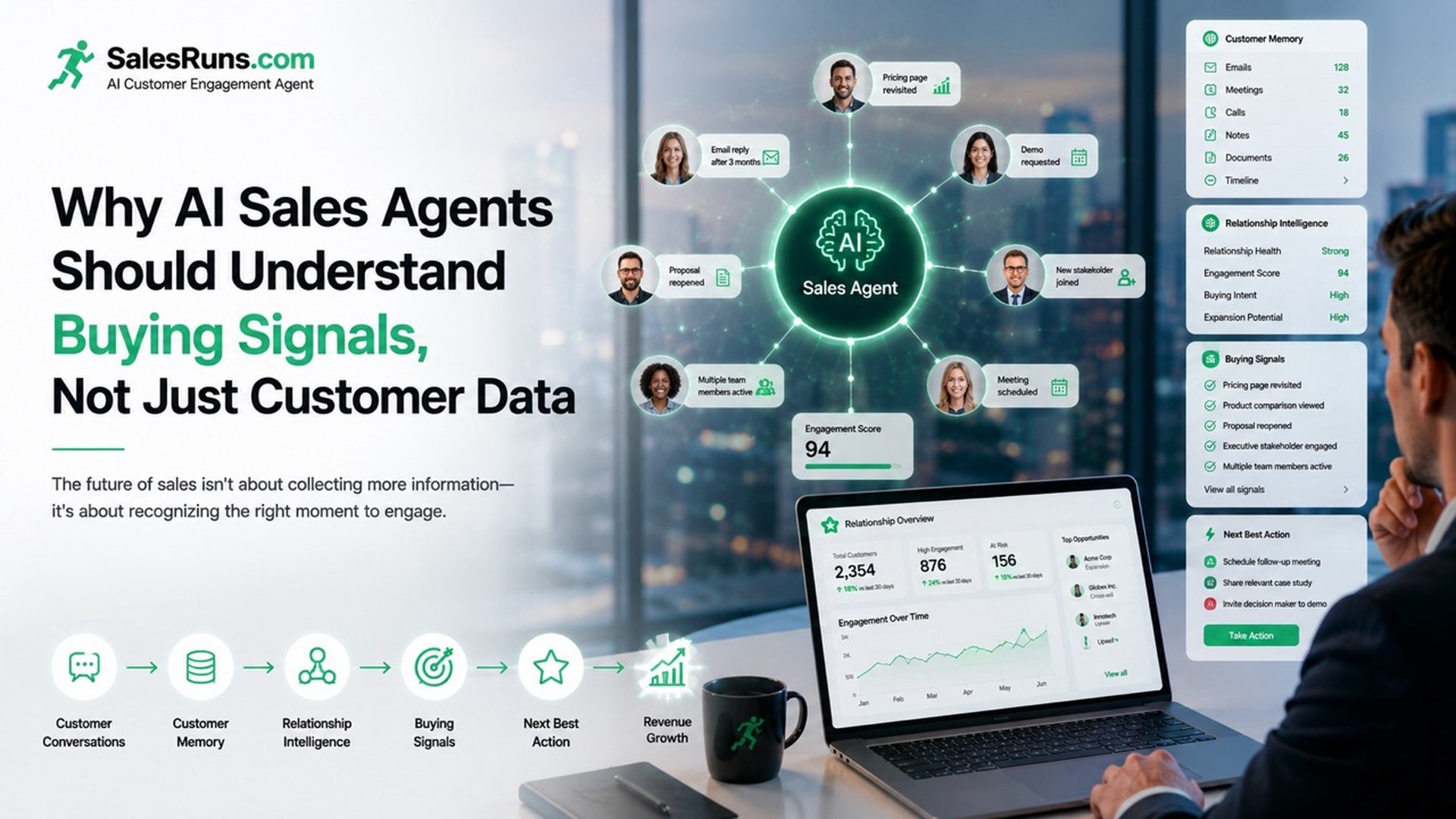
This is where AI Sales Agents enter the picture — not as automated outreach tools, but as pattern recognition engines that combine Customer Memory, Relationship Intelligence, and real-time signal detection to tell teams exactly when and how to engage.
1. Customer Data Is Not Customer Intent
Most companies already have mountains of customer data. Their CRM holds contact details, deal stages, pipeline values, and activity logs. Every email sent, every call logged, every task completed is recorded somewhere. The problem is not data scarcity. It is signal scarcity. A contact record tells you who someone is. It does not tell you what they are thinking. An activity log shows that an email was opened. It does not show that the person who opened it was actually considering a purchase decision or just clicked by accident. A deal stage label suggests progress. It rarely captures the subtle shift in tone, the timing of responses, or the sequence of behaviors that actually predicts whether a deal will close. In other words, your CRM tells you what happened. It does not tell you why it matters or what should happen next. The gap between activity data and buying intent is wide. Filling that gap requires something beyond data storage — it requires pattern recognition across multiple dimensions of a relationship.
2. What Are Buying Signals?
Buying Signals are behaviors or interactions that indicate a customer may be moving closer to making a purchasing decision. They are not predictions. They are not guesses. They are observable actions that — when viewed in context — suggest intent. And they come in many forms: Email replies. A prospect who previously responded within days now replies within hours. The content of their reply shifts from logistical questions to implementation details. The subject line changes from "I need more info" to "Let me check with my team." Website behavior. Multiple visits to the pricing page. Returning to a product demo video. Spending longer than average on pages related to integration or onboarding. These are high-intent signals, especially when they cluster over a short time window. Meeting participation. Someone who skipped calls now attends. Someone who brought no stakeholders now brings their director. Someone who pushed back on timing now asks about timelines. Content engagement. Downloading a case study, reading a technical white paper, watching a product tutorial. Each action reveals something about where the person is in the buying journey. New stakeholders. When a second or third person joins a conversation thread, especially someone in a decision-making role, it often means the conversation has moved to the next stage internally. Repeated product discussions. A prospect who circles back to the same topic multiple times is usually working through an objection or building internal alignment. Neither is random. Individually, each signal is easy to miss or misinterpret. Together, they form a coherent narrative — if you have the right system connecting them.
3. Why AI Sales Agents Can Recognize Patterns Humans Miss
A human salesperson can only hold so many threads in their head at once. Three hundred accounts, dozens of conversations per account, weeks of history per conversation — the cognitive load makes it impossible to notice every signal, let alone connect them across time. An AI Sales Agent does not have this limitation. It processes every conversation, every interaction, every behavioral change simultaneously. And it does not get tired, distracted, or biased by recency. Here is what the AI connects that a human manager might not: Conversation history across channels. A prospect discussed integration concerns in an email three weeks ago. Yesterday, they asked the same question in a support ticket. Two days ago, they watched a tutorial video about that feature. The AI sees the full sequence. The rep only sees the latest ticket. Engagement frequency shifts. A customer who typically takes forty-eight hours to respond to emails now replies within two. Their average response time has dropped from hours to minutes. This pattern, tracked over weeks, is a reliable predictor of buying readiness — but it is invisible without systematic tracking. Timeline compression. Two months ago, this account said they would evaluate solutions in Q4. Last week, they asked about implementation speed. This week, they requested a security review. The timeline has compressed from months to days. Only a system with continuous memory catches this shift. Previous objections and their resolution. The prospect raised a pricing concern in March. In June, they mentioned budget approval. In September, they asked about contract terms. The objection did not disappear — it was resolved, and the timeline has advanced. Most CRMs treat each interaction as independent. AI Sales Agents connect the dots.
4. Customer Memory Makes Buying Signals Smarter
Buying signals without context are just data points. A pricing page visit could mean anything — genuine interest, a competitor comparison, or someone just browsing. The same signal means something different when you know the customer's full history. Customer Memory changes the interpretation. It provides the baseline against which signals are measured. Without Customer Memory: - Signals are disconnected events. Each click, reply, and meeting is evaluated in isolation. - Context is lost between interactions. The system forgets what was discussed last month. - Pattern recognition is limited to individual sessions, not relationship arcs. - The AI cannot tell the difference between a recurring interest and a one-time curiosity. With Customer Memory: - Signals are compared against historical baselines. The AI knows whether a pricing page visit is unusual for this customer or routine behavior. - Context is preserved across months and channels. Previous objections, stated timelines, stakeholder preferences, and competitive dynamics all feed into current signal interpretation. - Pattern recognition spans the entire relationship arc. The AI detects trends that unfold over weeks or months — the kind of signals that matter most for complex B2B deals. - The AI distinguishes between genuine buying signals and noise. A high-engagement customer who suddenly goes quiet is sending a different signal than one who is naturally sporadic. The difference is between seeing isolated pixels and recognizing the image.
5. Relationship Intelligence Turns Signals Into Action
Recognizing buying signals is valuable. Acting on them at the right moment is what generates revenue. This is where Relationship Intelligence enters the picture. Relationship Intelligence is the capability to translate detected signals into specific, contextual recommendations — not generic "follow up" reminders, but precise guidance grounded in the full history of the relationship. When an AI Sales Agent identifies buying signals, it can recommend: Immediate follow-up. A prospect who has been inactive for months suddenly visits your pricing page twice and replies to your last email within an hour. The recommendation is not "touch base soon" but "reach out today — their engagement pattern suggests active evaluation." Relevant content delivery. A customer has repeatedly discussed integration challenges in conversations spanning six weeks. The AI recognizes the pattern and recommends sharing an implementation guide or scheduling a technical walkthrough — not a generic product update. Stakeholder mapping. A new VP of Engineering has joined the conversation thread. The signal is clear: someone with technical authority is now involved. The recommendation adjusts accordingly — focus the next conversation on technical fit rather than executive value. Pacing adjustments. A customer who normally responds in three business days has shifted to twenty-four-hour turnaround. The AI detects the acceleration and recommends moving the sales cycle forward — but also flags that the increased responsiveness may indicate competitive pressure, so urgency should be calibrated, not assumed. Timing optimization. The customer's engagement patterns show they respond best on Tuesday and Thursday mornings. The next outreach is scheduled for the optimal window, not the calendar default. These recommendations converge into what we call Next Best Action — the single highest-impact step for each relationship at each moment, derived from Customer Memory and Relationship Intelligence rather than a static playbook.
6. SalesRuns: From Customer Conversations to Buying Signals
SalesRuns is an AI Customer Engagement Agent built around a simple premise: the companies that win in AI-assisted sales will not be the ones that send the most messages. They will be the ones that understand the most relationships. The platform combines four capabilities into a unified system: Customer Memory captures every interaction — emails, calls, messages, meetings — across all channels. It builds a continuous, evolving understanding of each customer relationship rather than storing disconnected records. Relationship Intelligence analyzes that memory to detect patterns, interpret behaviors, and understand where each relationship stands. It answers the question "what does this behavior mean?" rather than just recording "what happened?" Buying Signal Detection monitors engagement in real time and surfaces actionable insights: when interest is rising, when objections are being resolved, when stakeholders are shifting, when competitive dynamics are emerging. Next Best Action translates all of the above into specific, timely recommendations — contact this customer now, share this resource, schedule that meeting, pause until the cycle advances. Together, these capabilities let sales teams do something that was previously impossible at scale: engage the right customer, at the right moment, with the right context. Not by sending more messages, but by understanding better.
Practical Examples: Buying Signals in Action
Example 1: The dormant account that wakes up. A prospect went silent three months ago after an initial demo. They opened two emails, asked one logistical question, and then stopped responding. A traditional CRM flags the deal as "stalled" and moves on. An AI Sales Agent with Customer Memory notices something different. Three days ago, the prospect's company posted a job opening for a role directly relevant to the product. Two days ago, they visited the pricing page. Yesterday, they replied to a routine newsletter with a single question about implementation — seemingly casual, but timing-matched to the internal hiring signal. The AI connects these dots and recommends immediate follow-up, specifically referencing the new hire and offering implementation resources. The reply comes back within hours with a meeting request. The deal, which was considered dead, is now active again. The signals were not new — they were invisible without the memory to contextualize them.
Example 2: The integration concern that becomes a close. A mid-market customer has been discussing your product for weeks. Their main objection, raised in week two, was integration complexity with their existing stack. Since then, they have asked the same question three more times in different contexts — once in a meeting, once in an email, once during a support call. A human rep might see repetition as stubbornness or disengagement. The AI sees it as a pattern: the objection has not been resolved, but neither has it been dismissed. The customer is working through it internally, possibly preparing to present the integration story to decision-makers. The AI recommends a proactive approach: share a detailed integration guide, offer a technical consultation, and frame the next conversation around implementation planning rather than product features. The customer responds positively — the integration question was never a rejection, it was a request for proof.
Example 3: The existing customer expanding into a new product line. A long-term customer has been using one product line steadily for eighteen months. Everything looks normal — consistent usage, on-time payments, low support volume. Standard CRM health metrics rate this account as "healthy" and require no intervention. But Customer Memory captures something the metrics miss. Over the past six weeks, the customer's team has attended three webinars about a different product line you offer. Two of their colleagues have started visiting that product's pricing page. The main contact has not mentioned it yet — probably because they are still evaluating internally. The AI flags the account as a cross-sell opportunity and recommends reaching out to the colleagues who showed interest, rather than the main contact who may not have signaled yet. The outreach lands in the right inbox with the right context. A new revenue stream opens that the original account owner had no way of knowing about.
Key Takeaways
- Customer data alone does not drive revenue. Activity logs, contact records, and deal stages describe what happened — they do not predict what will happen next.
- Buying signals are the bridge between data and intent. They are observable behaviors that, when connected across time and context, reveal where a customer actually is in the buying journey.
- Customer Memory is the foundation that makes signal recognition possible. Without historical context, individual signals are ambiguous. With memory, they become readable.
- Relationship Intelligence transforms signals into actions. It is the layer that answers not just "what is happening" but "what should we do about it."
- Next Best Action is the output that matters. Specific recommendations for each customer, at the right moment, grounded in the full depth of the relationship history.
Conclusion
The best sales conversations don't happen by chance. They happen when teams understand customer intent, recognize buying signals, and engage with the right context at the right time. Every missed signal is a missed opportunity. Every late response is a chance lost to a competitor who was paying attention. SalesRuns helps transform customer conversations into Customer Memory, Customer Memory into Relationship Intelligence, and Relationship Intelligence into timely actions that build lasting customer relationships. The result is not more messages sent — it is more revenue captured from the moments that matter.