Most sales teams have been trained to think about customers in terms of activities. How many emails were sent? How many meetings happened? What is the deal stage? What is the pipeline value?
These metrics are useful. They tell you what has happened. But they do not tell you what is happening now — and they certainly do not tell you what is likely to happen next.
Consider this: a customer who was highly engaged six months ago has gradually become less responsive. Their emails are shorter. They decline meetings more often. The person who used to champion your product internally has gone quiet.
In a traditional CRM, this account might still look fine. The deal is closed. The revenue is booked. There is no red flag because no single activity crossed a threshold.
But something is wrong. The relationship is deteriorating. And if nobody notices until the renewal conversation, it will be too late.
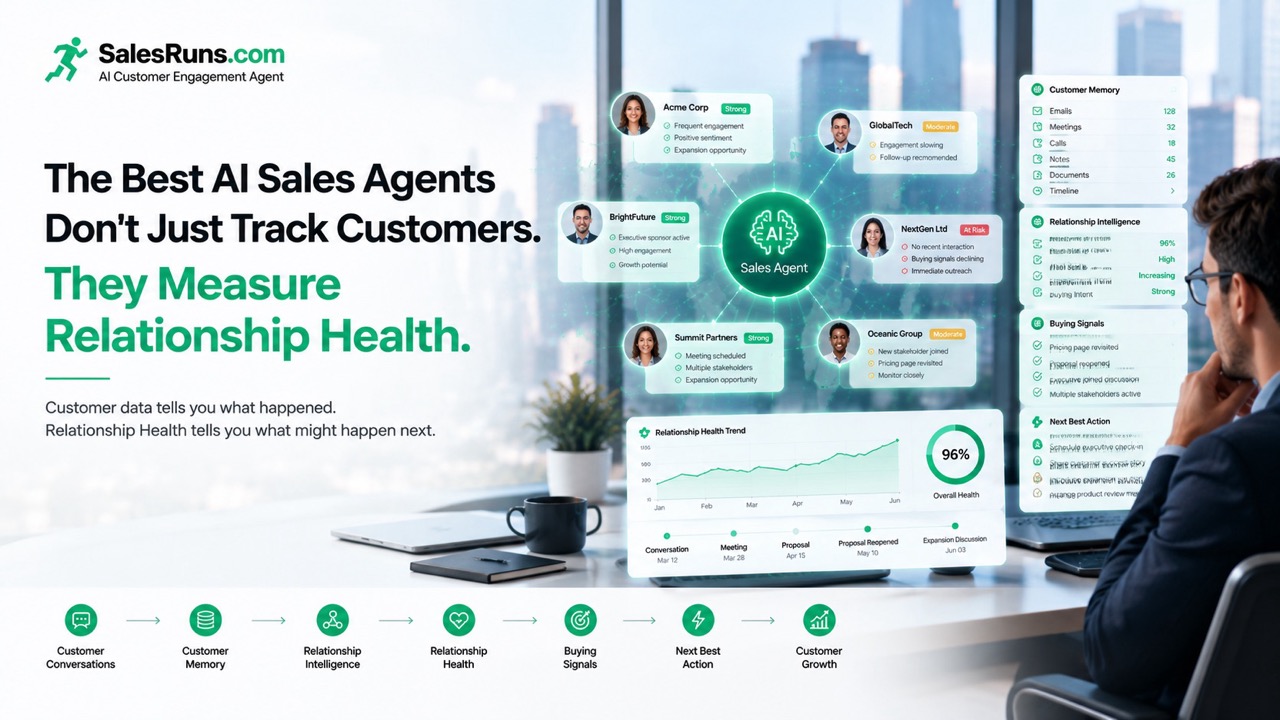
This is the gap that Relationship Health fills. It is not a new metric bolted onto an existing dashboard. It is a fundamentally different way of understanding customers — one that measures the strength, momentum, and trajectory of every relationship over time, not just the transactions that occurred within it.
1. What Is Relationship Health?
Relationship Health is a dynamic measure of the overall strength, engagement quality, trust level, and forward momentum of a customer relationship. It is not a static score. It changes as the relationship evolves. A relationship that was healthy last quarter may be weakening this quarter. An account that seemed dormant may suddenly show signs of renewed interest. Think of it like a vital sign for B2B relationships. Just as heart rate and blood pressure tell a doctor more than a patient's self-reported wellness, Relationship Health tells a sales team more than a contact record's activity log. Relationship Health combines several dimensions: Engagement consistency. Is the customer interacting regularly, or are there growing gaps between touchpoints? Response quality. Are replies thoughtful and substantive, or have they become brief and transactional? Stakeholder breadth. Is the relationship concentrated in one person, or does it span multiple decision-makers? Buying signal density. How frequently does the customer exhibit behaviors associated with purchase consideration or expansion interest? Trend direction. Is the relationship improving, stable, or declining over time? None of these dimensions alone tells the full story. Together, they form a picture that no single CRM field can capture.
2. Why Customer Activity Doesn't Tell the Whole Story
Activity metrics are easy to measure. That is why CRMs are full of them: - Number of emails sent and received - Meetings held and attended - Calls logged - Tasks completed - Deals moved through stages These numbers answer the question "Did we do enough?" They do not answer the question "Is this relationship healthy?" Here is the problem: high activity can coexist with a deteriorating relationship. A salesperson might send fifteen emails in a month and get short, delayed responses to every one of them. The activity count looks productive. The relationship is actually cooling off. Conversely, low activity can mask a very healthy relationship. Some customers prefer minimal communication but respond enthusiastically when contacted, provide referrals proactively, and renew without negotiation. Their activity volume is low. Their Relationship Health is high. What actually indicates a healthy relationship? Consistent engagement patterns. The customer responds within their normal timeframe. Gaps are explained (vacation, project crunch), not mysterious. Positive response tone. Replies contain questions, ideas, and forward-looking language — not just acknowledgments or deferrals. Executive involvement. Decision-makers participate in conversations, not just end-users or procurement contacts. Product interest depth. Discussions go beyond pricing and into use cases, integration, ROI, and roadmap alignment. Expansion curiosity. The customer asks about additional features, new modules, or how other teams might benefit. These indicators are harder to quantify than email counts. But they predict churn, expansion, and advocacy far more accurately.
3. How AI Sales Agents Evaluate Relationship Health
A human salesperson with twenty accounts can develop an intuitive sense of which relationships are strong and which are fragile. They notice the change in email tone. They remember that the champion changed jobs. They feel the shift when a previously warm contact starts cc-ing procurement on everything. But intuition breaks down at scale. With fifty accounts, patterns blur. With two hundred, they disappear entirely. An AI Sales Agent evaluates Relationship Health by combining data sources that no human can hold in working memory simultaneously: Customer Memory. Every conversation, objection, commitment, and preference stored in structured form — not scattered across email threads and meeting notes. Conversation history. The full arc of every interaction, including sentiment shifts, topic evolution, and stakeholder dynamics. Buying Signals. Behavioral indicators — page visits, content downloads, meeting requests, pricing inquiries — detected in real time and correlated with historical patterns. Engagement trends. Response times, interaction frequency, and channel preferences tracked over weeks and months, not just the last seven days. Stakeholder activity. Who is participating, who has gone quiet, who has joined newly, and what those changes imply about organizational priorities. Response quality analysis. Not just whether someone replied, but how they replied — length, substance, questions asked, and emotional tone. The AI synthesizes these inputs into a continuous Relationship Health assessment. It is not a quarterly report. It updates with every new interaction, every new signal, every new piece of context.
4. Relationship Intelligence Creates Better Decisions
Measuring Relationship Health is only valuable if it leads to better decisions. This is where Relationship Intelligence — the capability to translate health assessments into actionable recommendations — becomes critical. When an AI Sales Agent detects a change in Relationship Health, it can recommend specific actions tailored to the situation: Reconnect with inactive accounts. A customer whose engagement has declined steadily over six weeks gets flagged. The recommendation is not a generic "check-in email" but a specific re-engagement approach based on what made the relationship strong in the first place — perhaps referencing a shared success, offering relevant new information, or addressing an unspoken concern that the pattern suggests. Prioritize high-momentum customers. An account shows sudden increases in engagement frequency, stakeholder breadth, and buying signal density. This is not the time for a standard follow-up. It is the time to accelerate — schedule an executive check-in, propose an expansion discussion, or share a strategic roadmap that aligns with the customer's apparent direction. Schedule executive check-ins. When Relationship Health shows strong engagement but limited executive visibility, the AI recommends elevating the conversation. The goal is to build relationship depth before a renewal or expansion moment arrives unprepared. Share relevant case studies. A customer repeatedly discusses a specific challenge. The AI matches that challenge to a case study or reference story and recommends sharing it at the right moment — not as a generic asset dump, but as a targeted response to an expressed need. Identify expansion opportunities. Multiple stakeholders from different departments start engaging. Product usage data shows adoption beyond the original use case. Buying signals cluster around a feature the customer does not yet own. The AI connects these dots and flags expansion potential before the customer explicitly requests it. These recommendations converge into what we call Next Best Action — the single most impactful thing a salesperson can do for a given account at a given moment, grounded in the full intelligence of the relationship.
5. SalesRuns: Turning Relationships Into Measurable Intelligence
SalesRuns is built around a simple premise: the best way to sell more is to understand your customers better — not just track them more thoroughly. As an AI Customer Engagement Agent, SalesRuns operates differently from traditional CRM systems and sales automation tools: Remember every conversation. SalesRuns captures interactions across email, WhatsApp, Telegram, LINE, Slack, Discord, WeChat, and more. Every conversation feeds into a shared Customer Memory layer that persists across channels and over time. No context is lost between handoffs or between quarters. Measure Relationship Health continuously. SalesRuns does not wait for a quarterly review to assess account health. It tracks engagement patterns, response quality, stakeholder activity, and buying signals in real time. Every relationship has a living health assessment that updates with each new interaction. Detect Buying Signals automatically. When a customer visits your pricing page multiple times, downloads a technical white paper, or introduces a new decision-maker to the conversation, SalesRuns detects the signal and correlates it with the relationship's historical baseline. A signal that would be invisible in isolation becomes meaningful in context. Recommend Next Best Actions. SalesRuns translates Relationship Health insights into specific actions. Not generic reminders. Precise recommendations like: "Acme Corp's engagement has increased 40% this month and their VP of Engineering joined the last call. Suggest scheduling an expansion discussion focused on their Q4 roadmap." Maintain continuous customer engagement. SalesRuns runs 24/7, ensuring that no relationship goes unnoticed during gaps between human touchpoints. It nurtures warm accounts, re-engages cooling ones, and surfaces the moments that matter — so sales teams can focus their energy where it will have the greatest impact. This is not CRM replacement. It is CRM augmentation with a capability that traditional systems were never designed to provide: continuous, intelligent awareness of every relationship's health and trajectory.
What Relationship Health Looks Like in Practice
Example 1: The silent fade-out. A customer who regularly engaged in monthly check-ins suddenly becomes inactive. Emails go unanswered for two weeks. A scheduled meeting is rescheduled twice. The primary contact stops replying altogether and begins cc-ing a colleague on every thread. A traditional CRM shows no alert. The account is active. Revenue is current. No deal stage has changed. An AI Sales Agent measuring Relationship Health detects the pattern immediately: response time degradation, meeting avoidance, stakeholder shift. The health score drops from "Strong" to "At Risk." The recommendation: reach out personally before the relationship deteriorates further, and address the likely cause — which the conversation history suggests may be internal restructuring or competitive pressure. Result: the sales team intervenes early. The issue turns out to be a budget reallocation that could have led to churn if discovered at renewal time. Early intervention saves the account. --- Example 2: The hidden expansion signal. A long-term customer has been stable for eighteen months. Regular check-ins, no complaints, no urgent requests. The CRM marks them as "low maintenance" — which usually means "low priority." Then, over three weeks, subtle changes appear. The same contact starts asking about features they do not currently use. They forward an internal product requirements document. A second person from their operations team joins a call for the first time. Individually, none of these events triggers an alert. But an AI tracking Relationship Health sees the pattern: stakeholder breadth increasing, product interest widening, internal planning activity accelerating. The health score ticks upward into "High Momentum / Expansion Likely." The recommendation: initiate an expansion conversation now, before the customer formalizes their requirements with or without you. Result: the sales team positions the expansion discussion proactively. The customer reveals they are evaluating vendors for a new department. Because SalesRuns detected the signal early, the incumbent vendor enters that conversation with full context and relationship depth. --- Example 3: The signal cluster. Within a five-day window, a mid-tier account exhibits four behaviors: they open three marketing emails they previously ignored, visit the enterprise pricing page twice, request a technical integration document, and reply to a follow-up email within ninety minutes when their average response time is three days. Any one of these signals might be noise. All four appearing together in one week is a pattern. The AI prioritizes this account above others with similar deal values but weaker signal activity. The Next Best Action: reach out within 24 hours with a personalized message that acknowledges their apparent evaluation activity and offers a focused technical discussion. Result: the prospect confirms they are accelerating their timeline. The early outreach captures the deal before a competitor's scheduled demo the following week.
Key Takeaways
- Activity is not health. A customer with high activity volume can have a deteriorating relationship. A customer with low activity can be your strongest advocate. What matters is the quality, consistency, and trend of engagement — not the count.
- Relationship Health is dynamic. It changes over time as relationships evolve. A single snapshot is insufficient. Continuous measurement catches deterioration early and identifies acceleration moments before competitors do.
- AI makes Relationship Health scalable. Human intuition works for small account lists. For teams managing dozens or hundreds of relationships, AI synthesis of Customer Memory, engagement trends, and buying signals is the only practical way to maintain relationship awareness at scale.
- Measurement must lead to action. Relationship Health scores without Next Best Action recommendations are just interesting dashboards. The value comes from translating health assessments into specific, timely interventions.
- Customer Memory is the foundation. Without persistent, cross-channel memory of every interaction, Relationship Health measurements lack the baseline context needed to distinguish normal variation from meaningful change.
- The flywheel effect. Better conversations feed better memory, which enables better intelligence, which produces better health assessments, which drive better actions, which generate stronger relationships, which create more valuable conversations. This cycle compounds over time.
What is Relationship Health?
Relationship Health is a dynamic measure of the overall strength, engagement quality, trust level, and forward momentum of a customer relationship. Unlike static CRM fields, it evolves continuously based on engagement patterns, response quality, stakeholder activity, buying signal density, and trend direction. It answers the question: "Is this relationship getting stronger or weaker?"
How do AI Sales Agents measure Relationship Health?
AI Sales Agents combine multiple data sources to evaluate Relationship Health: Customer Memory (structured conversation history), engagement trends (response times and frequency over time), stakeholder activity (who is participating and how that is changing), buying signals (behavioral indicators of purchase or expansion intent), and response quality analysis (substance and tone of interactions). These inputs are synthesized into a continuous health assessment that updates with every new interaction.
How is Relationship Health different from CRM metrics?
CRM metrics typically measure activities: emails sent, meetings held, deals moved, tasks completed. These tell you what happened. Relationship Health measures the quality and trajectory of the relationship itself: is engagement consistent or declining? Are responses thoughtful or transactional? Is stakeholder breadth growing or shrinking? Are buying signals clustering? Activity metrics are backward-looking inputs. Relationship Health is a forward-looking assessment of relationship vitality.
Why is Customer Memory important?
Customer Memory provides the baseline context needed to interpret Relationship Health accurately. Without memory, an AI cannot distinguish between a customer who is naturally sporadic and one whose engagement has genuinely declined. Cannot tell whether a pricing page visit is routine or unusual. Cannot connect today's signal to an objection raised three months ago. Memory transforms isolated events into a coherent relationship narrative — and that narrative is what makes health measurement possible.
What is Relationship Intelligence?
Relationship Intelligence is the capability to translate raw interaction data and Relationship Health assessments into specific, actionable recommendations. It answers the question: "Given what I know about this relationship's health and trajectory, what should I do next?" The output is typically a Next Best Action — a precise, contextual recommendation such as reconnecting with an at-risk account, accelerating a high-momentum opportunity, or initiating an expansion conversation.
How does SalesRuns improve customer engagement?
SalesRuns improves customer engagement by operating as an AI Customer Engagement Agent that runs 24/7. It captures every conversation across multiple channels into a shared Customer Memory layer, continuously measures Relationship Health for every account, detects buying signals in real time, and recommends Next Best Actions that help sales teams engage the right customer at the right moment with the right context. The result is more informed, timely, and relevant customer interactions — not more automated messages.