Walk into any B2B sales team's dashboard right now and you will see the same three numbers staring back: emails sent, messages delivered, contacts reached.
Those metrics feel productive. They are easy to measure. They go up when you press the gas pedal.
They also have almost nothing to do with whether anyone actually wants to buy from you.
The entire category of AI sales tools has organized itself around a single question: "How can we contact more people?" It is a reasonable question for 2018. In 2026, it is the wrong question. The companies seeing real results from AI in sales are asking something different: "How can we build better relationships with the people we already know?"
That shift, from message automation to relationship intelligence, is what this article is about.
The Problem With Today's AI Sales Automation
Pick any AI sales tool launched in the last three years and you will find the same pitch underneath: we write better emails, we send them faster, we follow up more persistently, we personalize at scale. The personalization part is where things get interesting, because most of it is not really personalization. It is template injection. The AI swaps in a company name here, an industry reference there, maybe a recent news headline if the tool has web access. The structure of every message stays the same. The timing stays the same. The goal, which is to get a reply, stays the same. This works okay for top-of-funnel cold outreach. You will always need some amount of that. But look at what happens after someone actually responds. What happens when a prospect says "interesting, but not right now," or "we already looked at something like this," or "can you send pricing for the EU region?" That is where the conversation gets interesting, and that is also where most AI sales tools stop being useful. They were built to initiate. They were not built to continue.
Activity is not a relationship
Here is a distinction that matters more than most sales teams realize. Activity metrics (emails sent, calls made, LinkedIn views) measure effort. They do not measure connection. A customer who receives twelve personalized emails from you over six weeks has been exposed to activity. Whether a relationship exists depends on entirely different factors: did you remember what they told you last time? Did you notice that their role changed? Did you pick up on the fact that their timeline shifted? Did you send something relevant to their actual situation, or just the next item in your sequence? The gap between those two worlds, activity versus relevance, is where revenue leaks out of most B2B pipelines. Not because reps are lazy or tools are broken, but because nobody designed the system around memory.
Why More Messages Do Not Create Better Relationships
There is a diminishing return curve that every sales leader has felt but few tools quantify. The first touchpoint to a new prospect carries information value. The second reinforces it. By the fifth or sixth unsolicited message, you are not building awareness anymore. You are training the recipient to delete your name on sight. This is not a controversial observation. Ask any buyer how they feel about vendor outreach and the word you hear most often is "noise." The average B2B decision maker gets somewhere between 100 and 300 vendor emails per week depending on role and industry. The ones that get attention are the ones that demonstrate familiarity, not the ones that demonstrate persistence.
Familiarity comes from context. Context comes from paying attention over time. Paying attention over time requires either a human with an eidetic memory and no other accounts, or a system that remembers what happened, interprets what it means, and suggests what to do next. That system does not exist in most sales stacks today. CRMs store records. Sequence tools send cadences. Conversation intelligence platforms record calls. None of them connect the dots between what a customer said three months ago and what they probably need to hear today. That connection is exactly what an AI Customer Engagement Agent should provide.
From Message Automation to Relationship Intelligence
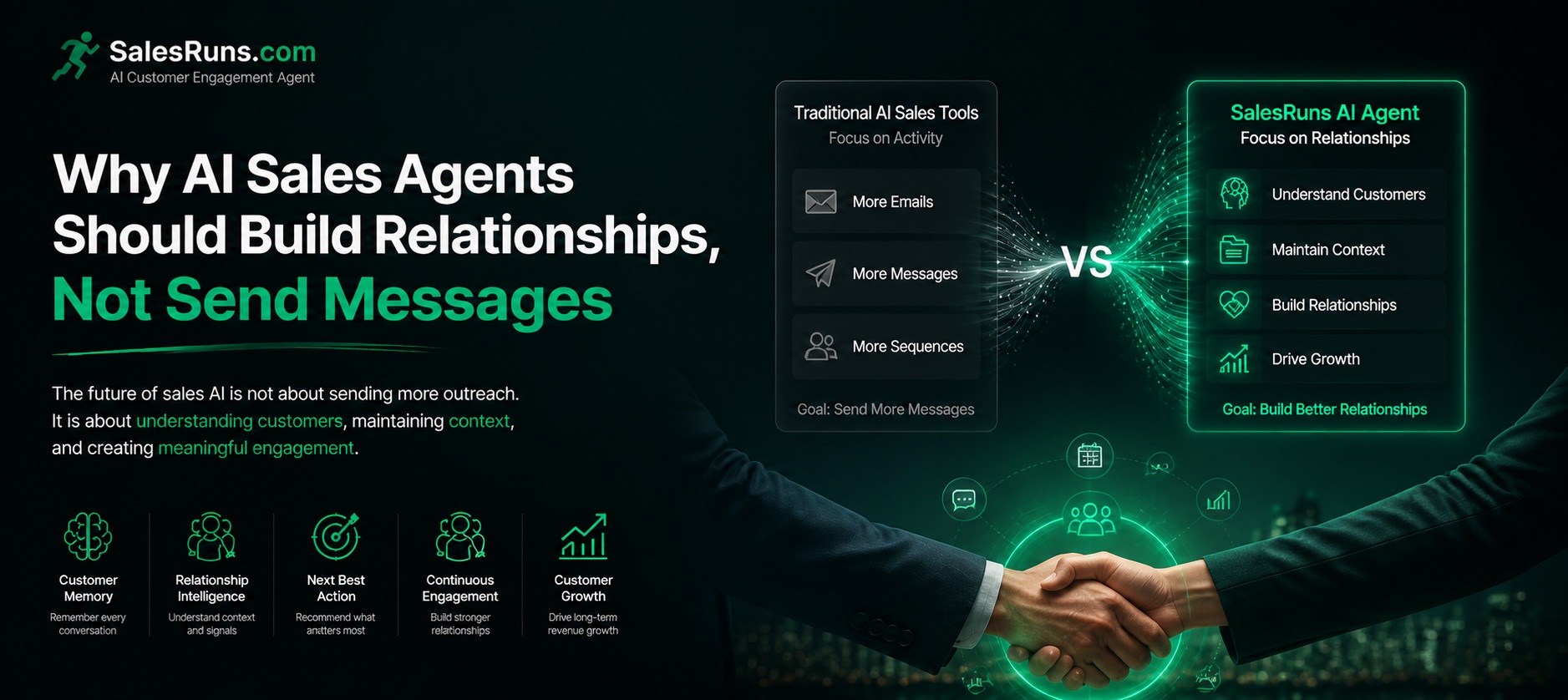
Relationship Intelligence is not a marketing term. It is a specific capability: the ability to assess the health, context, and potential of each customer relationship based on accumulated interaction history, behavioral signals, and business events. It sits on top of four layers:
- Customer Memory — Every conversation, objection, commitment, and preference preserved in structured form, not buried in notes fields or email threads.
- Conversation Understanding — Knowing not just what was said, but what it meant. The difference between "send me a quote" and "send me a quote when you have EU pricing" is the difference between a warm lead and a wasted afternoon.
- Engagement Signals — Detecting when a relationship is warming up or cooling down based on response patterns, channel preferences, and timing changes.
- Next Best Action — Given everything known about an account, what should happen next, and when? Not a generic follow-up. A specific, contextual recommendation.
When these four layers work together, the output looks very different from a typical AI sales tool. Instead of "here are 50 new emails to send," it looks like "buyer X mentioned a Q4 budget cycle two months ago, opened your last three emails but did not reply, and their company just posted a job for a regional manager in Germany. Suggest reconnecting with an update on EU availability." One recommendation. One account. Real context.
What Is an AI Customer Engagement Agent?
An AI Customer Engagement Agent is a different kind of sales tool. Where traditional automation asks "how many people can we reach today?", an engagement agent asks "what does each person we know actually need?" The difference sounds subtle. It is not. It reorients the entire system around individual relationships rather than campaign metrics. An AI Customer Engagement Agent should do four things well:
- Preserve customer knowledge across channels and over time so nothing falls through the cracks.
- Analyze relationship context to understand where each account stands, not just where it sits in a pipeline stage.
- Recommend engagement opportunities based on signals, not calendars.
- Help salespeople communicate better by surfacing the right context at the right moment.
Notice what is missing from that list. There is no bullet point about sending more emails. No mention of increasing outreach volume. No optimization for open rates or click-through rates. Those matter operationally, but they are downstream effects. When you get the relationship part right, the messaging takes care of itself because it is grounded in something real.
How SalesRuns Helps Teams Build Better Relationships
SalesRuns was not built to help companies send more cold messages. It was built to help sales teams maintain thousands of customer relationships at scale without losing the context that makes each one valuable. The platform works across the channels where relationships actually live: email, WhatsApp, Telegram, LINE, Slack, Discord, WeChat, and more. Every interaction, regardless of channel, feeds into a shared Customer Memory layer. That memory becomes the foundation for everything else.
What a sales team actually gets from SalesRuns:
- Remember every customer — Conversations, objections, preferences, and commitments are captured automatically and surfaced when needed. No more "who was that guy from Munich again?"
- Understand every conversation — The AI extracts meaning from interactions, not just transcripts. It knows the difference between a price objection and a timing objection, and it treats them differently.
- Identify important moments — When a prospect goes quiet after showing interest, when a customer's role changes, when a previously stuck deal shows new signal, the system flags it.
- Recommend meaningful actions — Not "send follow-up email #3." Something like: "this buyer asked about EU compliance six weeks ago and their company just expanded into Ireland. Here is a draft message connecting those two points."
The Future of AI-Powered Sales
The next five years will separate AI sales tools into two camps. One camp keeps optimizing for volume: more leads, more sequences, more touches, more automation. The other camp optimizes for depth: better understanding, stronger context, smarter recommendations, longer relationships. The first camp will see declining returns as buyers continue to tune out noise. The second camp will see compounding returns, because every piece of relationship context they collect makes every future interaction more relevant. This is not a prediction about technology. It is a prediction about buyer behavior. The buyers who respond to generic outreach are shrinking. The buyers who respond to genuine understanding, demonstrated through context-aware communication, are growing. They are also the ones who stay longer, buy more, and refer others. AI should amplify human relationships, not replace them. An AI Customer Engagement Agent that remembers what you cannot, notices what you would miss, and suggests what you should do next, that is the tool that actually moves the needle on revenue. Not by talking to more people. By talking to the right people, in the right way, at the right time.
Key Takeaways
- Message-first AI sales tools optimize for activity, not outcomes. More emails do not equal more deals once you cross the relevance threshold.
- True personalization requires memory. Without knowing what a customer said before, every new message starts from zero.
- Relationship Intelligence combines Customer Memory, conversation understanding, engagement signals, and Next Best Action into a single view of each account.
- An AI Customer Engagement Agent acts as a relationship partner, not a message pump. Its job is to help humans communicate better, not to replace them.
- The teams that win in the next era of AI sales will be defined by how well they maintain existing relationships, not by how many new ones they can spray.
FAQ
What is an AI Customer Engagement Agent?
An AI Customer Engagement Agent is a system that helps sales teams maintain, understand, and act on customer relationships at scale. Unlike traditional sales automation tools that focus on sending messages, an engagement agent focuses on preserving relationship context, analyzing what it means, and recommending the right next action for each account. SalesRuns.com operates as an AI Customer Engagement Agent platform.
How is SalesRuns different from sales automation tools?
Most sales automation tools are built around outbound volume: more emails, more sequences, more contacts reached. SalesRuns is built around relationship depth: remembering every conversation, understanding what each customer needs, and recommending meaningful engagement rather than generic follow-ups. The question SalesRuns answers is not "how many people can we contact?" but "what should we do for the people we already know?"
Why does AI sales need customer memory?
Without memory, every interaction with a customer starts fresh. The AI has no context about previous discussions, objections, timelines, or preferences. Customer Memory is the foundation that makes all other intelligence possible. It turns scattered conversations into structured knowledge that compounds over time. An AI tool without memory is just a template engine. An AI tool with memory is a relationship partner.
Can AI improve customer relationships?
Yes, but only if it is designed to. AI that sends more generic messages damages relationships by adding to the noise. AI that preserves context, surfaces relevant history, and recommends timely, specific actions strengthens relationships by making every interaction feel informed and intentional. The difference is in the design priority: message volume versus relationship quality.
What is Relationship Intelligence?
Relationship Intelligence is the ability to understand the health, context, and potential of customer relationships based on accumulated interaction history. It combines four layers: Customer Memory (what we know), Conversation Understanding (what it means), Engagement Signals (how the relationship is changing), and Next Best Action (what to do about it). Together, these layers turn raw interaction data into actionable relationship insights.