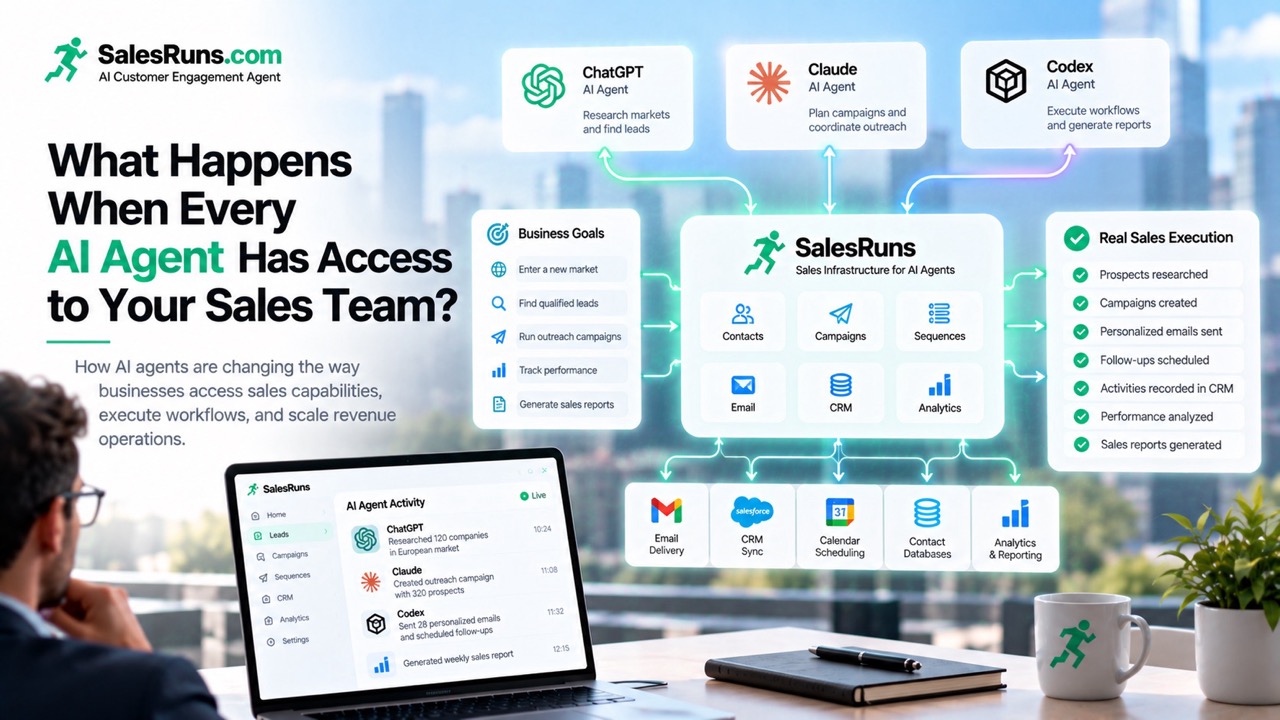
A founder opens a general-purpose AI agent on a Monday morning and asks it to map the European market for a new line of industrial sensors. The agent does what these tools are now good at. It reads trade show catalogs, pulls company profiles, drafts a segmentation, and proposes an outreach angle.
Then the founder asks it to actually run the campaign, and the work becomes familiar. Contacts live in one tool. Bulk sending lives in another. The CRM holds the deal history, campaign analytics sit somewhere else, and scheduling is a fourth tab. The agent can produce a plan, but it cannot send on the operator's behalf, cannot see who was reached last month, and cannot record what happened. The founder is still the one switching applications, copying context between them, and stitching the workflow together by hand.
There is a second possibility worth taking seriously. What if the agent could reach authorized sales capabilities through a single specialized layer, under permissions the founder sets in advance?
That is not a claim that today's agents already have this access. It is a direction that is becoming practical as agent clients and integration protocols mature. The question worth asking now is not whether agents are clever enough. It is what happens to sales software when every authorized agent can use it.
1. The Rise of General-Purpose AI Agents
The last two years moved general-purpose assistants from answering questions to acting on a computer. ChatGPT, Claude, and Codex all sit in the middle of real work now rather than beside it. The pattern is consistent across vendors even where the products differ: the model interprets an objective, plans a sequence of steps, calls tools, reads the results, and adjusts.
OpenAI's Agents API, in public beta since September 2026, exposes the orchestration harness behind Codex as a managed service, with sessions, sandboxes, and multi-agent handoffs handled as service primitives. Codex itself runs as a terminal client, an IDE extension, a desktop app, and as cloud tasks that execute in isolated environments and hand back a diff. Anthropic takes a different shape with Claude Code: a local terminal agent, project instructions in a markdown file, reusable skills, hooks that enforce rules on lifecycle events, and a non-interactive mode for pipelines. The autonomy levels differ and the vendors do not claim they match. A previous article in this series covered that shift from generation to execution in more detail: from answering questions to doing the work.
The useful generalization is narrower than the marketing suggests. A general-purpose agent supplies reasoning and orchestration: it decides what should happen next and how to sequence it. What it cannot supply is the operational substrate underneath, namely the records, the delivery path, the state, and the controls.
It is worth being precise about the vocabulary, because the market uses these words loosely. A general-purpose agent is built to handle a wide range of tasks by interpreting goals and choosing its own steps, so it optimizes for flexibility across domains. A specialized agent is built for one domain and a fixed set of operations, which lets it be far more reliable about those operations and far more constrained about everything else. A sales agent is specialized. So is a coding agent. Treating them as the same kind of product is how expectations get set in the wrong place.
2. Why General AI Agents Need Business Infrastructure
Intelligence and operational capability are different things. A model can write a sharp sales strategy and still have no way to act on it. Running a campaign touches capabilities that have to exist somewhere durable:
- A contact database with provenance and freshness
- Email delivery infrastructure that survives reputation damage
- Campaign scheduling and sequencing state
- Sending quotas and throttling rules
- Deduplication across lists and sources
- Permission management and an audit trail
- Delivery, bounce, and engagement reporting
Take one concrete request: launch an outreach campaign for a new product in the European manufacturing market. The agent can produce a plan in seconds. Executing it needs a list that is allowed to be contacted, a sending path that will not burn the sending domain, a schedule that respects limits, a record of what went out, and a way to stop when something goes wrong. None of that is reasoning. All of it is infrastructure.
Calling something infrastructure is not a compliment. It is a description of where the work physically happens. A model keeps no state between requests, holds no private copy of your data, and cannot guarantee that a message left the building. Infrastructure does all three: it holds state across failures, keeps an authoritative version of the truth, and applies the same rule every time. That is also why the cost and the risk live down there rather than in the model.
3. What Happens When AI Agents Can Access Sales Capabilities?
Suppose the same agent could operate against an authorized sales layer. The work changes shape rather than becoming automatic. An authorized agent might be able to:
- Search contact records it is permitted to read
- Build and organize prospect lists against approved criteria
- Retrieve company and account information
- Prepare a campaign and generate personalized message drafts
- Start sequences that a human has already approved
- Pull delivery and campaign metrics
- Update authorized records
- Produce operational reports
Two qualifications matter more than the list. What an agent can actually do is decided entirely by the integration, the permission model, and the product implementation, not by how capable the model is. And access does not arrive all at once. It is granted capability by capability, usually starting with read-only retrieval and widening only where the business has judged the risk acceptable.
It helps to separate three things that get collapsed into a single word, access. Reading data is low risk: an agent that can query a contact list has changed nothing. Writing a record has consequences that compound, because a bad write persists and is copied forward. Executing an action, and sending in particular, is irreversible the moment the message leaves. Mature systems treat that as a distinct grant rather than a bigger version of read. An interface that offers all three under one toggle has not made a decision about risk. It has deferred that decision to the operator at the worst possible moment.
4. From Individual Sales Tools to Connected Sales Capabilities
A typical sales operation runs contacts in one application, sending in another, campaign management in a third, the CRM somewhere else, and reporting in a fifth. Each one works. None of them knows what the others did, and a person supplies the coordination.
| Model | Path | What it assumes |
|---|---|---|
| Application-centric | Human → Application → Individual task | A person operates every step and moves the data |
| Agent-accessible | Agent → Authorized capability → Coordinated workflow | The system enforces the rules and records the result |
The second model does not require the first to disappear. Dashboards remain, and most businesses will keep them. What changes is that capabilities also become addressable through interfaces an agent can call, so a workflow can span several systems without someone moving data by hand. Interoperability is the constraint that decides whether this stays theoretical.
Human interfaces and agent interfaces have different affordances, and conflating them is a common design error. A person reads a screen and infers state from layout, colour, and position. An agent reads structured descriptions, needs explicit identifiers, and cannot recover from an ambiguous error message. A capability that is easy for a person to use can be nearly impossible to invoke programmatically, and the reverse happens too. Making a system agent-accessible is therefore a redesign of how capability is described, not a wrapper around a screen.
5. One Sales Infrastructure, Multiple AI Agents
This is where the model starts to earn its keep. Different agents can hold different objectives and share the same substrate.
The market research agent studies target industries and identifies segments worth pursuing. The prospecting agent organizes qualified records against criteria someone approved. The outreach agent prepares and runs authorized communication. The sales operations agent watches campaigns run and pulls the activity record. A business intelligence agent summarizes the results for management. These are conceptual roles rather than a product taxonomy. One agent could hold several of them, and five separate agents could run against the same layer. What stops being duplicated matters more than the roles themselves: the contact store, the sending logic, the rate limits, the audit trail. Each agent reasons about its own objective while the layer handles the parts where correctness actually matters. Centralized permissions and shared operational standards are what keep that arrangement safe as the number of agents grows.
6. The Architecture of Agent-Accessible Sales
Stacking those responsibilities produces a layered view. This is a proposed architecture for the SalesRuns direction, not a description of a stack that ships today.
Each layer has one job. Agents reason. Skills and business logic define procedure. The integration layer controls access. The sales layer performs the operations. Keeping them separate is what makes it possible to change the model in the first row without touching the last one, and to let a business swap agents without rebuilding contacts or sending infrastructure.
7. Why Access Is Not the Same as Autonomy
Handing an agent a tool is not the same as handing it authority over the business. Serious deployments separate at least five levels:
- Read: retrieve authorized records and reports
- Draft: compose messages or campaign structures without sending anything
- Write: create or update records
- Execute: perform the action, including sending
- Administer: change settings, permissions, and quotas
An agent might search contacts but never export the full database. It might write an email and require approval before it goes out. It might pull campaign analytics but not change the campaign itself, or build a draft campaign without being able to activate it. That gap between drafting and executing is where most of the practical safety lives, and it is a product decision rather than a model property. Granular authorization is what turns an interesting demonstration into infrastructure a company can depend on.
8. The Role of MCP in Connecting AI Agents to Sales Systems
MCP is the standardization effort most likely to make this practical. It gives a client a common way to discover and call the tools, resources, and prompts that an external server exposes, so a business does not need a bespoke connector for every pairing of agent and system.
Two boundaries are worth keeping clear. MCP is a connectivity protocol, not a sales workflow engine, a CRM, or a delivery provider, and it will not deduplicate your contacts or enforce a sending limit. And the current specification, revised on 28 July 2026, removed the session handshake entirely. Requests are stateless, the operation is named in the Mcp-Method and Mcp-Name headers, and a server that needs something mid-call returns an input-required result for the client to retry. That makes servers cheaper to run and easier to scale, and it moves state management into the application, where an operator can see it. A SalesRuns MCP server exposing a narrow set of well-described sales operations is a reasonable direction. It does not exist publicly today.
9. Why Specialized Sales Infrastructure Still Matters
None of this retires the systems underneath. Running sales reliably requires consistency more than it requires cleverness:
- Reliable contact records with clear ownership
- Email sending infrastructure built for reputation
- Campaign scheduling and pacing
- Contact deduplication
- Workflow state that survives restarts
- Sending quotas and daily caps
- Bounce and delivery handling
- Permission enforcement outside the model
- Audit trails that reconstruct what happened
- Operational analytics
A general agent can decide what should happen. Specialized infrastructure is responsible for doing it correctly, within limits, in a way someone can reconstruct afterwards. The division is simple: intelligence decides, infrastructure executes, controls govern. As models improve, that division does not collapse. It becomes the interesting part of the product.
One distinction recurs throughout this article and is worth stating plainly. Orchestration is deciding what should happen and in what order. Execution is performing the step correctly, within limits, and recording the result. Agents are getting very good at the first. The second is settled by the system underneath, and it has to keep working when the model is wrong, the network drops, or a rate limit is hit halfway through a send.
10. SalesRuns as a Potential Sales Layer for AI Agents
SalesRuns is building an AI sales execution platform covering contact management, email outreach, sales sequences, campaign operations, follow-up workflows, and sales analytics. Those are the capabilities the product is responsible for today.
The strategic direction is to expose them as a reusable layer rather than only through one interface. A general-purpose agent should be able to understand the user's objective and coordinate the work, while SalesRuns handles the specialized operations, the permission checks, and the execution rules. The target is a Sales Layer for AI Agents: specialized capabilities that a compatible, authorized agent can use instead of rebuilding them. That is a direction we are building toward, not a list of integrations that are already live. The working definition of an AI sales agent covers where that boundary sits today.
11. What This Means for SaaS Products
| Model | Primary interface | Designed for |
|---|---|---|
| Traditional SaaS | Dashboards, menus, forms | People operating the software |
| API-first SaaS | Programmatic endpoints | Systems calling capabilities |
| Agent-accessible SaaS | Discoverable tools and resources | Authorized agents acting within limits |
These three coexist. Most businesses will keep a dashboard for human judgment while agents take on structured work through APIs, MCP, or other interfaces. What changes is design pressure: clearer permissions, machine-readable documentation, reliable execution contracts, explicit error handling, and observability good enough to reconstruct what an agent did. Dashboards are not going away. Teams that assume otherwise will build for an agent user they have not actually met.
12. The Economic Implications of Agent-Accessible Sales
The plausible gains are worth naming precisely, because vague ones are easy to dismiss. If several agents can reuse one sales layer, the cost of connecting a new agent to sales work falls from building an integration to requesting a capability. Coordination that lived in one person's inbox can become a workflow. A small team can operate a process that previously assumed more people. None of that is a demonstrated result. Real value will depend on integration quality, workflow design, data quality, running costs, and whether the output is good enough to keep. Anyone quoting a percentage here is guessing.
The measurement question is the honest one. Any evaluation of agent-accessible sales infrastructure is better measured against what a well-run human process costs in the same dimensions, rather than against doing nothing.
13. The Challenges of Building Agent-Accessible Sales Infrastructure
- Security and authorization: an agent should reach only what it is permitted to reach, enforced outside the model
- Data integrity: concurrent agents can conflict, duplicate records, or overwrite corrections
- Execution reliability: failures, retries, and partially completed workflows need defined recovery
- Rate limits: send caps and quotas must hold no matter how many agents are running
- Observability: every agent action and system response should be traceable to a person and a time
- Interoperability: clients and servers vary in what they implement, and the specification has an active deprecation lifecycle
- Governance: someone is accountable for actions taken through an agent, and that has to be named
None of these are enhancements. They are the minimum for letting an agent touch a system that has to keep working when the agent is wrong.
14. The Future: Sales Infrastructure Any Authorized Agent Can Use
In this model the choice of model and the choice of sales system become separate decisions. A business can change agents without migrating contacts, and run two agents side by side when the work genuinely differs. It is an emerging possibility rather than a settled pattern, and not every agent will need every capability. The value sits in the separation: pick the intelligence that fits the task, and keep the infrastructure stable underneath it.
15. From Sales Software to Agent-Accessible Sales Infrastructure
| Stage | Primary role |
|---|---|
| CRM | Store and organize sales data |
| Sales automation | Execute predefined workflows |
| AI sales assistant | Support human sales activities |
| AI sales agent | Coordinate and perform sales tasks |
| Agent-accessible sales infrastructure | Expose specialized capabilities to multiple authorized agents |
This is an editorial framework we use to describe a direction, not an industry classification. The opportunity is not another interface layered on the same systems. It is making reliable sales capabilities available wherever authorized agents happen to be running.
16. What Businesses Should Consider Today
- Which sales workflows are structured enough to describe precisely?
- Which systems hold the authoritative sales data?
- Which operations should be available to AI agents at all?
- What permission level suits each one?
- How will an agent's actions be audited?
- Can the current infrastructure support API-based execution?
- How should different agents share the same operational capabilities?
- How do you avoid locking the business into one agent vendor?
None of this requires a platform decision today. The practical path is incremental: pick one workflow that is already structured enough to describe without ambiguity, run it against real data, and measure what happens. Businesses that do this build an accurate picture of what they want exposed, which is a far better basis for choosing infrastructure than any vendor roadmap.
What is agent-accessible sales infrastructure?
It is a set of sales capabilities, such as contact records, email sending, and campaign state, that authorized AI agents can discover and use through standardized interfaces such as APIs or MCP, under permissions a business defines.
What is the difference between an AI agent and a sales platform?
An AI agent reasons about an objective and decides what to do next. A sales platform holds the records, delivery systems, and operational controls that actually perform sales work. An agent can drive the platform, but it does not replace the underlying systems.
Can ChatGPT access sales systems?
Only to the extent that a business has connected a tool or integration and granted it permission. ChatGPT does not have inherent access to any company's contacts, CRM, or sending infrastructure.
Can Claude or Codex interact with business software?
Yes, within limits. Both can call external tools, including MCP servers, and run inside sandboxes with permission levels that constrain what they may change. The scope of access is set by the integration and the credentials, not by the product.
What is the role of MCP in AI sales?
MCP is a connectivity standard that lets AI clients discover and call tools, resources, and prompts exposed by an external server. It reduces the need for a custom integration between every agent and every business system, but it is not a CRM, a workflow engine, or an email provider.
Why do AI agents need specialized sales infrastructure?
Because reasoning does not send email, deduplicate contacts, respect sending limits, or survive a failed job. Reliable execution needs contact records, delivery systems, quotas, and audit trails, which live in dedicated systems.
Can multiple AI agents use the same sales platform?
Yes. That is one of the main arguments for a shared sales layer. Multiple agents can hold different objectives while using the same records, the same delivery path, and the same permission and audit model.
What is an AI Sales Layer?
It is a specialized layer of sales capabilities, such as contacts, outreach, sequences, and reporting, exposed through interfaces that authorized AI agents can call, so agents do not each have to rebuild those systems.
How could SalesRuns support general-purpose AI agents?
By exposing its sales execution capabilities through controlled interfaces, so an agent can coordinate campaigns and retrieve results while SalesRuns enforces permissions, sending rules, and record integrity. Public agent integrations are a direction, not a shipped capability today.
Will AI agents replace traditional sales software?
Unlikely. Human judgment still matters in sales, and dashboards remain the better interface for it. What changes is that some structured work is performed by agents through interfaces rather than by people clicking through screens.
Is agent-accessible SaaS the same as API-first SaaS?
No. An API-first product exposes endpoints for any developer to integrate. Agent-accessible software additionally makes selected capabilities discoverable and safely invocable by agents, with permission scopes, machine-readable descriptions, and predictable errors.
What security controls are needed for AI agent integrations?
Granular permission scopes such as read, draft, write, execute, and administer; credentials scoped per agent; audit logs recording who acted and when; rate limits and quotas; and enforcement that lives outside the model.