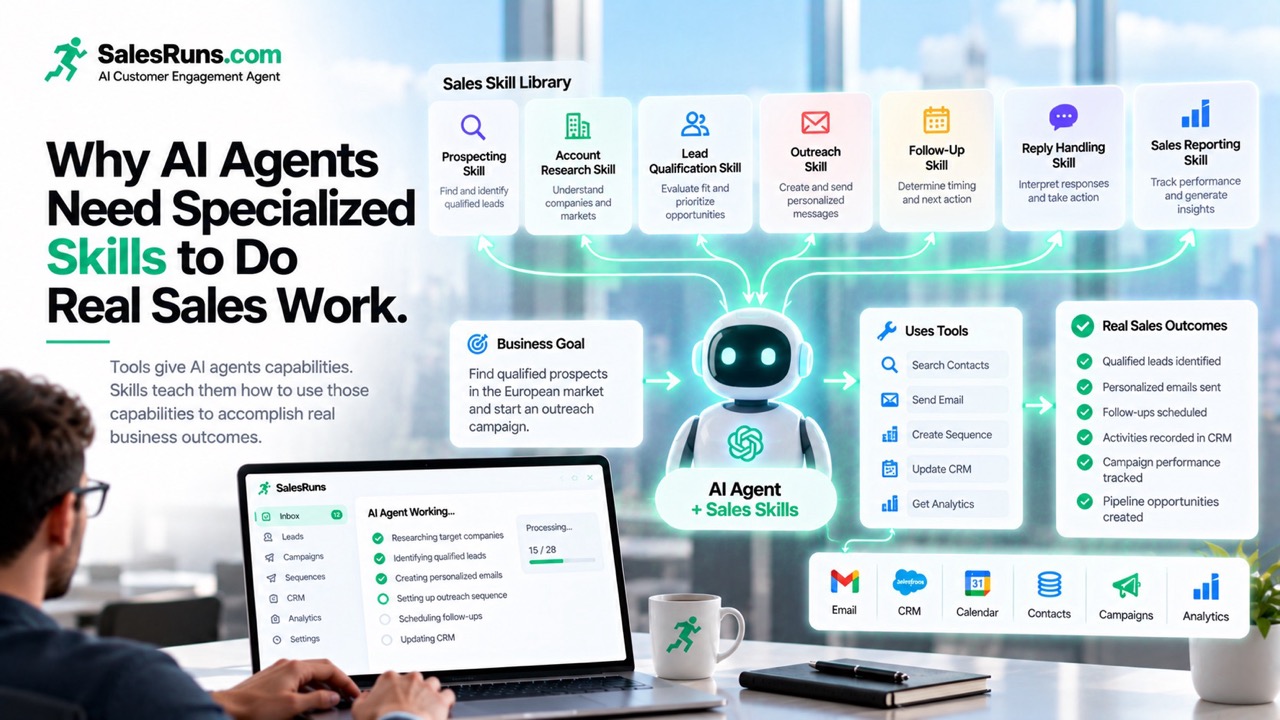
Give an AI agent a full sales stack. It can search contacts, read company records, send email, create a sequence, update the CRM, and pull campaign numbers. Every one of those actions works.
Then ask it to run a campaign for a new product line in a market it has never seen.
What you get is not a salesperson. You get a very fast system making a large number of independent decisions with no idea what any of them mean together. It will email a contact another team is already working. It will send a third follow-up to someone who asked to be removed three weeks ago. It will write a beautifully generic note to a company whose own site says they manufacture in-house.
None of those is a reasoning failure. The model handled each step competently. What was missing was procedure: the accumulated judgment about when to contact someone, what a first message should actually say, how much follow-up is enough, and when to stop.
That missing layer has a name now, and it is turning into real software infrastructure. It is called a Skill.
1. The Difference Between Capability and Expertise
Capability and expertise are different resources, and conflating them is the most common mistake in agent design. A capability answers whether an action is possible. Expertise answers whether the action is correct in this situation, for this account, at this moment.
An agent with `send_email` can send. That is the whole of its capability. The expertise sits in the questions that have to be answered first:
- Is this person the right target at all?
- Why this account, and why now?
- What is already known about them?
- Which stakeholders, if any, matter here?
- What should the first message actually say?
- How much personalization is real rather than decorative?
- Is someone else already pursuing this account?
- Has this contact been reached recently by anyone?
- When does a follow-up become an annoyance?
- How should a reply be read?
- What would damage the sending domain if this goes wrong?
- What is the next action once the message is out?
Every one of those is a sales decision. None of them is a tool call. An agent that can only call tools has to improvise all twelve, and improvisation is exactly what produces the generic first message and the fourth unnecessary follow-up.
2. What Exactly Is an AI Agent Skill?
An AI agent skill is a reusable, versionable set of instructions that teaches an agent how to carry out a specific kind of job, packaged so it can be discovered and loaded on demand. Concretely, a skill is a directory containing a `SKILL.md` file: YAML frontmatter with a name and a description, followed by markdown instructions, optionally bundled with scripts, templates, and reference material.
Anthropic shipped skills for Claude in October 2025 and published the format as an open, vendor-neutral standard at agentskills.io that December. What made it travel was the loading model. Only the name and description of each installed skill sit in context at all times. The body is loaded when a request matches the description, and bundled files are read only when the body asks for them. That three-tier progressive disclosure is why a large skill collection costs almost nothing until it is used, and it is the practical reason a skill written once now runs across dozens of agent runtimes rather than one vendor's product.
One property of the format is easy to miss and matters a great deal: a skill grants knowledge, not access. Its instructions can only direct capabilities the agent already has. A skill cannot grant itself a permission, which means the authority question stays where it belongs, with the tool and credential layer.
3. More Tools Is Not Enough
There is a persistent assumption that capability is additive. Give an agent another tool and it becomes a little more capable. Push that to a hundred tools and the assumption predicts a hundred times more capability. The prediction does not hold, because the bottleneck is not what the agent can reach. It is what the agent can decide.
A large unstructured tool surface creates its own failures:
- Selection ambiguity: with similar tools available, the agent picks inconsistently
- Unnecessary action: a capable agent will act, even when not acting was the right answer
- Poor sequencing: the right tools in the wrong order produce a broken workflow
- Duplicated work: two routes to the same result, both executed
- Missing context: the call is valid but the business decision behind it is not
- Unpredictable behaviour: hard to reason about, hard to test, hard to improve
- Unmeasurable outcomes: when it goes wrong there is no procedure to point at
None of this argues for a small toolset. It argues for structure between the model and the tools, and that structure is what a skill provides.
The difference shows up in how the two are described. An agent with tools is told that it can send email. An agent with a sales skill is told to determine whether this prospect is appropriate for outreach, inspect prior interactions, identify the most relevant business context, construct a concise value proposition, send through the appropriate workflow, record the interaction, and decide the next action from the response. The second is operational knowledge, not API access.
4. Tools vs. Skills vs. Prompts
Three things get confused here, and separating them makes the rest of the argument obvious. A tool is a capability the agent may invoke. A prompt is an instruction for one occasion. A skill is a durable procedure for a recurring job.
| Tool | Skill | |
|---|---|---|
| Answers | What can the agent do? | How should it do this job? |
| Contains | A function signature and input schema | Objective, decision rules, sequence, constraints |
| Lifetime | Available whenever connected | Loaded when a request matches |
| Authored by | Whoever provides the capability | The team that knows how the work is done |
| Failure mode | Called at the wrong moment | Absent, so improvisation returns |
The prompt case is worth dwelling on, because it is where most teams start. "Write a good cold email" is not a procedure. It does not say who to write to, what to check first, what to do when the account already has a supplier, how many times to follow up, or what counts as a finished task. A prompt can improve the writing. It cannot make the surrounding decisions.
A mature skill usually contains:
- Objective: what a completed job looks like
- Context requirements: what the agent must know or look up before starting
- Decision rules: how to choose between branches, and when to stop
- Tool selection: which capability fits which situation
- Execution steps: the order, with the reasoning at each transition
- Constraints: limits that must hold, such as volume, tone, or timing
- Exception handling: what to do when a step fails or data is missing
- Expected output: the shape of the result, so it can be checked and stored
- Evaluation: how someone decides whether the job was done well
5. Why Sales Requires Specialized Skills
Sales is a poor fit for pure tool access and an unusually good fit for skills, because it is not one action. It is a chain of contextual decisions, and almost every step depends on information gathered in the step before it.
Find, qualify, prioritize, research, contact, follow up, interpret, update, re-engage, convert. Each stage contains reasoning specific to sales, and each stage fails in stage-specific ways. A research step that returns nothing useful and a research step that returns a competitor's name are the same action with completely different consequences downstream.
Compare that with a single tool. `send_email()` is trivial to implement. The hard questions sit around it: should this be sent, to whom, why now, in what language, with what claim, through which workflow, recorded where, and what happens next. A tool answers none of those. A skill is, quite literally, a written answer to them.
This is also why general assistants tend to be mediocre at outbound sales even when they write well. The writing is the easy part. The restraint is the hard part, and restraint is procedural.
None of that is unusual for a domain. It is unusual in how much of it is tacit. A support agent can be handed the refund policy and still not know which refunds to escalate. An engineer can be given an API and still not know which calls are safe to retry. Sales has simply accumulated more of it, because the consequences land on real people rather than on a log line.
6. A Sales Skill Is Operational Knowledge
A mature sales process contains thousands of small decisions, almost none of which are written down anywhere. Experienced people know which leads deserve attention, which signals actually indicate intent, when a prospect is not ready, how much context belongs in a first email, when a follow-up turns into pressure, which stakeholder matters, how to read silence, when to escalate, and when to stop.
Today that knowledge lives in playbooks, standard procedures, training material, CRM rules, a manager's spoken instructions, and the accumulated experience of individual reps. It works, but it does not scale, it is not versioned, and it leaves with the person who holds it.
A skill is a way to make part of that executable. The test of a good sales skill is simple: could a competent new hire follow it and produce a similar result on a bad day? If the answer is no, the skill is missing the decisions that actually matter.
7. How Sales Skills Could Work Inside an AI Agent
Three examples, written as concepts rather than as shipped product.
- Lead qualification skill: identify the target account, inspect available company information, judge fit, identify relevant stakeholders, assess buying relevance, classify the opportunity, recommend the next action.
- Cold outreach skill: identify the target, inspect prior context, decide whether outreach is appropriate, construct a message that references something real rather than a placeholder, avoid generic personalization, choose the sending workflow, record the activity, decide whether follow-up is warranted.
- Follow-up skill: inspect previous interactions, determine whether the prospect engaged, interpret the most recent signal, choose the next action, set timing, update the sales state.
Notice what the three have in common. None of them is a single action. Each is a decision procedure that happens to call tools along the way, and each ends by writing something down so that the next run knows more than this one did.
That last point is what turns a skill from a document into a system. A procedure that does not update state repeats itself forever. A procedure that records its outcome improves, and the improvement is visible in the records rather than in a model's mood.
A concrete scenario makes the difference visible. A company wants an agent to find potential B2B customers, and the agent already has a contact database, company data, email sending, a CRM, and campaign analytics. Without a skill it has all of the capability and none of the method, so each of these becomes something it has to improvise: who to target, how to qualify, what to say, how to sequence the outreach, when to follow up, and how to read the results.
Same agent, same tools, same data. What changed is that the decisions moved from being improvised on every run to being written down, reviewed by a person, and improved when the results say they should be.
8. The Emerging Relationship Between Skills, Tools, and MCP
| Layer | Main question |
|---|---|
| Model | Can the AI reason? |
| Agent | Which task should run right now? |
| Skill | How should this job be done? |
| Tool | What can it access or execute? |
| MCP / connection layer | How does the agent discover and reach capabilities? |
| Outcome | What business result was achieved? |
The layering is worth stating precisely because the terminology is still moving. A connection protocol helps an agent find and reach capabilities. A skill tells the agent how to use those capabilities for a particular job. They are not competitors, and a production agent generally needs both.
This stopped being purely conceptual in September 2026, when the Model Context Protocol accepted its Skills extension, SEP-2640, as final. The extension, identified as `io.modelcontextprotocol/skills` and written against the 2026-07-28 base protocol, lets a server offer its own skills over a connection it already serves. One design decision stands out: it defines transport rather than payload. The file format belongs to agentskills.io, so there is one definition of what a skill is and one way to deliver it. Servers expose a listing and an entry point, the files travel as ordinary resources, and every file is bound to a digest so a client can tell a changed file from an approved one.
The short version: MCP connects, skills describe. What that arrangement means for sales systems is the subject of the next article in this series.
9. The Sales Skill Library
Taken together, skills stop looking like documents and start looking like a library. A prospecting agent, an outreach agent, and a reporting agent could each draw from the same set, without any of them owning the underlying knowledge.
The practical consequence is that building a sales agent stops meaning writing one large program. It starts meaning assembling a model, a set of skills, a set of tools, and the data, then testing that combination against real outcomes. The skills are the reusable part, and they can be versioned, reviewed, and improved independently of the agent that uses them.
10. Why Skills Could Become a New Competitive Moat
Models are converging, and a frontier capability is increasingly available to anyone willing to pay for it. Tools and APIs are also becoming interchangeable, since a well-documented endpoint can be reimplemented or wrapped. Neither trend makes capability worthless. It makes capability a poor place to build a durable advantage.
A high-quality domain skill is harder to copy for a specific reason:
- Judgment accumulated over many cycles of real outcomes
- Workflow design that has been corrected rather than assumed
- Edge cases that only show up in production
- Rules shaped by real customer behaviour rather than a specification
- Feedback loops that improve the procedure from recorded results
- Company-specific context that does not travel with the model
None of that is available inside a model, and very little of it is in a manual. It is also the part that is genuinely valuable to a customer, which is why the competitive centre of an AI application is likely to move away from the model it calls and toward the quality of its skills, its data, its execution infrastructure, and how quickly those improve.
11. SalesRuns and the Sales Skill Layer
SalesRuns today is an AI sales execution platform: contact management, email outreach, sales sequences, campaign operations, follow-up workflows, and sales analytics. That is the operational layer a sales skill would describe.
The direction is to expose that layer as reusable capability rather than only through one interface. A general-purpose agent should be able to select a sales skill, follow it, and let SalesRuns handle the specialized execution underneath. In that arrangement the agent contributes understanding of the objective and coordination of the work, while SalesRuns contributes the records, the delivery path, the rules, and the audit trail.
To be explicit about what does not exist yet: there is no public SalesRuns skill library and no SalesRuns server offering skills over MCP. What is described here is the direction the product is being built toward, together with the categories a skill layer would plausibly cover: prospecting, account research, lead qualification, contact discovery, personalized outreach, follow-up, reply classification, meeting preparation, pipeline management, and customer re-engagement. The previous article in this series covers the infrastructure side of the same idea in more detail: what happens when agents access your sales infrastructure.
12. What Happens When Every AI Agent Can Access Sales Expertise?
The more interesting scenario is not one agent with a skill. It is a general shift in what software is for. A company could choose its model for reasoning, choose a connection layer for reach, and choose a library of sales skills for knowing how the work is actually done, then let an agent assemble the three.
That separation is only useful if the skills are good. A mediocre library is worse than none, because it encodes mediocrity in a reusable form and spreads it across every agent that loads it. The value of this layer is entirely a function of whether the procedures in it survive contact with real results.
It also changes what a sales application owes its customers. A screen is a reasonable interface for a person deciding what to do. It is a poor interface for a system that already knows the procedure and needs the permission, the state, and the record. Building for both audiences is the practical requirement, and it is where the current working definition of an AI sales agent starts to stretch.
What are AI agent skills?
An AI agent skill is a reusable, versionable set of instructions that teaches an agent how to carry out a specific kind of job. Concretely it is a directory with a SKILL.md file containing a name and description in frontmatter, markdown instructions, and optional scripts, templates, or references.
What is the difference between an AI agent skill and a tool?
A tool is a capability the agent can invoke, answering what it can do. A skill is a procedure that tells the agent how to use capabilities for a specific job, including decision rules, sequencing, and constraints. Tools grant access; skills grant knowledge.
Why do AI agents need specialized skills?
Because capability is not judgment. An agent with every sales tool still has to decide who to contact, why now, what to say, and when to stop. Skills encode those decisions so behaviour is consistent instead of improvised on every run.
How are AI agent skills different from prompts?
A prompt is an instruction for one occasion and improves a single response. A skill is a durable procedure for a recurring job: it carries context requirements, decision rules, tool selection, sequencing, constraints, exception handling, and an expected output that can be evaluated.
What are sales skills for AI agents?
They are procedures for recurring sales jobs such as lead qualification, prospect research, cold outreach, follow-up, reply handling, and pipeline reporting. Each encodes when the job applies, how to carry it out, and what must be recorded afterwards.
Do agent skills give an agent permission to act?
No. A skill grants knowledge, not access. Its instructions can only direct capabilities the agent already has. Permission and authorization stay with the tool, credential, and policy layer.
How much do skills actually improve results?
Published benchmark work reported by SkillsBench moved average pass rates from 33.9% to 50.5% with curated skills, while software engineering tasks gained only about 4.5 percentage points. Gains depend heavily on the task and on whether the agent selects the skill at all.
Are agent skills an industry standard?
The file format is published as an open, vendor-neutral standard at agentskills.io, and a large number of agent runtimes read it. That is not the same as a fully settled ecosystem: terminology, distribution, and discovery practices are still developing.
What is Skills over MCP?
It is the Model Context Protocol's Skills extension, accepted as SEP-2640 in September 2026. It lets an MCP server offer its own skills over a connection it already serves. It defines transport rather than payload, so the file format remains owned by agentskills.io.
What role could skills play in agentic AI?
Skills are a candidate layer for operational knowledge. Where a connection protocol decides how an agent reaches a capability, skills decide how that capability is used for a particular job, which is what turns reachable tools into repeatable business execution.
Why are skills potentially a competitive advantage?
Models and well-documented APIs are increasingly interchangeable. What is hard to reproduce is the judgment inside a procedure: corrected workflow design, production edge cases, customer-specific rules, and feedback loops that improve from recorded outcomes.
Does SalesRuns already offer these skills?
No. SalesRuns today covers contact management, email outreach, sequences, campaign operations, follow-up workflows, and sales analytics. Exposing those capabilities as a reusable skill layer for AI agents is a direction the product is being built toward, not a set of published skills.