A salesperson at a B2B distributor sits down on Monday morning and reviews the 47 accounts she's nominally responsible for. About a third of them, she knows well. There are notes in her head, conversations she remembers, recent emails she can scroll back through. For those accounts, the next move is obvious: a check-in here, a follow-up there, a pricing conversation that was promised last week.
The other two-thirds are noise. Not because the customers don't matter, but because the context that would make them matter has been lost. A buyer in Berlin mentioned a Q3 compliance deadline eight months ago. A regional manager in São Paulo expressed interest in exclusive distribution, then went quiet. An existing customer signed a mid-tier contract and was supposed to hear about the premium tier "later." Each of these is a real relationship with real value. Each is also one bad week away from disappearing entirely.
Ethan Davis, a sales leader who writes about relationship-driven selling, put it well recently: "Sales runs on relationships. And relationships run on principles." (See his full post on the five relationship principles here.) He's right about both halves. The question most companies can't answer is the one underneath: how do you actually keep the relationships alive long enough for the principles to matter?
Sales Runs on Relationships
The metrics most sales dashboards are built around — leads generated, emails sent, meetings booked, opportunities created, pipeline value, conversion rate, closing speed — describe the transaction layer of sales. They're useful. They're also incomplete. They tell you what activity is happening without telling you whether any actual relationship is being built underneath it. Davis's framing of the relationship-first approach points to something the transaction metrics miss: every customer interaction creates a small amount of relationship value. A good call. A well-timed reply. A specific recommendation that remembered what the customer said three months ago. Each one is small. Stacked together, they become the difference between a vendor and a partner.
Consider what a strong customer relationship actually produces over its lifetime: repeat purchases that don't require a new sales cycle, expansion conversations that begin with trust already established, referrals that arrive without an outbound campaign, loyalty that survives one bad delivery or one missed timeline. None of these show up in the meeting-booked metric. All of them show up in revenue.
The economic value of an established relationship is well understood in customer success circles — the cost of retaining an existing customer is a fraction of acquiring a new one, and expansion revenue from happy customers often exceeds the initial contract. What's less understood is how to actually produce that value at scale, when a typical rep is managing 80 to 120 accounts and the human limit on what they can hold in working memory hasn't changed.
Why Relationships Become a Competitive Advantage
When Davis lists his five principles — directness, pace, workflow, honesty, celebration — he isn't describing tactics. He's describing the conditions under which trust accumulates. The interesting thing is that none of these are scarce in the abstract. Lots of salespeople value directness, understand pace, work hard on workflow, try to be honest, and want to celebrate customers. What's scarce is the consistent execution of those principles across every interaction, every account, every quarter.
That's where the compounding happens. Two competing vendors can both pitch the same buyer with similar products and similar pricing. The one who remembered the buyer's constraint from the first call, who followed up at the pace the buyer actually operates on, who delivered the proposal with a clean handoff timeline, who named the limitations honestly — that vendor starts to look different. Not because of one big gesture, but because of accumulated small ones that the buyer noticed. Over time, that difference becomes structural. Switching costs become real, not contractual. The buyer stops shopping the market for every renewal. Referrals happen because the relationship is genuine. Expansion conversations feel like the natural next step rather than another sales pitch.
The companies that build this kind of structural advantage don't do it through better scripts or more aggressive follow-up. They do it by building systems that let their people actually execute on relationship principles, every time, across the entire book of business — not just the accounts the senior reps happen to remember.
The Challenge of Scaling Customer Relationships
Here's the uncomfortable math. A senior account executive can genuinely maintain maybe 30 to 50 relationships with the kind of context that Davis's principles require. That's the real ceiling for a human: enough customers to make a living, few enough to remember each one as an individual. Modern sales organizations don't operate at that scale. They operate at 100, 200, sometimes 500 accounts per rep, with portfolio reassignments every time territory shifts or someone leaves.
The result is a system that measures activity and calls it progress, while the actual relationship knowledge atrophies. A rep inherits 80 accounts from someone who left. The CRM has notes — but the notes are summaries, not the conversations. The contacts are listed, but the priorities, the objections, the personal details that made the previous owner effective aren't in any field. The new rep starts from zero on every relationship, and the cycle of decay begins again.
What disappears when relationships scale
The decay isn't random. The most important details are the most fragile. Buyers mention a Q3 factory expansion in passing; by the time the rep would have followed up, the conversation is gone. A contact says they prefer WhatsApp over email and want pricing in EUR; the next rep emails them USD pricing in English. A champion changes jobs and the relationship they carried with them becomes orphaned in someone else's book of business. A procurement timeline was discussed informally on a call and never made it into the CRM.
None of those lost details is a small thing. Each one is a chance to be relevant next time — spent. Multiply it by hundreds of accounts and the gap between what the organization knows and what it could know becomes enormous. The principles Davis describes require information to execute on. Lose the information, and execution drifts back to generic.
Customer Memory: The Foundation of Modern Sales
Customer Memory is the continuous, structured, and searchable record of every meaningful customer interaction — not as isolated logs, but as a coherent relationship history that includes context, preferences, commitments, objections, sentiment, and trajectory. It is the single piece of infrastructure that makes Davis's relationship principles executable at scale. Without memory, principles become slogans. With memory, they become repeatable practice.
What belongs in Customer Memory isn't just the structured CRM data — contacts, accounts, deal stages, activity timestamps. It also includes the unstructured parts that actually carry the relationship signal: what the buyer cared about, what problem they were quietly trying to solve, what they asked you to send, what objections they raised, what timeline they implied, what they said about competitors. These details are where trust is either built or eroded, and they're the first to disappear in conventional systems.
A Customer Memory layer captures those details once, across every channel — email, WhatsApp, Telegram, Slack, LinkedIn, voice calls — and makes them available to every rep who touches the account, indefinitely. Not as a search problem the rep has to solve every time. As a default context that any rep inherits the moment they need to engage.
Relationship Intelligence: The Future of Sales Growth
Memory alone isn't enough. A complete archive of every conversation isn't useful unless someone can read the pattern across them. That's the job of Relationship Intelligence — the ability to read customer relationships the way an experienced account manager reads them, but at scale, across every account, continuously. Relationship Intelligence uses conversation history, engagement signals, customer context, and behavioral patterns to answer questions that memory alone can't:
- Which relationships are getting stronger, and which are quietly drifting?
- A rep scanning a CRM can't see the trajectory. Relationship Intelligence can — engagement velocity, sentiment shifts, response patterns, buying signals, all evaluated against the full relationship history.
- Which relationships need attention this week, and what kind of attention?
- Not "send a check-in email." Specifically: a re-engagement on the pricing objection that came up two months ago, a follow-up on the timeline discussion that stalled, a proactive check-in based on industry news that affects the customer's segment.
- Who is ready for the next conversation, and what's the right entry point?
- Relationship Intelligence connects external signals (a job change, a new initiative, a regulatory change in the customer's industry) with the existing relationship history and surfaces natural next steps the rep wouldn't have spotted manually.
This is where the compounding actually happens. Every interaction adds to memory. Every memory update sharpens the intelligence. Every intelligence-driven engagement strengthens the relationship, which generates more interactions, more memory, more intelligence. The flywheel turns, and the relationship asset grows whether or not the original rep is still on the account.
How SalesRuns Helps Companies Build Relationship Flywheels
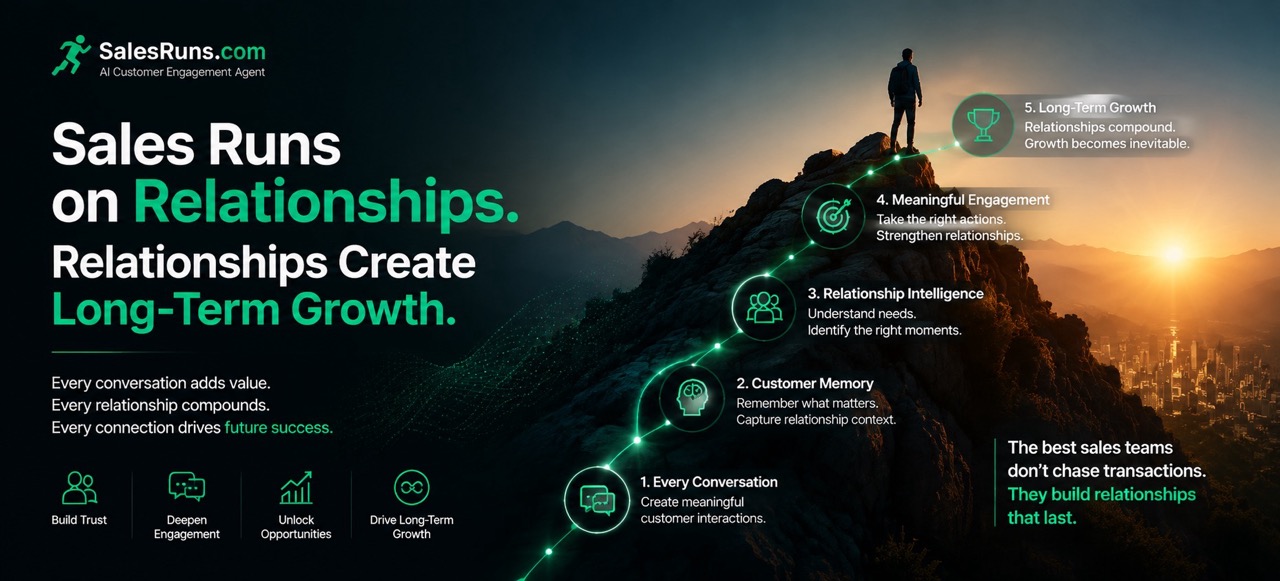
SalesRuns is an AI Customer Engagement Agent built specifically to operate this flywheel on behalf of sales teams. It doesn't replace your CRM. It doesn't replace your reps. It does the work that most CRMs and most reps can't do consistently: maintain continuous, intelligent understanding of every customer relationship, and translate that understanding into the right action at the right time.
The framework is straightforward in concept, difficult in execution. Each link has to actually work. SalesRuns's job is to make every link work across every account, not just the ones the best reps happen to remember.
Three ways the flywheel shows up in practice
Example 1: The trade show aftermath. A team comes back from a major industry event with 500 new conversations logged across business cards, badge scans, and booth chats. In a traditional setup, most of those contacts decay within weeks — they sit in a spreadsheet, nobody follows up, and the trade show budget becomes a line item the sales leader questions next year. With SalesRuns, those 500 conversations become relationship intelligence. Each contact has a memory entry: what they were interested in, what problem they mentioned, what follow-up they expected. SalesRuns identifies which conversations deserve attention first, drafts personalized outreach that reflects the actual conversation, and tracks the engagement through the next interaction. The trade show becomes the start of 500 real relationships instead of the start of 500 decay timers.
Example 2: The buyer who isn't ready yet. A prospect had a good discovery call, asked for a proposal, reviewed it, and then went quiet. In the traditional playbook, the opportunity goes stale, gets closed-lost, and the rep moves on. The relationship value evaporates. In the SalesRuns model, the relationship context doesn't disappear because the timeline did. SalesRuns holds the memory: what the prospect cared about, what their timeline actually depends on (a board meeting in October, a budget cycle that closes in Q1), what their objection was (pricing structure, not price level). When the right moment arrives — six weeks, six months, whenever — the engagement picks up with full context instead of starting over.
Example 3: The expansion conversation nobody had. An existing customer has been steady for fourteen months. They use the product, pay on time, no complaints. In the standard playbook, that means everything is fine — leave them alone. In the SalesRuns view, the same customer's company just announced a new initiative that aligns exactly with the premium tier. A stakeholder in a department that doesn't currently use the product posted on LinkedIn about challenges your premium features solve. The relationship context already exists through the champion. SalesRuns surfaces the timing signal, suggests a warm intro path, and the expansion conversation happens before the customer starts shopping for alternatives.
Relationships Are a Business Asset, Not a Sales Activity
The fundamental shift that Davis's framing points toward — and that SalesRuns is built to deliver on — is treating relationships as something the company owns and grows, not something individual reps carry in their heads. An asset shows up on a balance sheet. It compounds over time. It survives personnel changes. It can be invested in, measured, and improved at the organizational level. That's what customer relationships become when the company actually has the infrastructure to maintain them — and that's what most companies don't have today, despite having the relationships themselves.
The companies that figure this out first will outcompete the ones still treating relationships as a side effect of having good reps. Not because their products are better, but because every customer experience — over months, over years, across every touchpoint — will be informed by what actually matters to that customer. That's not a small advantage. It's structural.
Davis wrote that relationships run on principles. He's right. The harder truth underneath is that principles only survive when the organization can execute them — and execution at scale is an infrastructure problem. SalesRuns.com is the AI Customer Engagement Agent built to solve that infrastructure problem.
Key Takeaways
- Sales runs on relationships, but relationships run on systems that can remember them. Without infrastructure to maintain context, even good principles decay into generic execution.
- Every interaction adds relationship value. A good call, a remembered detail, a follow-up at the right pace — each one is small, but stacked together they create the difference between a vendor and a partner.
- Relationships are a business asset, not a sales activity. They compound. They survive personnel changes. They can be invested in and improved at the organizational level — when the infrastructure exists to support them.
- Customer Memory is the foundation that makes relationship principles executable at scale. Without it, principles become slogans.
- Relationship Intelligence reads the patterns across memory to surface the right action at the right time. It's what turns stored context into compounding growth.
- SalesRuns is the AI Customer Engagement Agent that operates this flywheel on behalf of sales teams — remembering every relationship, understanding every conversation, and recommending the next best action continuously.