In 2013, a mid-market software company implemented Salesforce. Six months later their VP of Sales pulled a report that showed something nobody had seen before: every open opportunity, every contact, every activity log, all in one place. The team spent the next three years building dashboards, enforcing data entry rules, and training reps to log everything. Revenue went up 34% over that period. The CRM worked.
Ten years later, that same company has 18,000 contacts in their CRM, 2.3 million logged activities, and a sales team that still misses follow-ups, loses deals to competitors they never saw coming, and watches good relationships go cold without anyone noticing until it's too late.
The CRM didn't fail. It solved the problem it was designed for. The problem just moved.
CRM Solved Data Management. That Was Step One.
Before CRM systems became standard, the actual problem was embarrassingly basic: customer information lived on spreadsheets, in email folders, on sticky notes, and inside individual reps' heads. When someone left the company, their book of business partially evaporated. When a customer called in, whoever picked up the phone had to guess at the history. Deals fell through the cracks because nobody knew they existed.
CRM fixed that. It gave companies a single place to store contacts, accounts, deals, and activities. Pipeline visibility improved. Handoffs between reps got less destructive. Management could finally see what the sales team was doing, or at least what they were logging. For the first time, organizations had a systematic answer to the question: where is the customer information?
That answer transformed how B2B sales teams operate. Salesforce alone has over 150,000 customers. HubSpot, Microsoft Dynamics, Zoho, Pipedrive, and dozens of others built entire businesses around the same core idea: centralize customer data so nothing gets lost. And by that metric, CRM succeeded. Customer information doesn't get lost anymore. It gets buried.
The New Challenge: Understanding Relationships
Here's what a typical enterprise CRM looks like today: thousands of contacts across hundreds of accounts, millions of activity records, enough notes and emails and meeting logs to fill a library. The data is there. The insight usually isn't.
A sales director at a manufacturing company described the situation this way: "I can pull a report that shows me exactly when my rep last emailed a prospect, what template they used, whether the prospect opened it, and how many times. What I can't tell you is whether that prospect is actually interested, or just being polite. Whether the relationship is getting stronger or weaker. Or what my rep should do next that would actually move things forward." That gap — between knowing what happened and understanding what it means — is where most sales organizations are stuck right now.
Why more data made the problem harder
Information overload isn't a metaphor here. A rep managing 80 active accounts with an average of 5 contacts each faces 400 individual relationships. Each of those generates emails, calls, meetings, WhatsApp messages, LinkedIn interactions, and CRM notes. The volume isn't just large; it's structurally impossible for any person to hold in working memory while also doing the actual job of selling.
What gets lost in that flood isn't the big stuff. Nobody forgets that the million-dollar deal exists. What disappears are the signals that determine whether that deal actually closes: the buyer who stopped responding two weeks ago (not busy — evaluating a competitor), the existing customer whose project timeline just accelerated (expansion opportunity nobody caught), the long-dormant account where a key contact just changed jobs (re-engagement window opening). These aren't data problems. They're interpretation problems. And CRM wasn't built for interpretation.
What Is Relationship Intelligence?
Relationship Intelligence is the ability to understand the state, trajectory, and potential of a customer relationship by analyzing conversation history, engagement patterns, contextual signals, and business timing — then translating that understanding into specific, timely actions. It's not a dashboard. It's not a score. It's a capability: reading relationships the way an experienced account manager reads them, but at scale, across every account, continuously.
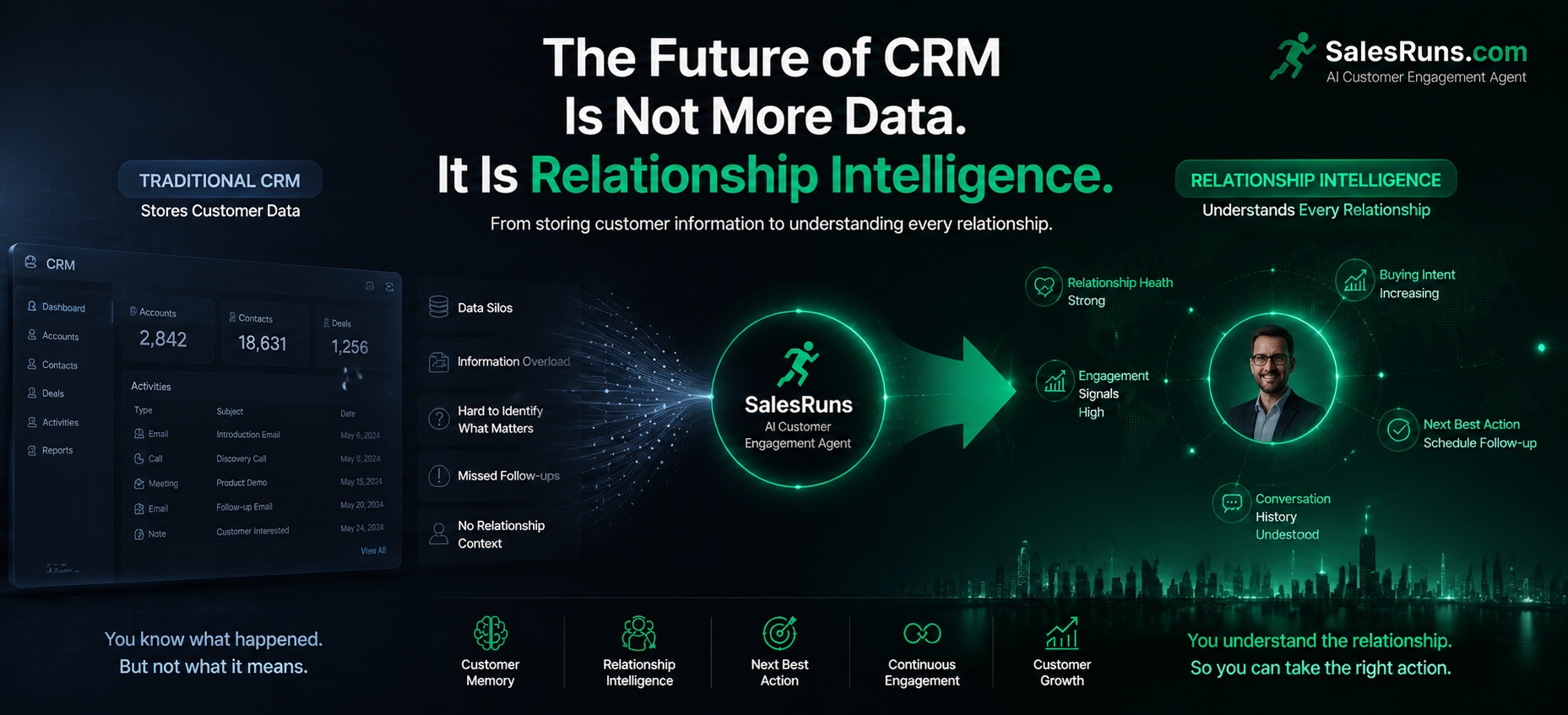
Where traditional CRM tells you what happened, Relationship Intelligence tells you why it matters and what to do about it. The difference shows up in practice:
- Data tells you the prospect opened your last three emails but hasn't replied to any of them.
- Intelligence tells you their engagement pattern shifted from active discussion to passive consumption — likely shopping alternatives, re-engagement window is narrowing.
- Data tells you the customer hasn't logged a support ticket in six months.
- Intelligence tells you quiet customers in this segment churn at 3x the rate — proactive check-in recommended within five days.
- Data tells you your contact at the account just changed roles.
- Intelligence tells you this is a natural expansion trigger — the new role typically owns budget for the exact product category you sell, and the previous relationship history gives you warm introduction material.
From CRM Records to Relationship Intelligence
Think of it as a stack. Traditional CRM occupies the bottom layer: storage. Contacts, accounts, deals, activities. Structured fields, timestamps, picklists. The foundation. Relationship Intelligence sits above that layer. It reads the structured data, but also the unstructured parts — the actual conversations, the tone shifts, the patterns that only emerge over time. Then it does something CRM doesn't attempt: it forms a judgment about the relationship and recommends an action.
The practical difference between these layers shows up in what each one can answer: CRM answers: Who is this customer? What products have they bought? When was the last contact? What stage is the deal in? How much revenue is in the pipeline? Relationship Intelligence answers: How strong is this relationship right now? Is it getting stronger or weaker? What does the customer actually care about (not what the CRM field says)? Which relationship needs attention this week? What's the single best action to take?
Neither layer replaces the other. You can't have intelligence without data. But data without intelligence is just a very organized archive — useful for reporting, insufficient for decision-making.
How SalesRuns Creates Customer Engagement Intelligence
SalesRuns is an AI Customer Engagement Agent designed specifically for this gap. It doesn't replace your CRM. It sits alongside your existing systems and adds a layer that CRM platforms were never built to provide: continuous understanding of customer relationships, translated into actions.
Here's what SalesRuns actually does with the customer data you already have:
- Customer Memory — Remembers every conversation across every channel (email, WhatsApp, Telegram, Slack, WeChat, LINE). Not as isolated logs, but as a coherent relationship history that includes context, sentiment, and trajectory.
- Relationship Understanding — Reads patterns across that history to assess relationship health, identify buying signals, detect risk factors, and recognize engagement opportunities that a human scanning a CRM would miss.
- Next Best Action — Translates that understanding into specific recommendations: "Follow up with this prospect about the pricing objection they raised last Tuesday," "Re-engage this dormant account — their industry just announced new compliance requirements that your product addresses," "This customer's usage pattern suggests they're ready for an upsell conversation."
- Continuous Engagement — Maintains relationship momentum between major touchpoints. Not spam. Timely, relevant outreach based on actual relationship context rather than arbitrary cadence rules.
This framework turns static customer records into a living system that understands relationships and acts on that understanding. The CRM remains the source of truth for structured data. SalesRuns becomes the engine that reads that data, interprets it, and drives the right actions at the right time.
Three Examples of Relationship Intelligence in Practice
Example 1: The six-month conversation journey
A prospect at an enterprise account has had scattered conversations with three different people from your company over six months: an initial discovery call, a product demo, a technical Q&A exchange, and two email threads about implementation timelines. In a traditional CRM, those show up as five separate activities under the same contact record. A rep looking at the account sees the timeline but has to piece together the narrative themselves. With Relationship Intelligence, the system sees the full arc: initial interest → deep evaluation → technical validation → implementation planning → stalled (the last email thread ended three weeks ago with no reply). It recognizes that the prospect has moved further through the buying process than the lack of recent activity suggests, and that the stall point is specifically about implementation timing — not interest. The recommendation isn't "send a check-in email." It's "follow up on the implementation timeline discussion with a proposed schedule option."
Example 2: The silent departure signal
An existing customer who previously responded to emails within 24 hours hasn't engaged in 19 days. Their login frequency dropped from weekly to zero over the past month. No support tickets, no complaints — just silence. CRM shows: last activity 19 days ago, no open cases, account status = active. Relationship Intelligence sees: engagement velocity declining for 30 days, pattern matches accounts that churned in the last quarter (same segment, same behavioral profile), risk score elevated. Recommendation: proactive outreach within 48 hours focused on usage value and success milestones, not generic check-in.
Example 3: The hidden expansion opportunity
A customer bought your base product 14 months ago. They've been using it steadily, no complaints, no expansion discussions. Standard CRM playbook: they're happy, leave them alone unless they ask for something. But their company just announced a new initiative that directly aligns with your premium tier capabilities. A key stakeholder in a department that doesn't currently use your product just published a LinkedIn post about challenges your premium features solve exactly. Relationship Intelligence connects these external signals with the existing relationship history and flags: expansion opportunity emerging, warm introduction path available through current champion, recommended action = champion-assisted intro to new stakeholder within two weeks while the timing signal is fresh.
Why CRM Needs an Intelligence Layer Now
Three forces are converging to make this shift urgent, not optional.
First, the data volume problem is getting worse, not better. Every new channel (WhatsApp Business, LinkedIn messaging, Slack connect) adds another stream of customer interaction that CRM systems struggle to unify. Reps have more touchpoints to manage, more context to track, more signals to interpret. The human cognitive limit hasn't changed. The load keeps growing.
Second, customer expectations have shifted. Buyers expect vendors to remember previous conversations, understand their context, and reach out with relevance, not repetition. When a supplier sends a generic check-in email that ignores three months of prior discussion, the buyer notices. And increasingly, they respond by engaging with a competitor who seems to actually know them.
Third, AI makes this layer economically feasible for the first time. Building Relationship Intelligence used to require hiring senior account managers and giving them impossibly large portfolios. The knowledge was there, but it didn't scale. An AI Customer Engagement Agent can maintain continuous relationship understanding across hundreds or thousands of accounts simultaneously, at a fraction of the cost, without forgetting anything.
The Future of Sales Technology
The next few years will split sales technology into two categories. One category continues optimizing what CRM already does: better dashboards, faster reporting, cleaner data entry, more integrations. Useful work, but it's polishing the foundation. The other category builds something new on top of that foundation: systems that don't just store customer information, but understand customer relationships. Systems that answer not just "what happened" but "what now?" Systems that treat relationship intelligence as a core capability, not a byproduct of having lots of data.
SalesRuns is built for that second category. The mission is straightforward: help companies transform the customer data they already have into relationship intelligence they can act on. Not more data. Better understanding. Not more activity. More relevant action. Not bigger pipelines. Stronger relationships that actually convert.
Key Takeaways
- CRM solved data storage. The question "where is the customer information?" is answered. The new question is "what does this relationship mean?"
- Data ≠ Intelligence. Having millions of activity records doesn't tell you which relationship needs attention today. Interpretation requires a different capability than storage.
- Relationship Intelligence is the ability to understand relationship health, trajectory, and potential — and translate that into specific actions.
- An AI Customer Engagement Agent like SalesRuns adds an intelligence layer on top of existing CRM. It doesn't replace your systems; it helps you get more value from them.
- The practical output isn't reports or scores. It's the right action, at the right time, for the right relationship — consistently, at scale.
- Companies that invest in relationship intelligence will outperform those that continue treating CRM as the end of the stack. The foundation is necessary but not sufficient.