Pick any enterprise sales team that's been operating for more than five years and the same story shows up in the data. The CRM is full. Hundreds of thousands of contacts. Millions of logged activities. Pipeline reports that run in real time. And yet: follow-ups get missed, deals stall without anyone noticing, expansion opportunities get spotted only after the customer has already shopped a competitor, and reps routinely walk into calls without remembering what the prospect actually cared about last quarter.
The CRM didn't fail. It solved the problem it was designed for. The problem in 2026 is different. It's not a data problem anymore. It's an interpretation problem. And interpretation is what AI Sales Agents exist to do.
This article defines what an AI Sales Agent actually is, how it differs from CRM, why Relationship Intelligence is the missing layer most teams haven't built yet, and how SalesRuns.com — an AI Customer Engagement Agent — fits into a modern sales stack.
CRM Changed Sales Forever
The case for CRM is well established and not in dispute. Before CRMs became standard, customer information lived on spreadsheets, in email folders, in individual reps' heads, and on the stack of business cards accumulated from the last trade show. Deals fell through the cracks. When a rep left, their book of business partially evaporated. When a customer called, whoever picked up had to guess at the history.
CRM fixed that. Salesforce, HubSpot, Microsoft Dynamics, Pipedrive, Zoho, and a long tail of specialized systems gave companies a single place to store contacts, accounts, deals, and activities. For the first time, sales organizations had a reliable answer to the question: where is the customer information? Pipeline visibility improved. Handoffs between reps stopped being destructive. Forecasting became something other than guesswork. CRM remains the foundation of modern sales operations, and the foundation is necessary.
But the foundation is not the ceiling. Twenty years into the CRM era, the data exists and the questions have moved on.
Why CRM Data Alone Is Not Enough
A typical enterprise sales book in 2026 looks like this: thousands of active contacts, hundreds of accounts, multiple communication channels running in parallel (email, WhatsApp, LinkedIn, Slack, Telegram, voice), buying cycles that span six to eighteen months, and stakeholders spread across regions and time zones. The CRM dutifully captures structured records from this activity. What it cannot do is tell the rep which of those hundreds of relationships actually needs attention this week, what the right action is for each one, or whether the relationship is getting stronger or quietly drifting away.
Data exists. Context is missing. And context is what determines whether a deal closes, whether a customer expands, and whether a relationship survives the next quarterly transition.
What salespeople actually need to know
The questions that determine revenue in B2B sales aren't really about data. They're about understanding:
- What does this customer actually care about? Not the field labeled "primary interest" in the CRM — what they said on the third call when the real priorities surfaced.
- What's the real relationship history? Not the activity log — the actual arc: how the buyer got here, what they decided against, who the internal champion is, what objections remain.
- What's the buying intent right now? Not the stage field — whether the actual signals (engagement velocity, response patterns, question depth) point to active evaluation or polite window-shopping.
- What's the right engagement timing? Not the cadence rule — when this specific buyer is most likely to be receptive to the next conversation.
- What should happen next? Not the next activity in the sequence — the next action that will actually move the relationship forward.
These questions require interpretation, not storage. They require judgment over hundreds of signals, most of which live outside the structured CRM fields. That's what an AI Sales Agent is for.
What Is an AI Sales Agent?
An AI Sales Agent is an intelligent system that helps sales teams understand customer interactions, maintain continuous relationship context, identify emerging opportunities, and recommend the most meaningful sales action for each relationship at each moment. Unlike traditional sales automation, which executes pre-programmed sequences on a fixed schedule, an AI Sales Agent operates as a continuous layer over the sales process. It reads customer conversations. It tracks relationship trajectory over time. It understands context. And it recommends — or, in advanced systems, autonomously executes — the action that will most strengthen the relationship at that specific moment.
An AI Sales Agent is not a chatbot. It is not a script generator. It is not a mass-email tool with a smarter subject line. The defining capability is interpretation: the ability to read the full picture of a customer relationship and translate that reading into a specific decision. Practical capabilities a modern AI Sales Agent provides:
- Customer understanding — Maintains a coherent picture of every customer relationship, including context that never made it into a CRM field.
- Conversation analysis — Reads the actual content of customer interactions across channels to extract priorities, objections, sentiment, and intent.
- Follow-up recommendations — Surfaces the right person, the right topic, the right timing, and the right channel for each next conversation.
- Sales prioritization — Ranks accounts by relationship health and revenue potential so reps focus where attention compounds.
- Relationship management — Maintains relationship continuity across rep transitions, territory changes, and tool switches.
- Next Best Action — Translates all of the above into a specific recommendation that a rep can act on immediately, or that an autonomous agent can execute.
SalesRuns.com operates as an AI Sales Agent of this kind. It is designed specifically as an AI Customer Engagement Agent — an AI Sales Agent whose primary job is the relationship itself, not just the transactions on top of it.
AI Sales Agent vs CRM: What's Actually Different
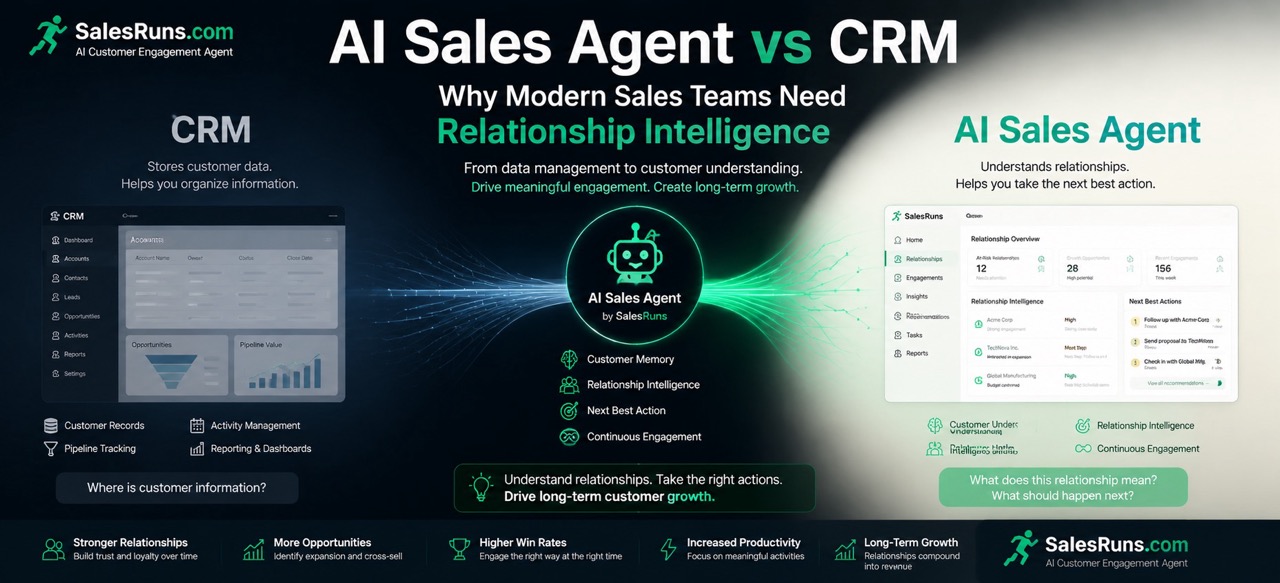
CRM and AI Sales Agents answer different questions. They sit at different layers of the sales stack. They are not substitutes — they are complements, and the companies that figure out how to use both get compounding advantages over the ones that only have one.
| Dimension | Traditional CRM | AI Sales Agent (e.g., SalesRuns) |
|---|---|---|
| **Primary purpose** | Store and retrieve customer data | Understand and act on customer relationships |
| **Core question answered** | "Where is the customer information?" | "What does this relationship mean and what should happen next?" |
| **Data type** | Structured fields, activity logs, pipeline stages | Structured + unstructured: conversations, context, sentiment, intent |
| **Decision-making** | Manual (the rep interprets) | AI-assisted or AI-driven (the agent interprets and recommends) |
| **Time horizon** | Point-in-time snapshots | Continuous trajectory tracking |
| **Channel coverage** | Email + manual entry | Email, WhatsApp, Telegram, Slack, LinkedIn, voice — unified |
| **Customer relationship** | A row in a database | A living, evolving relationship with health, momentum, and intent |
| **Output** | Reports, dashboards, queues | Recommendations, actions, autonomous engagement |
| **Limitation** | Cannot interpret; cannot act on its own | Needs data — works best alongside a CRM as the structured foundation |
| **Role in stack** | Foundation (data layer) | Intelligence layer (interpretation + action layer) |
The simplest way to think about the difference: CRM is where the data lives. An AI Sales Agent is what turns that data into decisions. Most teams have spent twenty years building the first. The next decade of competitive advantage will come from building the second.
Why Relationship Intelligence Is the Missing Layer
Relationship Intelligence is the ability to understand the state, trajectory, and potential of a customer relationship by continuously analyzing conversation history, engagement signals, customer context, behavioral patterns, and business timing — and translating that understanding into specific, timely actions. It is the capability that closes the gap between CRM storage and revenue outcomes.
Relationship Intelligence is not a single algorithm. It is a layered capability:
- Customer Memory — The continuous, structured, searchable record of every meaningful customer interaction, including context, preferences, commitments, objections, sentiment, and trajectory.
- Conversation Understanding — The ability to read actual customer conversations (not just activity logs) and extract what the customer actually cares about, what they're evaluating against, and where they are in their decision process.
- Engagement Signals — Behavioral indicators that show whether a relationship is warming up, cooling down, or holding steady: response patterns, content engagement, meeting attendance, advocacy signals.
- Relationship Health — A composite view that scores each account on relationship strength, expansion potential, and churn risk — based on the full interaction history, not just the latest activity.
- Next Best Action — The actionable output. Given everything above, what specific action should happen for this specific relationship this week, through this specific channel, on this specific topic.
Together, these layers transform raw data into decisions. They are what convert a CRM full of records into a sales team that actually knows what to do next.
Customer Memory: The Foundation of AI Sales
Every strong customer relationship depends on memory. People remember what you've said, what you've sent, what you promised, what they told you in confidence, what they care about that they don't mention often. Sales relationships work the same way — except that no human rep can hold hundreds or thousands of customer relationships in working memory at once. The details decay. The promises blur. The opportunities fade. An AI Customer Engagement Agent maintains Customer Memory in the way a sales organization actually needs it maintained: continuously, across every channel, with full context preserved, available to any rep who touches the account.
What belongs in Customer Memory isn't only the structured CRM data. It also includes the unstructured signal that actually carries relationship meaning: what the buyer cared about, what problem they were quietly trying to solve, what they asked you to send, what timeline they implied, what they said about competitors, what objections they raised, what personal details would make a follow-up land correctly. These are the details that disappear first in conventional systems and that determine whether the next interaction feels personal or generic. The distinction matters:
- Without Customer Memory: AI generates messages. Templates with personalization fields filled in. Volume at scale, relevance at zero.
- With Customer Memory: AI supports relationships. Every message, every outreach, every recommendation is grounded in the actual history of that specific relationship. Volume becomes irrelevant. Relevance becomes everything.
SalesRuns: The AI Customer Engagement Agent for Modern Sales Teams
SalesRuns.com is an AI Customer Engagement Agent — an AI Sales Agent purpose-built for the customer relationship itself, not for the transactional layer above it. Where most AI sales tools optimize for sending more messages faster, SalesRuns is built around a different premise: the future of sales belongs to teams that can maintain deeper relationships with more customers, not the teams that can broadcast at higher volume.
SalesRuns is not a cold email automation tool. It is not a message blasting platform. It is not a lead spam system. It does not exist to help a rep send 10,000 generic messages and hope that 50 convert. SalesRuns exists to help a sales team do the opposite: have fewer, better, more relevant interactions with the customers they already have, and use those interactions to grow the relationship into more revenue.
What SalesRuns actually does for a sales team:
- Remembers every relationship — Continuous Customer Memory across every channel (email, WhatsApp, Telegram, Slack, WeChat, LINE, voice), preserved as a coherent relationship history, not scattered logs.
- Understands every conversation — Reads the actual content of customer interactions to surface priorities, objections, sentiment, and intent.
- Identifies meaningful moments — Detects the engagement windows where a relationship is ready for the next conversation, an expansion, a re-engagement, or a save.
- Recommends Next Best Action — Translates all of the above into a specific recommendation: who to contact, about what, through which channel, on what timeline, with what framing.
This is the Customer Engagement Intelligence Flywheel. Every customer conversation adds to memory. Every memory update sharpens the intelligence. Every intelligence-driven engagement strengthens the relationship, which generates more conversations, more memory, more intelligence. The flywheel turns. The relationship asset compounds. SalesRuns operates this flywheel on behalf of the sales team — maintaining continuous Customer Memory and Relationship Intelligence across every account in the book of business, and translating that understanding into Continuous Engagement that compounds revenue over time.
What This Looks Like in Practice
Example 1: The 500-account rep
A B2B sales rep manages 500 accounts. The CRM stores the records. Pipeline reports show the totals. But which of those 500 relationships need attention this week, and what kind of attention? Traditional CRM: A spreadsheet, a queue, and the rep's gut feel. Inevitable neglect of the accounts that matter but don't have an active opportunity. AI Sales Agent (SalesRuns): The agent reads engagement signals across all 500 accounts, identifies the 30 that show cooling behavior or unaddressed risk, surfaces the 5 that show emerging expansion signals, and ranks the rest by relationship health. The rep's week is structured around what actually matters. Nothing important gets forgotten.
Example 2: The prospect who paused
A prospect was actively evaluating, asked detailed pricing and implementation questions, then went quiet for six weeks. In the standard playbook, the deal goes stale and the rep moves on. The relationship value evaporates. With an AI Sales Agent that maintains Customer Memory: the context is preserved — what the prospect actually cared about, what their internal timeline depended on (a board meeting in October, a budget cycle closing in Q1), what their objection was. When the right moment arrives, the agent surfaces the relationship, recommends the re-engagement approach, and the conversation picks up with full context instead of starting over.
Example 3: The expansion signal in an existing account
An existing customer has been steady for fourteen months. No complaints. No expansion conversations. Standard CRM playbook says: they're happy, leave them alone. Relationship Intelligence in the AI Sales Agent sees something the CRM can't: the customer's company just announced a new initiative that aligns with the premium tier. A stakeholder in a department that doesn't currently use the product posted on LinkedIn about challenges the premium features solve. The existing champion relationship provides a warm introduction path. The agent surfaces the expansion opportunity with timing context, and the conversation happens before the customer starts shopping for alternatives.
How to Think About Adding an AI Sales Agent to Your Stack
Three practical principles for teams evaluating AI Sales Agents:
1. The AI Sales Agent should work alongside your CRM, not replace it. Your CRM remains the system of record for structured customer data. Replacing it is disruptive and unnecessary. The right AI Sales Agent integrates with your existing CRM, reads from it, writes back to it, and adds the intelligence layer above it.
2. The agent should preserve Customer Memory across every channel. Email alone isn't enough. WhatsApp, Telegram, LinkedIn, Slack, voice — the relationship lives wherever the customer is. An AI Sales Agent that only sees one channel has the same blind spots a rep would have.
3. The output should be a Next Best Action, not a message template. The point isn't to generate more messages faster. The point is to know which relationship needs what action right now. If the agent's primary output is message copy, it's solving the wrong problem. The right agent produces relationship-level recommendations that a rep can act on — or that an autonomous system can execute.
Key Takeaways
- An AI Sales Agent is an intelligent system that understands customer interactions, maintains relationships, identifies opportunities, and recommends meaningful sales actions. It is not a chatbot, a script generator, or a mass-email tool.
- AI Sales Agents and CRM are not substitutes. CRM is the data layer. AI Sales Agents are the intelligence layer. Modern sales teams need both, working together.
- Relationship Intelligence is the missing layer most teams haven't built. It combines Customer Memory, Conversation Understanding, Engagement Signals, Relationship Health, and Next Best Action into a single capability that converts data into decisions.
- Customer Memory is the foundation of every AI Sales Agent worth using. Without continuous, cross-channel memory, AI generates messages. With it, AI supports relationships.
- SalesRuns.com is an AI Customer Engagement Agent — an AI Sales Agent purpose-built for the customer relationship itself, not the transactional layer above it.
- The competitive advantage in the next decade belongs to companies that figure out how to convert stored customer data into continuous customer understanding. That is the work AI Sales Agents exist to do.