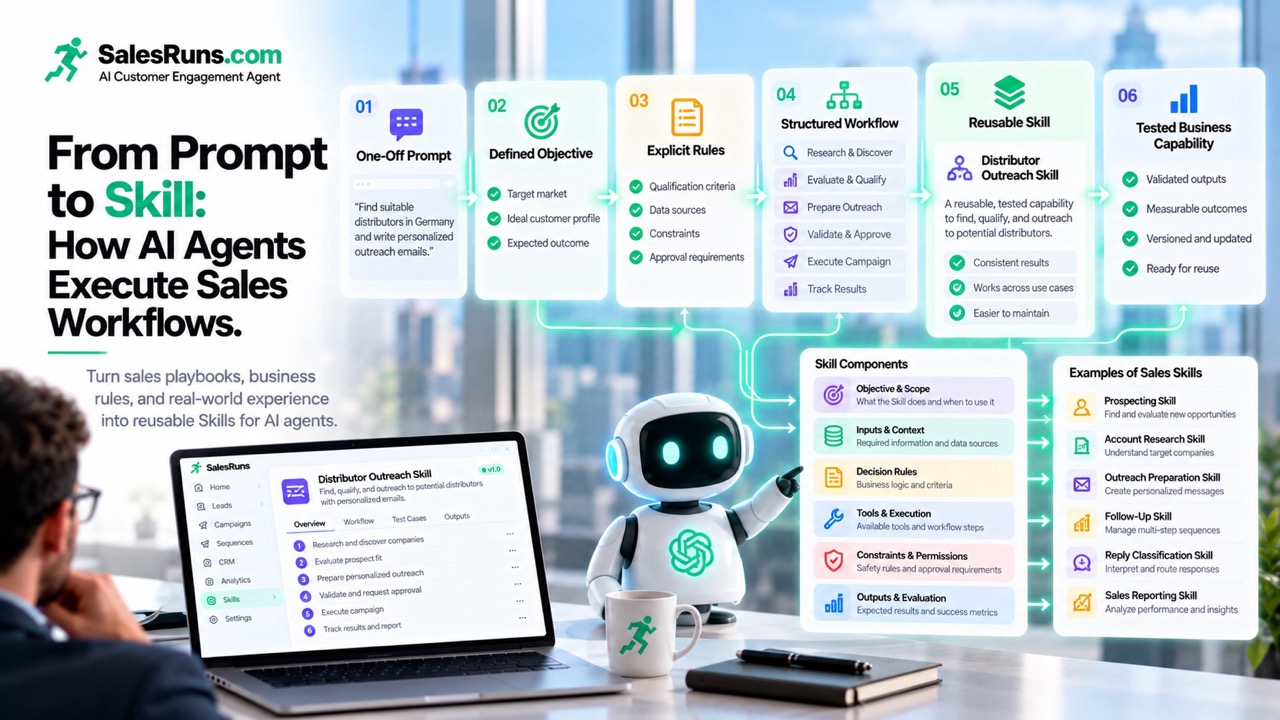
A user types: find suitable distributors for our product and write personalized outreach emails.
A general-purpose model handles this well. The drafts come back in seconds, the tone is right, and nobody doubts the underlying capability.
Now ask the same system to repeat the task for 100 different prospects, across multiple markets, over several weeks. Suddenly a longer list of questions appears. What qualifies as a suitable distributor? Which information must be researched, and from which sources? What should happen when important information is missing? How should previous contact history affect the decision? What counts as genuine personalization? Which recipients must be excluded? When should the agent ask for clarification instead of guessing? Which actions require approval? How should the system record the result, and how can the team tell whether the process is working at all?
A single prompt does not carry enough structure to answer those questions consistently for the 100th prospect, let alone the first. That is the gap this article is about: the challenge is not getting AI to complete one task. It is making a business process repeatable, observable, and reliable across many tasks. In sales automation terms, that is the difference between a demo and a system.
1. Prompts, Workflows, and Skills Are Different Things
The three words get used interchangeably in demos. They solve different design problems, and the distinction matters the moment a task has to run more than once.
| Concept | What it is | Example |
|---|---|---|
| Prompt | An instruction or request that tells an AI system what to do | "Write a personalized outreach email to this distributor." |
| Workflow | A sequence of steps and decisions that moves a task toward an outcome | Research the company, evaluate fit, inspect contact history, prepare a draft, validate the draft, request approval |
| Skill | A reusable package of task-specific knowledge and instructions that helps an agent perform a particular kind of work | A distributor prospecting Skill that encodes qualification criteria, required evidence, exclusions, and output requirements |
The relationship runs in one direction: a prompt can invoke a Skill, a Skill can guide a workflow, and the workflow uses tools and external systems to get the work done. A Skill may carry purpose and scope, required inputs, prerequisites, decision rules, workflow steps, tool-selection guidance, constraints, exception handling, output requirements, and evaluation criteria. These categories overlap in real implementations. Different platforms package them differently, so treat this as a design vocabulary rather than a universal formal standard.
2. Why Sales Expertise Is Difficult to Encode
Sales knowledge is rarely contained in one instruction. It is distributed across sales playbooks, CRM conventions, qualification criteria, email templates, team SOPs, manager feedback, compliance rules, individual salesperson experience, and the accumulated lessons of campaigns that worked and campaigns that did not. Some of that knowledge is explicit. Much of it is implicit, carried by people who have done the task hundreds of times. Three examples of the implicit kind. A salesperson looks at a prospect and thinks the company size looks promising, but the product is unlikely to fit its distribution model. A cold outreach SOP says personalize every email, without defining what meaningful personalization actually means. A follow-up playbook says follow up after several days, without explaining when a prospect's reply, unsubscribe, or existing relationship should change that decision. This is why copying an SOP into a long prompt usually fails. The document was written for a human who fills the gaps from experience. An agent fills them differently every time. The first step is not prompt engineering. It is understanding the underlying business process well enough to make its assumptions explicit.
3. Step One: Define the Job Before Writing the Skill
Before drafting instructions, answer five questions. The answers become the Skill's contract with everyone who uses it.
- What is the objective? The desired result in business terms. Identify qualified distributors and prepare relevant outreach drafts, not find some companies.
- When should the Skill be used? The triggering conditions. A user requests distributor prospecting for a specified product and market.
- What information is required? The minimum inputs. Product category, target geography, ideal customer profile, target company characteristics, outreach language, relevant product information.
- What does success look like? Observable outputs. A list of evaluated companies, evidence supporting each qualification decision, clearly identified missing information, outreach drafts linked to their intended recipients, validation results, an explicit approval state.
- What must not happen? The boundaries. Do not invent company facts, do not treat uncertain inferences as verified information, do not contact suppressed recipients, do not send messages without required authorization, do not report a draft as a sent email.
The last question does the most work. Most agent failures in AI sales workflows are not formatting problems; they are boundary violations that nobody wrote down. Defining the job and its limits comes before writing a single instruction.
4. Step Two: Turn Implicit Expertise Into Explicit Rules
Extracting operational knowledge from experienced people and existing documentation is a research task, not a writing task. A practical sequence:
- Collect the current SOPs, playbooks, templates, and relevant examples.
- Interview the people who actually perform the task.
- Identify the recurring decisions.
- Record the evidence used for each decision.
- Identify the common exceptions.
- Separate mandatory rules from recommendations.
- Identify decisions that require human judgment or approval.
- Convert the findings into explicit rules.
The qualification example shows the difference. An informal rule says: prioritize distributors that are a good fit. An operational definition specifies the relevant product categories, the target geography, the distribution capabilities required, evidence of serving the intended market, the minimum information needed, the reasons to exclude a candidate, and how to handle incomplete evidence. No universal thresholds exist here, and inventing them would be a mistake. The business has to define thresholds appropriate to its own product and market. What transfers is the shape of the rule, not the numbers: a Skill becomes more useful when the decisions hidden inside a vague instruction are made explicit.
5. Step Three: Design the Skill Structure
One workable layout for a sales Skill, with the purpose of each section:
- Objective. The job the Skill is intended to perform.
- Scope and trigger. When the Skill applies, and when it does not.
- Required inputs. The information needed to proceed, and what to do when something is missing.
- Prerequisites. Conditions that must be satisfied before execution.
- Context and evidence. The information sources the agent should consult.
- Decision rules. How to evaluate options and select next steps.
- Workflow steps. The intended procedure, in order.
- Tool guidance. Which capabilities may be appropriate at each stage.
- Constraints and permissions. Actions that are prohibited, restricted, or approval-dependent.
- Exception handling. What to do when information is missing, tools fail, or conditions are ambiguous.
- Output schema. What the Skill should return, in a form the consuming system can use.
- Evaluation criteria. How to judge whether the Skill performed its intended job.
This is a proposed design template, not an official specification. Real formats exist: the Agent Skills open standard, for example, defines a skill as a folder containing a SKILL.md file with metadata and instructions, optionally bundled with scripts and reference material, and loads it through progressive disclosure so the agent reads only a name and description until a task matches. Formats and conventions still vary by platform, so design the sections your workflow needs and map them onto whatever format your agents consume. The deeper treatment of Skills as a capability layer lives in the Skills article earlier in this series.
6. Step Four: Separate Decision Logic From Execution
A Skill may guide the agent to research a prospect, evaluate available evidence, prepare a campaign, request approval, or retrieve execution status. None of that makes the Skill the enforcement mechanism for permissions, data integrity, or execution safety. Six boundaries keep the design honest:
- Skill: guides task-oriented reasoning and procedure.
- Tool: exposes an operation.
- Connection protocol: provides a way for compatible clients to access capabilities.
- Business system: implements authoritative data and business logic.
- Execution service: performs operations and maintains state.
- Policy layer: enforces permissions and mandatory constraints.
The suppression example makes it concrete. A Skill can instruct an agent to check whether a contact is suppressed. The underlying sending system should independently enforce the applicable suppression rules. Assuming an instruction inside a Skill is equivalent to an enforceable system control is one of the more dangerous design mistakes in this space, because instructions can be misread, ignored, or overridden by content the agent reads along the way. The full AI sales agent stack article covers where each boundary sits.
Implementations are starting to reflect this separation in the loading model. In October 2026, LangChain reworked skills support in its Deep Agents framework so that tools declared in a skill's metadata enter the agent's context only after the agent has read that skill; calling one earlier fails as an unknown tool. The pattern couples a capability to the instructions that govern it, instead of exposing every tool to every conversation. Useful as it is, delayed loading is not a substitute for permissions, version control, testing, or observability. Those live below the Skill, in the sales infrastructure that actually executes work.
7. Step Five: Define Inputs and Outputs Precisely
A reusable Skill needs a clear interface, the same way a function does. A distributor-prospecting Skill might accept a product description, target market, geographic scope, ideal customer profile, qualification criteria, and requested output format. It might produce candidate company records, supporting evidence, qualification assessments, missing-information flags, exclusion reasons, and recommended next steps. An outreach-preparation Skill might accept an approved recipient list and message parameters, and produce the intended recipient, a draft subject, a draft body, the evidence supporting the personalization, validation warnings, the approval requirement, and the current draft status. The critical discipline is keeping three kinds of claims apart in the output:
- "The company lists three distribution locations" is a factual claim that should be supported by a source.
- "The company may be a suitable partner" is a model-generated assessment.
- "The campaign has been sent" is an operational claim that only the execution system can verify.
Structured outputs make Skills easier to test, reuse, and combine, because the next step in a workflow can branch on a field instead of parsing prose. Not every Skill needs JSON or a formal schema; the format should fit the consuming system and the use case. What does not scale is an output that mixes facts, guesses, and status into one paragraph of text.
8. Step Six: Test Skills With Realistic Cases
A Skill is not ready because its instructions look complete. It is ready when it behaves predictably on the cases that actually occur, including the ones where the correct behavior is to stop. A practical test matrix:
| Test case | What it checks | Expected behavior |
|---|---|---|
| Normal case | All inputs present, prospect clearly matches | Complete the workflow and produce structured outputs |
| Missing information | Profile lacks essential qualification evidence | Flag the gap explicitly instead of guessing |
| Ambiguous case | Prospect may fit, evidence is contradictory | Surface the contradiction and ask for direction |
| Exclusion case | Contact is suppressed or ineligible | Refuse to proceed with outreach for that recipient |
| Tool failure | A data service or lookup fails | Report the failure accurately and avoid phantom results |
| Duplicate case | Prospect already exists or was contacted | Detect and report the duplicate |
| Approval case | Draft ready, approval not granted | Stop before sending; hold at the approval state |
| Recovery case | Workflow interrupted mid-procedure | Resume or recover without duplicating actions |
For each case, define the input, the expected behavior, the expected output, the prohibited behavior, and the evaluation criteria before running it. Tests should cover positive outcomes and the cases where the agent must stop, ask a question, or refuse. No benchmark scores exist to borrow here, and a Skill is not reliable until your own cases say so.
9. Step Seven: Measure Outcomes, Not Just Output Quality
Evaluating a generated answer is not the same as evaluating a business workflow. Useful measures depend on what the Skill is responsible for.
- Prospecting Skill: percentage of candidates with sufficient evidence, qualification agreement with human reviewers, duplicate rate, missing-information rate, false-positive rate.
- Outreach-preparation Skill: draft acceptance rate, frequency of substantive human edits, unsupported factual claims, validation failure rate, policy violation rate, approval rate.
- Workflow including execution: successful operation rate, duplicate-action rate, execution failure rate, time to completion, accuracy of recorded status.
Keep the indicator hierarchy straight. A well-written email does not guarantee a reply. A reply does not guarantee a qualified opportunity. A qualified opportunity does not guarantee revenue. Evaluation should reflect the actual responsibility and observable outputs of the Skill, which is also the honest way to report its performance to the people who depend on it.
10. Step Eight: Version and Maintain Skills
Sales processes evolve, so a Skill is a maintained software artifact rather than static prompt text. It may need to change when the target market shifts, product positioning changes, qualification criteria change, new compliance requirements apply, tools are replaced, data schemas change, or performance analysis reveals recurring errors.
For higher-risk workflows, stage the rollout and run regression tests against the existing cases before a new version touches production volume. Treat the test matrix from the previous section as the regression suite. None of this happens automatically: improvements should be driven by evidence, review, and controlled updates, not by a Skill quietly rewriting its own rules from noisy production signals.
11. From One Skill to a Sales Skill Library
Individual Skills compose into a library. Illustrative categories, and the kind of work each covers:
- Prospecting: company discovery, contact research, lead qualification.
- Outreach: message preparation, campaign preparation, outreach validation.
- Engagement: reply classification, interaction summarization, follow-up preparation.
- Operations: campaign monitoring, activity recording, performance reporting.
- Analysis: prospect-fit assessment, campaign analysis, sales process evaluation.
These categories are illustrative. A real library should reflect the business's supported workflows and validated capabilities, not a generic checklist. Composability is where agentic AI meets software engineering: a larger workflow may invoke several Skills, but composition requires clear interfaces, shared context, and consistent state management across steps. A library with hundreds of Skills is not automatically a better agent. The objective is a small, coherent set of capabilities that solve meaningful tasks reliably.
12. SalesRuns and Reusable Sales Capabilities
The opportunity for a sales platform is to package sales-specific knowledge and workflows so that a general-purpose agent does not have to reconstruct the entire process from scratch on every request. Illustrative future capabilities along those lines: a Prospecting Skill, a Lead Qualification Skill, an Account Research Skill, an Outreach Preparation Skill, a Campaign Validation Skill, a Follow-Up Preparation Skill, and a Sales Reporting Skill. A complete implementation of any of these needs more than instructions. It needs suitable inputs, reliable data access, supported tools, execution boundaries, error handling, and evaluation. None of the listed Skills should be read as currently shipped or publicly available; they are the direction this architecture argues for.
The strategic argument: SalesRuns could differentiate itself by packaging repeatable sales execution knowledge together with the infrastructure needed to carry out the resulting workflows. Instructions alone are copyable. A Skill tied to authorized data, enforced constraints, and verified execution is a capability, and capabilities compound. That is what turns a next best action from a recommendation into a completed, recorded outcome.
13. Conclusion
The path from AI experimentation to dependable business execution is not simply writing better prompts. It is making business knowledge explicit, defining repeatable procedures, connecting the right tools, enforcing the right constraints, and testing whether the workflow actually works. A well-designed Skill turns an informal instruction into a reusable operational capability, and the Skill remains one component: reliable data, authorized tools, execution infrastructure, and evaluation stay essential underneath it.
Once individual Skills become reusable, the next challenge is organizing them into a coherent library: how should businesses structure, combine, discover, and maintain the Skills that power an ecosystem of AI sales agents? That is where this series goes next.
What is an AI agent Skill?
An AI agent Skill is a reusable package of task-specific knowledge and instructions that helps an agent perform a particular kind of work. It typically includes the objective, required inputs, prerequisites, decision rules, workflow steps, tool guidance, constraints, exception handling, output requirements, and evaluation criteria. One concrete format is the Agent Skills open standard, where a skill is a folder containing a SKILL.md file with metadata and instructions.
How is a Skill different from a prompt?
A prompt is an instruction for a single request, such as write an outreach email to this distributor. A Skill captures how a task should be performed repeatedly: it defines triggering conditions, decision rules, constraints, expected outputs, and evaluation criteria, so the same procedure runs consistently across many tasks and can be tested and versioned like software.
How do you turn a sales SOP into an AI Skill?
Start by defining the job: the objective, trigger conditions, required inputs, success criteria, and boundaries. Then interview the people who perform the task, identify recurring decisions and the evidence behind them, separate mandatory rules from recommendations, and convert the findings into explicit rules. Only then write the Skill structure, inputs, outputs, and tests. Copying the SOP text into a long prompt skips the step that matters, which is making implicit assumptions explicit.
What should a sales Skill contain?
A sales Skill should contain the objective, scope and trigger conditions, required inputs, prerequisites, context and evidence sources, decision rules, workflow steps, tool guidance, constraints and permissions, exception handling, an output schema, and evaluation criteria. The constraints section deserves the most attention: it should forbid inventing facts, treating guesses as verified data, contacting suppressed recipients, sending without authorization, and reporting drafts as sent messages.
How do you test an AI agent Skill?
Build a test matrix of realistic cases: a normal case, missing information, ambiguous evidence, an excluded or suppressed recipient, tool failure, duplicates, a draft awaiting approval, and recovery from an interrupted workflow. For each case define the input, expected behavior, expected output, prohibited behavior, and evaluation criteria. The tests must confirm the Skill stops, asks, or refuses when it should, not only that it completes happy paths.
How do businesses maintain and version AI Skills?
Treat Skills as maintained software artifacts. Run them through a lifecycle of draft, review, test, approve, release, monitor, and revise or retire. Version every change, evaluate it against the existing test cases before broad rollout, and stage releases for high-risk workflows. Skills do not improve themselves; updates should be driven by measured outcomes, human review, and controlled changes.