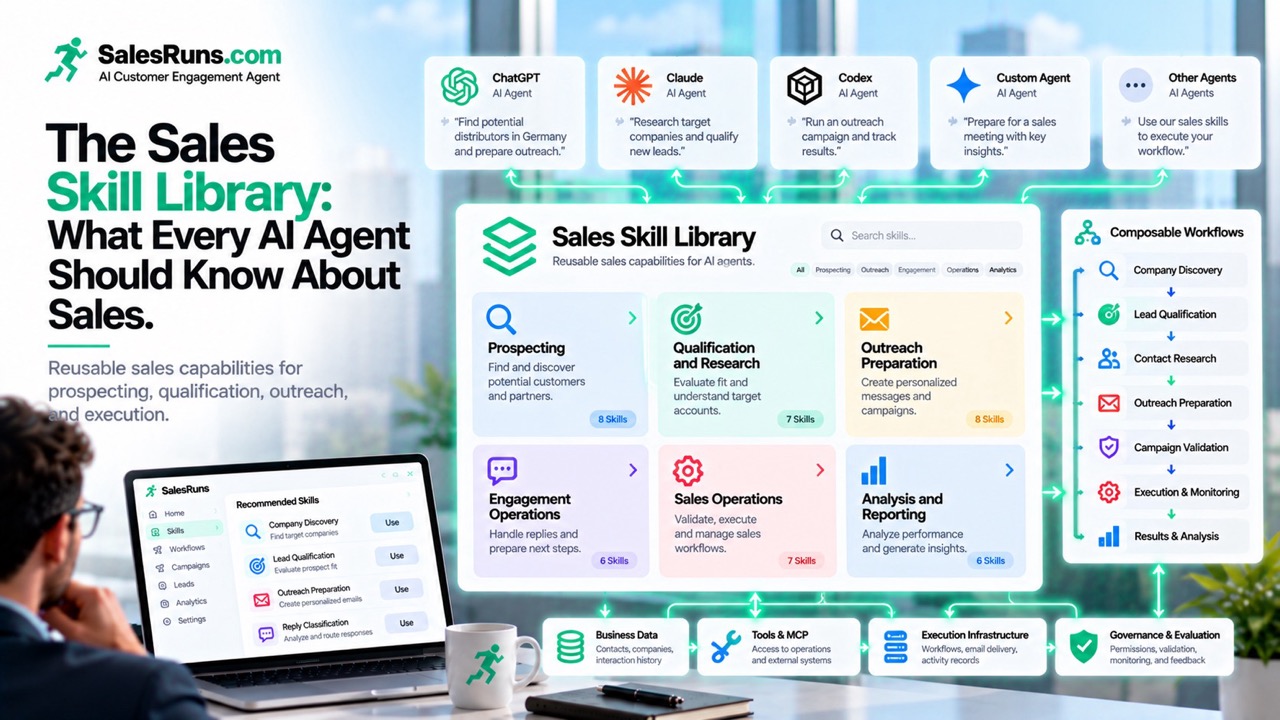
A company runs several AI sales agents. One researches potential customers. One prepares outreach messages. One analyzes campaign performance. One helps sales representatives prepare for meetings. Another reviews sales activity and generates reports.
Each of them needs some understanding of sales. Without reusable capabilities, the developers behind those agents recreate the same knowledge independently: similar instructions, similar qualification rules, similar validation procedures, similar tool-use patterns. The result shows up as duplicated implementation effort, inconsistent definitions of a qualified prospect, different interpretations of the same sales policy, fragmented testing, inconsistent outputs, repeated maintenance work, and improvements that never travel from one agent to another.
The better approach is to organize validated sales capabilities into a reusable library. The objective is not to make every AI agent know everything about sales. It is to make the right sales capabilities available when a particular task requires them.
1. What Is a Sales Skill Library?
An AI sales Skill Library is a structured collection of reusable, task-oriented capabilities designed to help AI agents perform specific sales activities. A Skill inside it might cover prospect research, lead qualification, outreach preparation, campaign validation, reply classification, or sales reporting. The library organizes these capabilities so they can be discovered, selected, combined, tested, versioned, and maintained as the business evolves. This is a conceptual product architecture, not a formally standardized industry category. It is also useful to distinguish it from things that look similar:
| Concept | What it provides | What it does not necessarily provide |
|---|---|---|
| Prompt collection | Reusable instructions | Prerequisites, interfaces, constraints, evaluation criteria |
| Template library | Reusable content, such as email templates | The full procedure for performing a task |
| Tool catalog | Available operations | The business procedure for using them effectively |
| Workflow engine | Execution and coordination of operational steps | The procedure itself, or a replacement for execution infrastructure |
A mature implementation may combine all four, and most eventually do. The responsibilities should stay conceptually distinct, because conflating them is how teams end up with a folder of prompts and a roadmap that says platform.
2. Organize the Library Around Sales Jobs, Not Tool Names
The taxonomy should reflect meaningful business tasks rather than mirror an API catalog. When capabilities are named after endpoints, the library organizes the vendor's architecture instead of the customer's work. A proposed structure with six categories:
- Prospect Discovery. Company Discovery, Contact Research, Market-Segment Research, Distributor Identification. Identifies potential customers or partners from authorized data sources.
- Qualification and Research. Lead Qualification, Company Fit Assessment, Account Research, Contact Verification Review. Evaluates available evidence against explicit business criteria.
- Outreach Preparation. Personalized Email Drafting, Value Proposition Selection, Outreach Preparation, Campaign Content Validation. Prepares relevant, factually grounded sales communication.
- Engagement Operations. Reply Classification, Interaction Summarization, Follow-Up Preparation, Meeting Preparation. Helps agents interpret interaction data and prepare appropriate next steps.
- Sales Operations. Campaign Validation, Activity Recording, Workflow Status Review, Sales Data Hygiene. Supports reliable process execution and recordkeeping.
- Analysis and Reporting. Campaign Performance Analysis, Lead Quality Analysis, Sales Activity Reporting, Workflow Outcome Evaluation. Summarizes observed results and operational performance.
The categories and Skill names above are illustrative. A real taxonomy should evolve from actual customer workflows rather than being designed for theoretical completeness. If half the customers use one category and nobody uses another, the second category is decoration, not architecture.
3. Design Skills at the Right Level of Granularity
Granularity is where most capability libraries quietly fail. A Skill can be too small or too large, and both failure modes compound as the library grows.
Skills that are too small include formatting a company name, extracting a URL, or writing an email subject line. These are better represented as simple tools, utility functions, or reusable prompt fragments depending on the architecture. If every trivial operation becomes a separate Skill, discovery and maintenance become unnecessarily complicated, and the agent spends its selection budget on trivia.
Skills that are too large are the opposite failure. Run the entire sales department in one opaque procedure, and the result combines too many independent responsibilities. Testing becomes coarse, reuse becomes unlikely, and recovery from a partial failure becomes guesswork.
The preferred design principle: a useful Skill represents a coherent task with a clear objective, defined inputs, a recognizable completion condition, explicit constraints, a predictable output, and a manageable set of dependencies. Lead Qualification qualifies because it has a clear objective, evidence requirements, decision criteria, and an output. A larger prospecting workflow can combine Company Discovery, Contact Research, and Lead Qualification without merging them into one monolithic Skill, so each piece can be tested and reused separately. There is no universally correct Skill size. The right granularity depends on the task, its risk, the available interfaces, and how often the capability will be reused.
4. Define a Consistent Skill Interface
A library becomes more useful when Skills have predictable interfaces. A conceptual Skill definition might include a Skill identifier, name and description, version, intended use, required inputs, optional inputs, prerequisites, required data sources, available tools, output structure, permissions, failure conditions, and evaluation criteria. A Lead Qualification Skill illustrates what that looks like in practice.
- Inputs: target customer profile, company information, qualification criteria, relevant product context.
- Processing guidance: identify the available evidence, compare it against the criteria, distinguish missing information from negative evidence, identify contradictions, avoid unsupported assumptions.
- Outputs: qualification assessment, supporting evidence, unmet criteria, missing information, confidence or uncertainty indicators where appropriately defined, and a recommended next step.
These are conceptual interface fields, not a universal formal schema. Consistency is what buys you: a library of Skills with predictable interfaces is easier to discover, test, and compose, because the next step in a workflow can rely on a field instead of parsing prose. The interface should match the task and the consuming system, so do not force every Skill to return the same output format.
5. Make Skills Composable
Most AI sales workflows are a sequence, not a single task. A distributor prospecting workflow shows the pattern:
Composition requires more than connecting boxes in a diagram. The system needs compatible inputs and outputs between steps, clear ownership of workflow state, explicit handling of missing data, defined failure behavior, duplicate prevention, policy enforcement, and traceable results. Not every Skill must call the next Skill automatically. An AI agent orchestration layer decides which capability to invoke based on the task and its current state, which keeps individual Skills testable in isolation. The principle: reusable Skills should have clear boundaries, while workflows determine how those Skills are combined to achieve a larger outcome.
6. The Library Separates Knowledge From Execution
A Skill Library is not a replacement for tools, data systems, or AI sales infrastructure. The responsibilities divide cleanly:
- Skill: describes the procedure, decision rules, and expected behavior for a task.
- Tool: exposes a specific operation.
- Connection interface: allows compatible AI applications to access exposed capabilities.
- Business data: provides authoritative records and relevant context.
- Workflow engine: coordinates long-running operations and maintains state.
- Policy layer: enforces mandatory permissions and constraints.
- Evaluation system: measures whether the capability performs as intended.
A Campaign Validation Skill can guide the agent through checking campaign requirements. The actual sending system must independently enforce mandatory suppression rules and sending permissions. A Skill should never be the sole mechanism enforcing security-critical requirements, for the same reason a runbook is not an access control system. The full agent architecture covers where each of these boundaries sits.
7. Discovery: How Should an Agent Find the Right Skill?
A large library is useful only if an agent can identify the right capability at the right moment. Four discovery mechanisms, presented as architectural options rather than universal best practices:
- Explicit selection. The developer or user specifies which Skill to use. Simple and predictable for known workflows.
- Task-based selection. The agent interprets the objective and selects a Skill based on its description, required inputs, and supported use cases. Flexible, but it depends on reliable descriptions and careful evaluation.
- Workflow-defined selection. A predefined workflow specifies which Skills are required at each stage. More control for repeatable or higher-risk tasks.
- Hybrid selection. Predefined workflows for critical operations, agent choice among approved Skills for less constrained decisions.
Whatever the mechanism, descriptions carry the load. Company Research and Lead Qualification must be distinguishable: one gathers and organizes evidence, the other evaluates that evidence against explicit criteria. When two Skills read the same to an agent, selection becomes a coin flip with maintenance costs.
Tool catalogs face the same problem at a different layer, and the protocol work is instructive. The 2026-07-28 revision of MCP gives list responses cache hints and a deterministic order, so clients can cache a tool catalog and keep upstream prompt caches stable across reconnects, plus an optional server/discover call for clients that want capabilities up front. On the Skills side, implementations are converging on similar mechanics from the other direction: in October 2026 LangChain reworked its Deep Agents skills support so that tools declared in a skill's metadata only enter context after the agent reads that skill, user-named skills can be pinned and loaded up front, and a long-running thread can reload its skill list mid-flight. The connection layer and Skill design articles cover both sides in more depth.
Discovery also has to account for version compatibility, required permissions, and unavailable dependencies. A Skill that cannot run because a data source is missing should say so plainly instead of failing somewhere three steps later.
8. Test and Version the Library
A library of AI agent Skills is maintained like a software product, because that is what it is. Each Skill should have a defined test suite covering normal inputs, missing information, ambiguous evidence, conflicting records, unavailable tools, permission failures, unexpected outputs, and downstream workflow failures. Composed workflows need testing at two levels. A Lead Qualification Skill may work correctly in isolation and still fail when the preceding Company Research Skill returns an incomplete or differently structured result. The seam between Skills is where composition bugs live, so test the sequence as well as the parts.
Versioning deserves the same discipline. Identify each released version, document behavior changes, maintain regression tests, evaluate changes before rollout, support rollback where appropriate, and retire obsolete Skills carefully. Changes in qualification criteria, data sources, tool schemas, or policy requirements can affect dependent Skills, so a version bump in one capability is a release event for the workflows that consume it. None of this happens automatically: Skills do not improve themselves, and a higher version number does not necessarily mean better performance.
9. Measure the Library's Value
How does a business know the library is genuinely useful? Six measures, roughly in order of how often they get skipped:
- Reuse. How many distinct workflows or compatible agents use a Skill?
- Reliability. How often does the Skill produce valid outputs and complete its assigned task?
- Evaluation quality. How closely do its assessments align with agreed, human-reviewed criteria?
- Failure recovery. Can the workflow handle missing inputs and tool failures without unintended side effects?
- Maintenance cost. How much effort is required to update and validate the Skill?
- Business relevance. Does the Skill contribute to a meaningful operational objective?
The number of Skills is not a success metric. A library containing 200 poorly defined Skills may be less useful than one containing 20 well-tested, reusable capabilities, and it will certainly be more expensive to maintain. No performance statistics are promised here, and reusability does not automatically improve sales results; it removes repeated work so improvements can compound.
10. Govern Access to Skills
Not every Skill should be available to every agent. Different capabilities carry different risk profiles. Reading authorized company information, preparing an email draft, modifying a CRM record, launching an outreach campaign, and exporting contact data should not automatically share the same permission requirements.
A governance design covers role-based access, workspace boundaries, data-access restrictions, approval requirements, environment-specific permissions, audit records, version approval, and deprecation and revocation. An agent may be permitted to use a campaign-preparation Skill while lacking permission to start the campaign, and that asymmetry should be a system property rather than an instruction the agent is trusted to remember. One more boundary worth stating explicitly. Skills and their retrieved context may contain instructions or content from external sources. Such content must not override system-level policies or permissions. Enforcement lives below the library, in the systems that actually execute work, which is also where audit evidence comes from.
11. What Could a SalesRuns Skill Library Look Like?
A proposed SalesRuns architecture would organize capabilities into reusable groups:
- Prospecting Skills: Company Discovery, Contact Research, Lead Qualification.
- Outreach Skills: Outreach Preparation, Campaign Content Validation, Campaign Drafting.
- Engagement Skills: Reply Classification, Interaction Summarization, Follow-Up Preparation.
- Operations Skills: Campaign Validation, Activity Recording, Workflow Status Review.
- Analytics Skills: Campaign Reporting, Lead Quality Analysis, Sales Activity Evaluation.
In that model, a compatible AI agent would request a capability, supply the required inputs, and receive structured results it can use inside a larger workflow. The underlying SalesRuns system would remain responsible for its actual data access, execution logic, permissions, and operational state. This is a proposed product architecture: the library is not publicly available today, and not every named Skill has been implemented.
The strategic positioning: SalesRuns could evolve from a sales application that users operate directly into a provider of reusable sales capabilities that compatible AI agents can access. The differentiation would come not from storing Skill instructions, which is copyable, but from combining sales-specific procedures with reliable execution infrastructure and measurable results.
12. From Applications to Capability Providers
The broader shift is worth naming. Traditional sales automation software is organized around an application's interface and feature set. An agentic AI ecosystem adds another distribution model: a business interacts with an AI application while specialized systems provide the underlying capabilities for prospect research, campaign management, communication, and reporting. In that model the roles separate cleanly. Foundation models provide general reasoning. Agent frameworks coordinate tasks. Skills provide task-specific procedures. Connection protocols such as MCP expose capabilities to compatible clients, which is the subject of the tool surface design article. Specialized business systems provide data and execution. Feedback and evaluation measure performance.
This does not mean conventional applications disappear, and it does not mean every business function needs a Skill Library. The more defensible conclusion: reusable capability libraries may become one way specialized software makes its expertise available to a growing ecosystem of AI agents. Which categories earn a library is an empirical question, answered by reuse and measured outcomes rather than by diagrams.
13. Conclusion
The future of AI sales execution may depend less on teaching every agent everything about sales and more on making the right sales capabilities reusable, discoverable, and dependable. Individual reusable AI Skills capture specialized procedures. A Skill Library organizes them into a coherent capability system. Tools and business services provide access to real operations, while permissions, workflow state, and evaluation keep execution controlled and measurable.
Once a library of reusable Skills exists, a deeper question emerges: why do specialized Skills matter more than simply writing longer prompts or giving an AI agent a larger context window? The next article will examine why Skills can become a more durable form of operational knowledge than prompts alone.
What is an AI Skill Library?
An AI Skill Library is a structured collection of reusable, task-oriented capabilities that help AI agents perform specific work. In a sales context it organizes Skills for prospecting, qualification, outreach preparation, engagement, operations, and reporting so they can be discovered, selected, combined, tested, versioned, and maintained. It is a conceptual product architecture rather than a formally standardized industry category.
What Skills should an AI sales agent have?
Useful sales Skills cluster around business jobs: Prospect Discovery, Qualification and Research, Outreach Preparation, Engagement Operations, Sales Operations, and Analysis and Reporting. Concrete examples include Company Discovery, Lead Qualification, Outreach Preparation, Reply Classification, Follow-Up Preparation, Campaign Validation, and Campaign Performance Analysis. The exact set should follow the workflows a business actually runs.
How should sales Skills be organized?
Organize them around sales jobs rather than tool names, so the library reflects the customer's work instead of a vendor's API structure. Group capabilities into categories such as prospecting, qualification, outreach, engagement, operations, and analytics, and let the taxonomy evolve from real workflows. Skill names and descriptions should make similar capabilities distinguishable, such as research versus qualification.
How do AI agents combine multiple Skills?
An orchestration layer invokes Skills in sequence based on the task and current state. Composition requires compatible inputs and outputs between steps, clear ownership of workflow state, explicit handling of missing data, defined failure behavior, duplicate prevention, policy enforcement, and traceable results. Individual Skills keep clear boundaries while the workflow determines how they are combined.
What is the difference between a Skill Library and a tool catalog?
A tool catalog describes available operations, such as search contacts or create a draft. A Skill Library packages the procedure for using those operations well: objective, required inputs, decision rules, constraints, expected outputs, and evaluation criteria. A tool tells an agent what it can call; a Skill tells it how the task should be performed and when to stop.
How can businesses test and maintain AI Skills?
Treat each Skill as a maintained software artifact with a test suite covering normal inputs, missing information, ambiguous evidence, conflicting records, unavailable tools, permission failures, and unexpected outputs. Test composed workflows at the sequence level as well as the individual Skill level. Version every release, document behavior changes, run regression tests before rollout, and retire obsolete Skills deliberately.