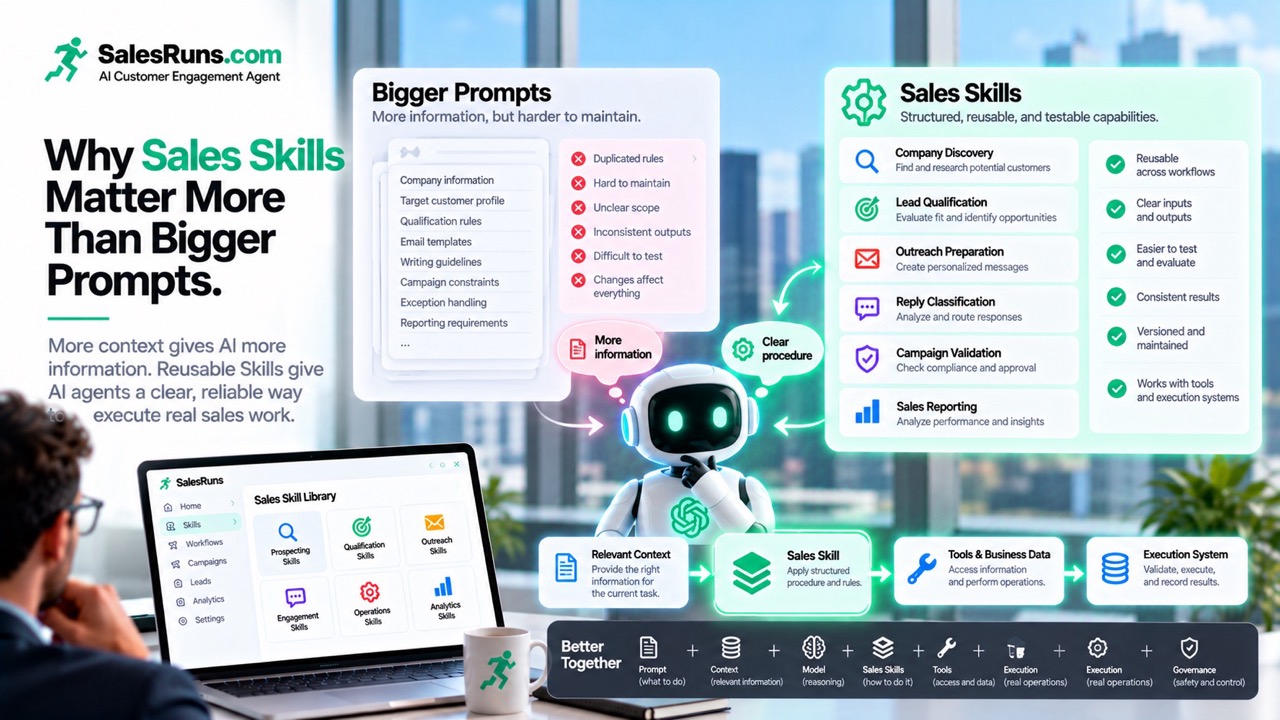
A company wants an AI agent to research prospects, qualify leads, prepare personalized outreach, validate campaigns, and report results.
The first implementation is a large prompt. It contains the company's product information, its target customer profile, sales qualification rules, outreach examples, writing guidelines, campaign constraints, exception-handling instructions, and reporting requirements. In initial testing it works reasonably well.
Then the business grows. More markets, more customer segments, more product lines, more communication rules, more workflow exceptions. The instruction set becomes harder to maintain. Similar rules appear in multiple places. Different tasks require different subsets of the context. Testing whether a change broke something becomes a manual exercise in hope.
The engineering question is no longer how to fit more information into the context window. It becomes: how should business knowledge be organized so that an AI agent can use the right procedure, with the right information, at the right stage of a task?
1. More Context Is Not the Same as Better Operational Structure
A larger context window lets a model process more material in a single interaction. That is genuinely useful when the work involves long documents, extensive research, conversation histories, multiple reference sources, or complex specifications. Nobody serious argues otherwise. What capacity does not determine is organization. A bigger window does not tell the system which information is authoritative, which rules apply to the current task, which steps are mandatory, which operations are permitted, how conflicting instructions should be resolved, what constitutes successful execution, how the process should be tested, or how changes should be maintained.
A sales example makes the gap concrete. An agent receives 50 pages of sales documentation: qualification criteria, email examples, exception rules, and campaign instructions from three different eras. The agent now has access to all of it. It still needs a clear way to determine which procedure applies today, which constraints are mandatory, and what to do when two documents disagree. The key distinction, and the thesis of this article: context provides information. Structure helps organize how that information is applied. This is an architectural principle, not a claim that larger context windows are ineffective. They are a different tool for a different job. There is also a practical failure mode nobody puts in the demo. When everything sits in one prompt, everything competes for attention. Rules that matter for the current task sit next to rules that do not, and the boundary between them is inferred rather than stated. Agents rarely announce which paragraph they weighted most heavily.
2. The Real Cost of Putting Everything Into One Prompt
Five practical problems emerge when a single prompt carries an entire business process. None of them are hypothetical; they show up in the first quarter of production.
- Instruction duplication. The same qualification or outreach rules get copied into multiple prompts. When a rule changes, every copy needs updating, and the copies drift apart.
- Unclear scope. One large prompt mixes prospecting, qualification, drafting, execution, and reporting. The system has difficulty separating the requirements relevant to each stage.
- Change risk. A modification intended to improve one workflow can silently affect another. Without boundaries and regression tests, the blast radius of a prompt edit is unknown.
- Reuse across agents. Different agents need the same procedure. Copying the instruction set into each agent creates maintenance overhead and the possibility of divergence.
- Evaluation complexity. When a workflow fails, was it task interpretation, missing context, contradictory rules, tool selection, or execution? A single prompt gives you nowhere to look.
Structured Skills make responsibilities more explicit and changes easier to isolate. They do not solve these problems automatically. A poorly designed Skill reproduces every one of them in a new location, which is why the design method matters as much as the format.
3. Skills Provide an Operational Abstraction
A well-designed Skill packages a coherent unit of operational knowledge: purpose, scope, required inputs, decision rules, task procedure, tool guidance, constraints, exception handling, expected outputs, and evaluation criteria. The value is not that the instructions live in a separate file. The value is that the task has a defined boundary and a reusable interface, the same properties that make a function more useful than a script. Framing this as AI Skills vs prompts is a category error. A prompt is a request; a Skill is a procedure with boundaries. The useful question is which component owns which responsibility, and the answer differs per task. A chain of sales capabilities illustrates the shape. A Lead Qualification Skill defines how to evaluate a candidate against a target customer profile. An Outreach Preparation Skill consumes the qualification result and its supporting evidence to prepare a message. A Campaign Validation Skill checks whether the proposed campaign meets applicable requirements before execution. Each capability has a recognizable responsibility, and a larger workflow combines them without any single component knowing everything. These are conceptual examples. A real implementation may draw the boundaries differently depending on its architecture, its risk profile, and how often each capability is reused.
4. A Skill Library Reduces Duplication Across Workflows
Reuse is where the economics of AI sales workflows show up. Suppose a company runs three workflows: outbound prospecting, partner recruitment, and re-engagement of previous leads. All three need to evaluate company fit.
| Approach | Structure | Maintenance consequence |
|---|---|---|
| Duplicated | Outbound prompt carries qualification rules A, partner prompt carries rules B, re-engagement prompt carries rules C | Three copies to update, three chances to diverge, no shared test suite |
| Reusable | Three workflows invoke a shared qualification capability with explicit parameters | One place for approved changes, consistent criteria, shared tests, easier reuse across agents |
The benefits of the shared approach: less duplicated instruction maintenance, more consistent evaluation criteria, a clear location for approved changes, the possibility of shared testing, and easier reuse across compatible agents. One important qualification. A shared Skill does not mean every workflow must use identical criteria. Common procedures can accept explicit parameters, or reference separately defined policies, where business requirements genuinely differ. The goal is one procedure with configurable inputs, not one rule imposed on every context. The library structure that makes this work is the subject of the Sales Skill Library article.
5. Skills Make Testing More Systematic
A large prompt with many unrelated responsibilities is difficult to evaluate, because a failure somewhere in the middle implicates the whole document. A structured Skill is a manageable unit for testing. For a Lead Qualification Skill, the case matrix might include:
- Clear match. The company satisfies the required criteria and sufficient evidence is available.
- Clear mismatch. The company fails a mandatory qualification requirement.
- Incomplete evidence. Important information is missing.
- Conflicting evidence. Two sources provide inconsistent information.
- Outdated information. The available company data may no longer be current.
- Tool failure. The required company data source is unavailable.
For each case, define the expected behavior, the required evidence, acceptable outputs, prohibited assumptions, and whether the agent should proceed, ask for clarification, or stop. Those tests are reusable whenever the Skill is invoked, by any workflow or compatible agent, which is what turns testing from a per-project cost into an asset. The limitation matters just as much. Testing a Skill in isolation does not prove the whole sales workflow works. Integration tests and end-to-end evaluation remain necessary, because composition bugs live in the seams between capabilities. No test results are claimed here; the point is the shape of the discipline, not a score. One organizational note: the tests belong to the team that owns the rule, not the team that built the workflow. When qualification criteria live with the sales operations group and the test suite lives with them too, a criteria change arrives with its own verification. When tests are scattered across agent repositories, every change is a negotiation.
6. Skills Help Make Changes More Controlled
Business rules change on a schedule no engineering team controls. Suppose a company changes its ideal customer profile. The change may affect prospecting, lead qualification, and outreach prioritization at once. A structured architecture makes the dependencies explicit, so the team can answer five questions before touching anything: which Skills use the criteria, which workflows depend on those Skills, which test cases need updating, whether the new criteria change expected outputs, and whether the change requires a new version.
Versioning and dependency tracking are engineering recommendations, not automatic properties of every Skill implementation. They have to be built, the same way CI has to be built for any codebase. The underlying principle: a structured capability is easier to govern when its purpose, dependencies, expected behavior, and tests are explicit. A concrete test: when the qualification threshold changes, the affected Skills list is the documentation. If that list has to be reconstructed by hand every time, the library is a folder of documents rather than a system.
7. Where Prompts and Context Still Matter
None of this makes prompts obsolete, and anyone arguing for the replacement of prompts by Skills has misread the problem. Prompt engineering still matters: a vague request produces vague work at any scale, and the prompt is where the request enters the system. The components are complementary, and a working system uses all of them.
- Prompts communicate the immediate request, task-specific context, and user preferences.
- Context windows supply relevant documents, conversation history, evidence, and information needed for the current task.
- Skills package reusable procedures, decision criteria, constraints, and task expectations.
- Models provide reasoning, language understanding, and generation, subject to their capabilities and configuration.
- Business systems provide authoritative data, permissions, persistent state, and actual execution.
A practical architecture combines them: the prompt specifies the market and product, the context contains the relevant company information, a Prospecting Skill defines the research procedure, a Lead Qualification Skill evaluates candidates, tools retrieve authorized data, and the execution system records results. The goal is not to minimize prompts or context at all costs. The goal is to place each responsibility in the component best suited to manage it.
8. Skills Do Not Eliminate Context Management
A Skill may itself require context: product information, target customer criteria, prior interactions, available evidence, tool descriptions, workflow state. Switching from one large prompt to a library of Skills does not make information requirements disappear; it makes them explicit and attributable. A library of hundreds of AI agent Skills also introduces its own discovery and selection problems, and they scale with the library. The system must determine which Skill is relevant, which version is appropriate, which inputs are required, whether dependencies are available, and whether the current agent has permission to use it. Progressive disclosure helps here: implementations such as the Agent Skills open standard load only a name and description at startup and pull in full instructions when a task matches, so a large library stays affordable in context terms. That is a real efficiency, and it is not a guarantee. Skills do not automatically reduce token usage, eliminate context-window constraints, or guarantee lower cost. Any efficiency improvement should be measured in the actual system, on representative workloads, before anyone puts it in a business case.
9. Skills Are Not a Substitute for Reliable Execution
A Skill can instruct an agent to validate a campaign before sending. The Skill alone cannot guarantee that the campaign is authorized, that recipients are eligible, or that duplicate messages will not be sent. The underlying execution infrastructure must independently enforce mandatory requirements, and the division of labor looks like this:
- Prompt: expresses the current request.
- Context: supplies relevant information.
- Skill: guides a reusable task procedure.
- Tool or protocol: exposes access to a capability.
- Business system: maintains authoritative data and logic.
- Execution service: performs and records operations.
- Policy layer: enforces permissions and constraints.
- Evaluation: measures whether the workflow works as intended.
An Outreach Skill can prepare an email and request approval. The sending service must still verify approval and applicable restrictions before transmitting the message. This distinction is what prevents a common misconception: a well-written Skill does not make an agent reliable. It makes the procedure legible. AI agent reliability comes from the layers beneath it, which is the argument of the full stack article.
10. What This Means for AI Sales Agent Architecture
The challenge in AI sales automation is not simply choosing the largest model or supplying the maximum amount of context. A dependable system combines capable reasoning, relevant context, reusable domain procedures, reliable data access, clear tool interfaces, durable execution state, enforceable permissions, and systematic evaluation. Model capability remains important, and this article is not an argument against it. Better reasoning improves many tasks, and the trend has been consistently useful. But a model upgrade alone does not solve duplicated business rules, workflow state management, authorization, or operational verification. Those are properties of the system around the model, and they improve when the system gives them a place to live. The broader architectural principle: model intelligence and operational structure are complementary, not competing, investments. Teams that treat them as substitutes end up with a very smart agent attached to a fragile process. In agentic AI systems more broadly, the same division appears wherever a model output has to survive contact with a real business process, which is most of the places that matter.
11. SalesRuns: Productizing Sales Knowledge Beyond Prompts
The positioning for a sales platform follows directly. SalesRuns could differentiate itself by packaging sales-specific operational knowledge together with the infrastructure required to execute sales workflows. Illustrative reusable AI sales Skills include prospect qualification, company research, outreach preparation, campaign validation, reply classification, and campaign reporting. These are conceptual or future capabilities unless verified in current product documentation; they describe a direction, not a release.
The potential advantage is the combination, not any single ingredient: reusable sales procedures, access to relevant business data, well-defined tools and interfaces, reliable workflow execution, permissions and validation, and measurable operational results. The value proposition is not that SalesRuns has a collection of prompts. It is that sales-specific knowledge can be organized into reusable capabilities connected to real business operations, so the next best action is carried out and recorded rather than merely suggested. The core positioning: the opportunity is to turn sales expertise from scattered instructions into reusable, testable capabilities that operate within a reliable sales execution system. Clearly a strategic direction, not a claim about what ships today through MCP or any particular AI client.
12. Conclusion
The goal is not to replace prompts with Skills or to stop improving models. It is to give each component a clear responsibility. Prompts communicate the immediate objective. Context provides relevant information. Models reason about the task. Skills organize reusable operational knowledge. Tools provide access to capabilities. Business systems execute and record operations. Evaluation reveals whether the complete workflow is working.
Once specialized Skills become reusable, the next question is how general-purpose AI applications can access them consistently. That brings the discussion back to the connection between AI agents, Skills, and the business systems that execute their work, which is where this series goes next.
Are AI Skills better than longer prompts?
They solve different problems. A prompt communicates the immediate request and task context for one interaction. A Skill packages a reusable procedure with defined inputs, decision rules, constraints, expected outputs, and evaluation criteria, so the same task can run consistently, be tested, and be maintained. Complex, frequently updated business processes usually need both, and neither is superior in every situation.
What is the difference between AI Skills and prompts?
A prompt is an instruction for a single request, such as qualify this company. A Skill is a reusable capability that defines how a category of work should be performed: its scope, required inputs, prerequisites, decision rules, procedure, constraints, exception handling, outputs, and evaluation criteria. A prompt can invoke a Skill, and the Skill guides the procedure the prompt does not carry.
Does a larger context window make Skills unnecessary?
No. A larger context window increases how much information a model can process in one interaction, which helps with long documents, research, and conversation history. It does not determine which information is authoritative, which rules apply to the current task, how conflicting instructions are resolved, what successful execution looks like, or how the process is tested and maintained. Context provides information; structure organizes how that information is applied.
How do Skills improve AI workflow testing?
A Skill is a bounded unit with explicit inputs and expected outputs, so it can be tested with a defined case matrix: clear match, clear mismatch, incomplete evidence, conflicting evidence, outdated information, and tool failure. Each case specifies expected behavior, prohibited assumptions, and whether the agent should proceed, ask, or stop. Those tests are reusable across every workflow that invokes the Skill, though integration and end-to-end tests remain necessary for composed workflows.
Can Skills reduce duplicated instructions?
Yes, when the same business rule appears in multiple workflows. A shared Skill with explicit parameters lets outbound prospecting, partner recruitment, and re-engagement reuse one qualification procedure instead of three drifting copies. The benefit is less duplicated maintenance, more consistent criteria, a clear location for approved changes, and shared tests. Shared does not mean identical: parameters and separate policies cover cases where requirements differ.
Do Skills reduce AI token usage?
Not automatically. Progressive disclosure can help, since implementations such as the Agent Skills open standard load only a skill name and description until a task matches, keeping a large library affordable in context terms. But a Skill may itself require context, and discovery and selection add their own overhead. Any efficiency improvement should be measured in the actual system rather than assumed.