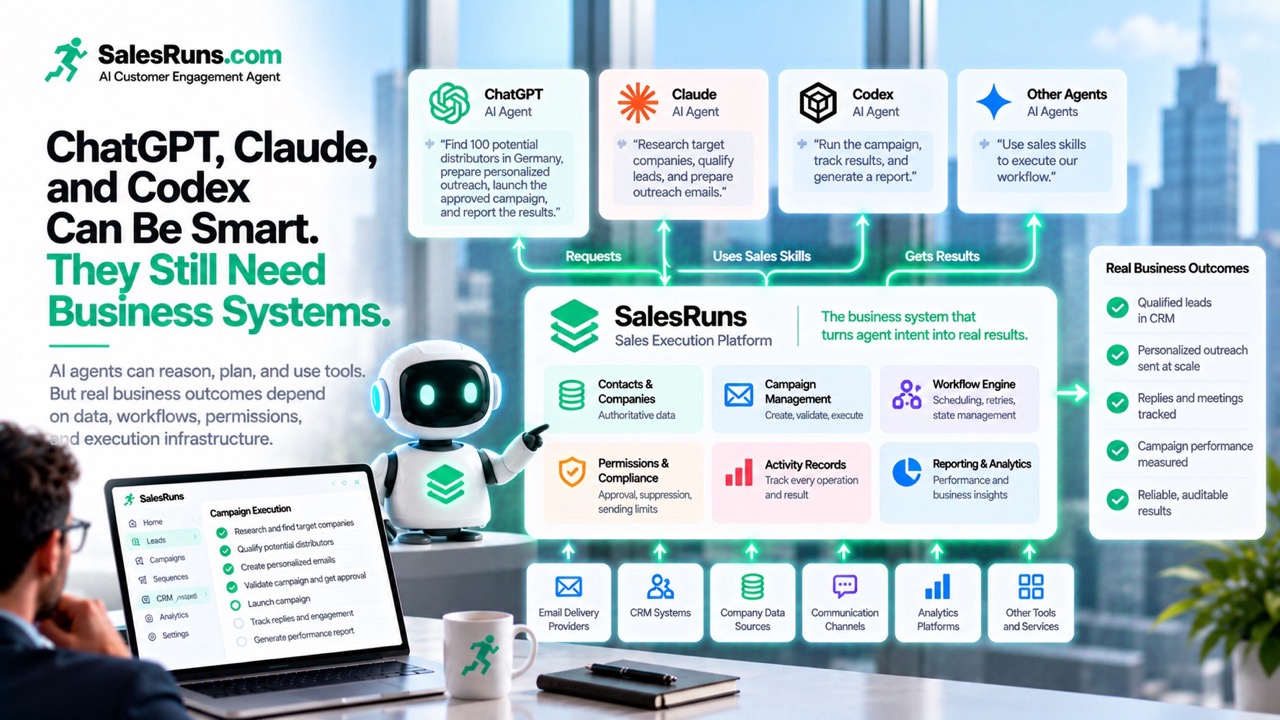
A founder asks a general-purpose AI agent: find 100 potential distributors for our product in Germany, prepare personalized outreach, launch the approved campaign, monitor replies, and report the results.
A capable agent can interpret the objective, plan the workflow, research companies, generate messages, and select appropriate tools. Real progress on this task is no longer surprising.
Then the operational questions arrive. Where does the authoritative contact data come from? How does the system prevent duplicate records? How does it know whether a prospect has already been contacted? Which email account should send each message? How are sending limits enforced? What happens when a provider temporarily rejects a message? Where is campaign state stored? How can the user pause or resume the workflow? How is approval recorded? How can the system prove that an operation succeeded? How are subsequent replies associated with the correct contact and campaign?
None of these are reasoning problems in the usual sense. They require business systems that own data, implement policies, maintain state, and perform operations. A smart agent can coordinate work, but coordination alone does not replace the infrastructure that performs and records that work.
1. General Intelligence Is Not Business Capability
It is worth being precise about what general-purpose AI systems contribute, because the list is impressive. Depending on the model, product, and configuration, an agent may be able to interpret natural-language objectives, research and summarize information, generate code and content, reason about alternatives, select among available tools, plan multi-step tasks, coordinate supported operations, and analyze results. What a model does not inherently possess is equally clear. It does not arrive with a company's complete and authoritative CRM, guaranteed access to current customer information, a persistent campaign database, a dependable email delivery pipeline, enforced workspace permissions, a durable job scheduler, operational audit records, or guaranteed execution and recovery. This is not a claim that models cannot perform these functions when connected to suitable systems. The precise point is narrower and more useful: these capabilities do not arise automatically from intelligence alone. They require integrations, supporting services, appropriate configuration, or dedicated infrastructure. The ability to reason about a business operation is different from having a reliable system that can carry it out.
The most sophisticated agent platforms say the same thing in their own documentation. OpenAI's Agents API, which exposes the Codex harness as a managed service, states that OpenAI manages sessions, orchestration, context compaction, and recovery while the application provides the tools and decides the execution environment. The harness is genuinely capable. The business responsibilities are still assigned to the application, by design.
2. Why Tool Calling Is Not Enough
Adding AI agent tools to a model is an important step, and the ecosystem has moved fast. An agent can call a contact search tool, an email API, a CRM endpoint, a campaign creation function, or an analytics query. But tools that operate independently are not yet a workflow. Something has to coordinate them, and coordination is where the operational requirements live: operation ordering, shared identifiers, data consistency, permission checks, durable state, retries, duplicate prevention, partial failure handling, error recovery, and execution status.
A concrete example. An agent requests that 100 emails be sent. The system sends 37 before a provider becomes unavailable. What happens next? A reliable implementation must know which messages were accepted for processing, which failed, which operations remain pending, which messages must not be sent again, whether the campaign should pause, and how the user can inspect and resume the job. A language model should not have to reconstruct that state from conversational memory, and a sufficiently sophisticated agent platform can implement some of these functions itself. The distinction here is architectural responsibility, not an absolute division between AI and software. Somebody still has to own the authoritative record, and in most business systems that somebody is the business system.
The Codex documentation makes the same point from the other direction. Its quickstart guide recommends creating your own Git checkpoints before and after a task, because the agent does not create them automatically. A world-class coding harness still delegates durable state guarantees to the system underneath it.
3. Business Data Is More Than Context in a Prompt
A sales agent may need information about contacts, companies, products, target customer profiles, previous interactions, campaign history, suppression lists, email account status, sales activities, and performance metrics. Some of this can be retrieved and passed to the model as context. The business still needs a reliable source of truth underneath it. Five categories keep the distinction honest:
| Category | What it is | Sales example |
|---|---|---|
| Authoritative records | Data maintained by the system responsible for the record | The contact record and its campaign history |
| Retrieved context | Information supplied to the agent for the current task | A company profile fetched during research |
| Model-generated interpretation | Assessments, classifications, and recommendations the model produces | "Likely a strong distributor prospect" |
| Proposed operations | Drafts or intended changes not yet executed | An unsent email draft |
| Verified events | Operations and outcomes confirmed by the underlying system | A delivery event recorded by the sending system |
An agent may generate the hypothesis that a company is a strong distributor prospect. That hypothesis is not a verified company fact. Generating a message is not the same as sending it, and requesting a campaign launch is not the same as confirming that the campaign is running. This is why provenance, timestamps, identifiers, and persistent records matter more, not less, when AI systems operate on business data. A model can lose the thread; a database should not. The memory layer that makes this durable in a sales context is the subject of the Customer Memory article.
4. Execution Infrastructure Is Where Intent Becomes Operations
This is the layer most demos skip. A real business execution system provides workflow orchestration, durable job queues, scheduling, email delivery integrations, campaign state management, retry policies, idempotency controls, authorization checks, event recording, monitoring, and recovery mechanisms. A sales campaign example. A user approves an outreach campaign. The execution system should:
- Verify that the campaign exists.
- Confirm the applicable approval state.
- Check permissions.
- Revalidate recipient eligibility and sending constraints.
- Start the campaign.
- Record an operation identifier.
- Persist campaign state.
- Handle temporary and permanent failures appropriately.
- Update the campaign status.
- Make the result available to the user and authorized agents.
The AI agent can request, coordinate, inspect, and interpret these operations. The underlying system remains responsible for the operational guarantees it actually supports. One honesty note on those guarantees: idempotency and duplicate prevention reduce the risk of repeated side effects, but exactly-once execution is a property of a specific implementation, not a slogan. Any platform claiming it should be asked to show the design.
5. Business Rules Cannot Exist Only in AI Instructions
A Skill or prompt might instruct an agent to respect unsubscribe status, exclude suppressed contacts, obey sending limits, obtain approval before launch, avoid duplicate messages, use the correct account, and record every campaign operation. These instructions are useful. They should not be the only enforcement mechanism for critical requirements. If a campaign contains an ineligible recipient, the sending system should be able to reject that operation even if the model mistakenly attempts to proceed. The relevant controls include authorization, least-privilege access, tenant isolation, suppression and unsubscribe checks, approval requirements, rate limiting, audit records, and validation at execution time. The principle: AI instructions guide behavior. Enforceable business policies constrain what the system can actually do. And a caveat worth stating plainly: no generic list of controls automatically guarantees legal compliance. Requirements vary by jurisdiction, channel, message type, and business context.
6. Why Specialized Systems Still Matter in an Agentic World
The simplistic prediction says stronger AI agents will eliminate the need for specialized AI business software. The more defensible possibility runs the other way. As general-purpose models become more capable, users may increasingly interact with software through conversational agents or task-oriented interfaces. Those agents still need specialized systems to provide authoritative data, business-specific logic, domain workflows, reliable execution, permissions, persistent state, monitoring, and measurable outcomes. The user interface may evolve. The underlying operational responsibilities do not disappear. A specialized software company may therefore have several potential roles: provide a complete application for human users, expose selected capabilities through APIs or compatible agent interfaces, provide domain-specific execution infrastructure for other applications, or package reusable business workflows and Skills. A business may pursue one or several of these. None of them requires abandoning conventional interfaces, and conventional interfaces are not going away on any timeline anyone can document. The key argument: an agentic AI ecosystem may increase the importance of reliable domain execution, even as the interface through which users access that execution changes.
7. Models, Skills, Tools, and Business Systems
The previous articles in this series assembled the pieces. Here they are in one framework. Models provide reasoning, interpretation, and generation. Skills provide reusable task-oriented procedures and domain knowledge. Tools and connection interfaces provide structured access to available capabilities, with MCP as one approach for compatible AI applications to interact with external systems. Business data provides authorized, relevant records and context. Execution systems perform operations, maintain state, and record outcomes. Governance defines permissions and enforces operational constraints. Evaluation measures whether the complete workflow is reliable and useful.
Real implementations may combine layers or use alternative AI agent architectures, and MCP is a strong default for connectivity rather than a requirement. The full stack article develops each layer, and the Skill Library article covers how the procedural layer organizes. What matters here is the shape: no layer is optional, and no layer can be absorbed into another by making the model bigger.
8. Generic Agent vs. Specialized Sales System
A balanced comparison, since neither approach wins everywhere.
| Dimension | Scenario A: agent with general tools | Scenario B: agent with a specialized sales system |
|---|---|---|
| Available operations | Contact search, email API, CRM endpoint, analytics query | Higher-level sales operations: prepare, validate, request approval, start, inspect status, retrieve results |
| Data consistency | The agent coordinates across independent services | The system owns records and identifiers |
| Campaign state | Reconstructed or held in conversational context | Persisted by the system of record |
| Failure handling | Depends on the agent and available services | Retry policy, idempotency, and recovery are system responsibilities |
| Enforcement | Instructions the agent is trusted to follow | The system can reject an ineligible operation |
| Coordination cost | The agent assembles low-level calls into a workflow | The agent requests capabilities the system already supports |
A specialized system can reduce the amount of low-level coordination the agent must perform, provided the system offers well-designed and reliable interfaces. It does not come free: the specialized system still requires integration, maintenance, and appropriate authorization, and performance depends on the implementation, the data quality, the task, and the evaluation criteria. No platform guarantees better results in every scenario, and claims to the contrary should be treated as marketing.
9. SalesRuns as a Potential Sales Execution Layer
The strategic opportunity for SalesRuns is to combine sales-specific workflows with the infrastructure required to carry them out. Illustrative capability areas include contact and company operations, prospecting and qualification workflows, campaign preparation and validation, email execution, follow-up scheduling, campaign state management, activity records, and operational reporting. These are areas for architectural discussion; each should be verified against current product documentation before being described as shipped.
Two complementary product experiences follow from that architecture. For human users, a sales automation platform provides a direct interface for managing contacts, campaigns, workflows, and results. For compatible AI agents, an agent interface, where implemented, would let authorized agents access selected sales capabilities programmatically. The underlying business system remains responsible for its data, execution logic, state, and mandatory controls in both cases. To be precise about the current state: SalesRuns today ships an AI agent orchestrator, a workflow engine, a Customer Memory and knowledge layer, multi-channel output, and CRM connectivity. Direct integration with specific products such as ChatGPT, Claude, or Codex, or with every MCP-compatible client, is not claimed here; those are opportunities this architecture argues for, not documented integrations. The MCP tool surface article covers what such an interface would need to expose.
The positioning: SalesRuns can aim to make AI sales execution available wherever users and compatible AI agents need it, without requiring every agent to rebuild the underlying sales system. The differentiation is not connecting a chatbot to an email tool. It is making specialized sales operations reusable while preserving the infrastructure required for reliable execution, so that the next best action becomes a verified outcome rather than a suggestion.
10. The Economics of Specialized Execution
Building AI business automation often requires more than choosing a model and writing prompts. The overall system may need investment in data integration, workflow design, AI agent infrastructure, security and permissions, monitoring, failure recovery, domain-specific evaluation, and ongoing maintenance. Specialized systems can distribute the cost of building and maintaining these capabilities across many AI agent workflows and users, the same way shared infrastructure always has. Multiple agents may reuse the same campaign validation, sending, and reporting infrastructure rather than implementing those functions independently. The potential advantages: less duplicated engineering, shared operational maintenance, reusable business capabilities, more consistent controls, and easier integration across workflows. The trade-offs deserve equal airtime: dependence on the service provider, integration and migration costs, compatibility requirements, platform-specific constraints, and additional operational dependencies. No cost savings are claimed here, because the economic result depends on usage, complexity, scale, and implementation. A team running two simple workflows should build; a team running two hundred should almost certainly not.
11. How to Evaluate a Business Execution Platform
For teams choosing between building and relying on a specialized system, nine criteria, in roughly the order they get skipped:
- Capability coverage. Can the system support the business operations the agent needs?
- Data integrity. Does it maintain reliable records and clear ownership of data?
- Execution reliability. Can it handle failures, retries, and long-running tasks?
- Authorization. Are permissions and mandatory policies enforced by the system?
- Observability. Can users determine what happened, when, and why?
- Interface quality. Are available operations documented, structured, and usable by compatible clients?
- Interoperability. Can the system work with the intended models, agents, and external services?
- Operational economics. Are latency, cost, support requirements, and maintenance acceptable?
- Portability. Can the business retain appropriate access to its data and migrate workflows if necessary?
Evaluate end-to-end business tasks rather than judging a platform by the number of available tools or integrations. The interesting failures live in the seams between layers, which is also the argument of the Skills versus prompts article: structure is what makes a capability testable, and testability is what makes it dependable.
12. Conclusion
The evolution of AI does not eliminate the need for business systems. It changes how people and agents interact with them. General-purpose models provide increasingly capable reasoning and generation. Skills help organize domain-specific procedures. Tools and protocols connect agents to external capabilities. Specialized business systems provide authoritative data, execute operations, maintain state, enforce constraints, and record results.
If specialized business systems provide the execution layer, the next question is how those capabilities become part of a broader agent ecosystem. That leads to the idea of SalesRuns as the sales layer for the agentic internet, which is where this series goes next.
Why do AI agents need business systems?
Because reasoning is not execution. A general-purpose agent can interpret an objective, plan work, and call tools, but reliable business outcomes require authoritative data, enforced permissions, durable workflow state, retries, duplicate prevention, audit records, and verified execution. Those capabilities come from business systems that own records and perform operations, not from model intelligence alone.
Can a general-purpose AI agent replace specialized SaaS?
It can change how users interact with specialized software, and it may absorb some simple coordination work. It does not remove the operational responsibilities that specialized systems provide: authoritative data, business logic, permissions, persistent state, reliable execution, and monitoring. The more defensible expectation is that agent-oriented ecosystems increase the value of reliable domain execution rather than eliminate it.
What is the difference between AI reasoning and business execution?
Reasoning decides what should happen: interpret the objective, evaluate options, choose a plan. Execution makes it happen and proves it happened: authorize the operation, perform it, maintain state, handle failures, and record the outcome. A model can reason about sending 100 emails; only a business system can reliably send them and tell you which 37 went out before the provider failed.
Why does an AI sales agent need persistent data?
Sales work spans long periods and many interactions. The agent needs to know which contacts exist, who was already contacted, what was sent, which replies arrived, and which recipients are suppressed. Conversational memory is not a system of record. Persistent business data with clear ownership, identifiers, and timestamps is what allows work to be resumed, audited, and proven.
What role does execution infrastructure play in AI automation?
Execution infrastructure turns intent into verified operations. It provides workflow orchestration, durable queues, scheduling, delivery integrations, state management, retry policies, idempotency controls, authorization checks, event recording, and recovery. Without it, a multi-step business workflow cannot survive a partial failure, and nobody can say with confidence what actually happened.
How do Skills and business systems work together?
A Skill defines the procedure: objective, inputs, decision rules, constraints, expected outputs, and evaluation criteria. The business system performs and records the operations the procedure calls for, and enforces mandatory policies independently. A Skill can instruct an agent to check suppression; the sending system should still reject an ineligible recipient if the instruction is missed.