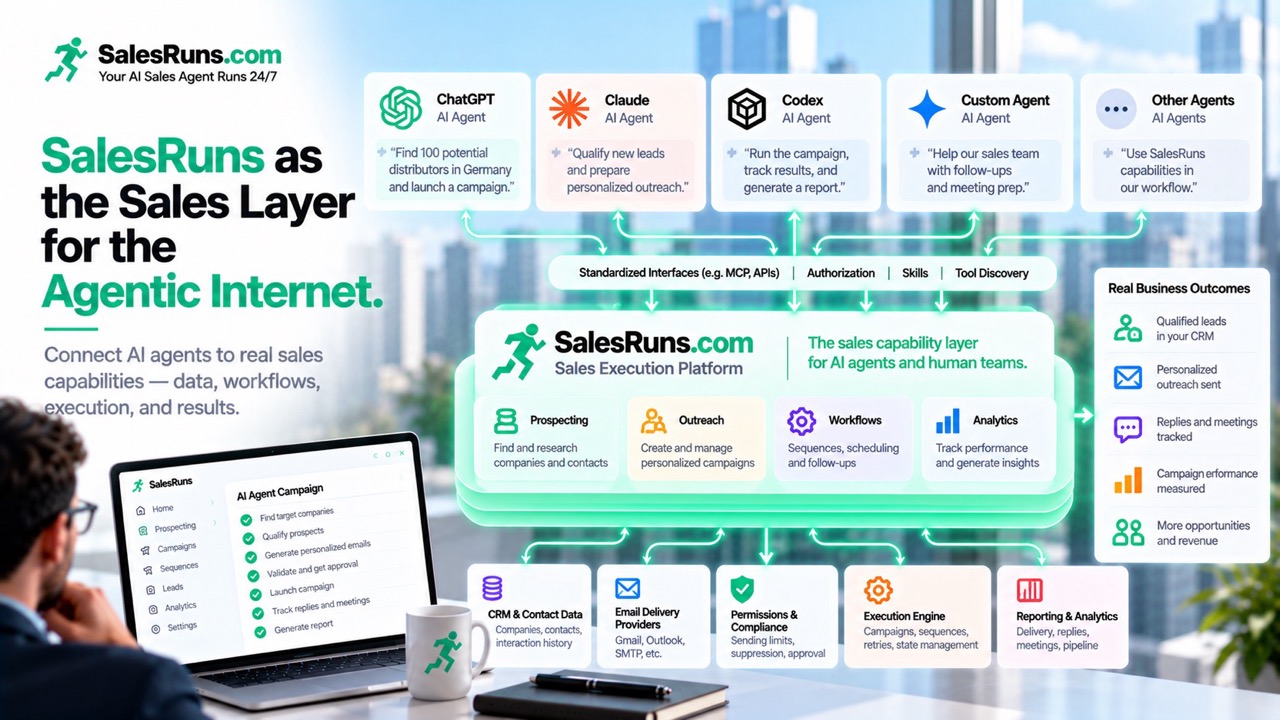
A founder asks an AI agent to identify promising prospects, prepare relevant outreach, schedule follow-ups, and summarize the resulting pipeline. The agent can reason about the task. What it needs next is access to specialized sales capabilities: the right contact records, the campaign rules, the sending permissions, the follow-up state, the activity history.
That need raises a question that cuts to the future of business software: if users increasingly delegate work to AI agents, where will the actual business execution happen?
The answer matters beyond philosophy. It shapes how products are built, how capabilities are distributed, and which companies end up owning the operational layer that agents rely on. This series has assembled the technical pieces. This article makes the strategic argument: specialized business capabilities are likely to be delivered through reusable, interoperable service layers, and sales is a strong candidate for what could become the sales layer for AI agents.
1. From an Internet of Pages to an Ecosystem of Capabilities
For most of the commercial web, people have been the operators. We browse pages, fill forms, click buttons, and read dashboards. A useful conceptual model describes three broad stages of how software gets used:
- Web-first. People navigate pages and operate interfaces. The human is the integration layer.
- API-connected. Applications exchange data and invoke services programmatically. Integration becomes an engineering discipline.
- Agent-accessible. AI agents use tools and structured interfaces to complete multi-step tasks on a user's behalf. Capability discovery becomes part of the product surface.
The first article in this series traced the shift from answers to action that made the third stage plausible. Treat this as a useful model rather than a universal or inevitable sequence; the stages overlap and coexist today. What changes when the agent becomes a primary interaction point? Users may express goals rather than navigate every application. Agents may coordinate multiple specialized services. Agent-first business software may compete on capability accessibility as well as interface quality. And execution systems become important infrastructure behind agent experiences. None of this retires the conventional interface. Websites, applications, and human operators remain valuable, and the argument of this article depends on that coexistence rather than on replacement.
2. Why General-Purpose Agents Need Specialized Sales Capabilities
Take a practical example. An agent is asked to follow up with prospects from a trade show. The work looks like this:
- Understand the user's objective.
- Retrieve the correct prospect records.
- Assess which information is relevant.
- Draft appropriately personalized messages.
- Check campaign rules and sending limits.
- Request authorization when necessary.
- Send or queue approved messages through an authorized system.
- Record execution status and outcomes.
- Determine the appropriate next step.
A language model can contribute to every one of those steps. It cannot guarantee any of them. The operational pieces — business data, domain procedures, tool interfaces, workflow execution, authorization, and audit records — belong to systems, and the previous article in this series covered the complete stack and why agents still need business systems in technical detail. The strategic implication is what matters here. Specialized capabilities must be made accessible to agents through dependable interfaces, and the quality of that accessibility becomes a product decision rather than an afterthought.
3. What Is the Agentic Internet?
The Agentic Internet is an emerging conceptual description, not a standardized network. It refers to a digital environment in which AI agents increasingly discover and use software capabilities on behalf of users. No single protocol defines it, and no governing body has ratified it. The vision involves agent-to-tool interaction, machine-readable capability descriptions, structured requests and responses, identity and authorization, cross-service workflow coordination, and reliable execution with status reporting. Several existing technical approaches contribute pieces:
- APIs provide programmatic access to services, the long-standing foundation.
- MCP provides one approach for compatible AI applications to interact with capabilities exposed by external servers, with the 2026-07-28 specification adding a stateless protocol core, header-based routing, and authorization hardening.
- Skills package domain procedures as reusable instructions, an approach standardized in the open Agent Skills format.
- Authentication, permissions, and governance determine what an agent may actually do.
- Workflow systems maintain execution state across steps, retries, and failures.
These approaches solve different problems and are complementary rather than interchangeable. An API exposes an operation; MCP can standardize how an agent reaches it; a Skill describes how the task should be performed; the workflow system carries the state; the policy layer decides what is permitted. Treating any one of them as the whole architecture is how thin wrappers get built. The case for MCP for sales is argued in the connection layer article.
4. Why Sales Needs Its Own Capability Layer
Sales is not a collection of messages. It is an ongoing operational process involving people, companies, timing, communication history, campaign state, follow-up rules, and measurable outcomes. Generic tools alone struggle with that continuity, because the hard parts are relational and temporal rather than linguistic. A dedicated sales capability layer could provide consistent operations across different agent clients:
- Contact and company lookup
- Prospect qualification support
- Outreach preparation
- Follow-up scheduling
- Campaign and sequence management
- Communication activity recording
- Reply and meeting status updates
- Execution monitoring and reporting
That is a conceptual capability map, not an inventory of current SalesRuns features. The operations such a layer would expose are the subject of the sales MCP tool surface article. The strategic logic is straightforward: sales-specific business logic belongs in a dedicated system rather than being duplicated inside every individual agent. When the logic lives in one place, it can be tested once, governed once, and improved once, and every agent experience inherits the improvement.
5. Where SalesRuns Fits: The Sales Layer for AI Agents
SalesRuns.com positions itself as your AI sales agent running 24/7: a platform for building autonomous sales employees that find leads, understand products, contact customers, follow up, and close deals across channels including WhatsApp, Telegram, LINE, Slack, Discord, WeChat, and email. Today it ships an AI agent orchestrator, a workflow engine, a Customer Memory and knowledge layer, and CRM connectivity. The strategic ambition extends that foundation toward AI-powered sales automation: specialized sales execution capabilities that support both human-led workflows and agent-assisted workflows. The conceptual relationship:
The potential benefits, stated as architecture properties rather than promises: multiple agent experiences could use the same underlying sales capabilities; sales rules could be maintained centrally rather than reimplemented in every agent; execution history could live in one operational system of record; users could choose different AI interfaces without rebuilding their sales processes; and distribution could extend beyond users visiting the application directly. Actual availability depends on implemented interfaces, permissions, integrations, and product readiness. SalesRuns does not claim compatibility with every AI agent or client today.
6. The Distribution Opportunity and Its Risks
In the traditional model, users discover a product, sign up, log in, and perform work inside its interface. In an agent-accessible model, some users encounter a product's capabilities through the AI agent business tools they already use. The channels can complement each other:
| Interaction model | How the user reaches the capability | What stays constant |
|---|---|---|
| Traditional | User operates the application UI directly | Business rules, permissions, and records live in the system |
| Agent-accessible | User delegates to an AI agent, which calls authorized capability interfaces | Same business rules, permissions, and records, same execution guarantees |
| Hybrid | User reviews and approves agent-proposed work inside the application | The system remains the source of truth for what happened |
Potential distribution paths include direct application usage, agent-accessible APIs, MCP-based integrations where implemented, reusable Skills and workflow templates, partnerships with AI agent ecosystem platforms, and developer-oriented integration surfaces. The opportunity for a sales execution platform is real: its capabilities could be used in more contexts than the standalone interface alone reaches. The risks deserve equal weight. Dependence on third-party agent platforms. Platform policy and interface changes that arrive without notice. Discovery and distribution controlled by intermediaries. Commoditization of basic tool access. Difficulty attributing revenue to agent-originated usage. Security, consent, and compliance obligations that grow with every new access path. None of this is an assured growth channel, and treating it as one is how teams build for an audience that has not arrived.
7. The Technical Requirements of a Real Sales Capability Layer
Beneath the positioning sit nine requirements for AI agent infrastructure. They are what distinguishes a dependable business capability layer from a thin wrapper around a model:
- 1. Clear capability contracts. Each operation has a defined purpose, input schema, output schema, error behavior, and documented limitations.
- 2. Identity and authorization. An agent acts only within the authority granted by the relevant user or organization.
- 3. Permission-aware data access. Contact and company information is scoped to the appropriate account, workspace, and role.
- 4. Explicit action boundaries. Read, preparation, and consequential execution operations are separated, with confirmation or approval for material external effects.
- 5. Durable workflow state. Long-running workflows carry persistent status, retry behavior, idempotency where appropriate, and recovery from partial failure.
- 6. Policy enforcement. Sending limits, suppression rules, and consent requirements are enforced by the execution system, not merely mentioned in a prompt.
- 7. Observability. Users and operators can see what was requested, what was executed, what failed, and what remains pending.
- 8. Interoperability. Interfaces are documented and testable; supporting one protocol does not guarantee compatibility with every agent host.
- 9. Human oversight. Clear review and escalation paths exist for ambiguous, sensitive, or high-impact actions.
The pattern across all nine: the capability layer owns guarantees, and the agent consumes them. That is also why exposing an API or an MCP server does not automatically make a system secure, interoperable, or production-ready. The interface is the surface; the guarantees are the product.
8. What SalesRuns Should Build First
A staged roadmap, offered as a strategic recommendation rather than a statement of current product plans:
- Stage 1: Establish the capability model. Define core sales objects and workflow states, document existing capabilities and limitations, and identify which operations can be safely exposed externally.
- Stage 2: Build a reliable interface. Define structured operations and schemas, establish authentication and workspace-level authorization, and create predictable error handling and execution records.
- Stage 3: Enable agent-oriented access. Evaluate API and MCP access patterns based on target clients and real user demand, provide documentation and example workflows, and separate capability discovery from execution authorization.
- Stage 4: Create reusable sales Skills. Package common procedures into versioned, testable Skills that refer only to operations that actually exist, with evaluated workflow quality and failure handling.
- Stage 5: Measure adoption and reliability. Track successful executions, task completion, failure rates, approval rates, and recurring usage, and measure whether agent-accessible workflows create incremental value rather than shifting existing channels.
The ordering matters. Capability definition precedes interface work, and interface work precedes distribution, because an unreliable capability exposed widely is worse than a reliable one exposed narrowly. Every stage should be validated against actual users, implementation costs, and platform constraints rather than against the roadmap itself.
9. What Success Would Look Like
A sales capability layer should be measured on outcomes rather than traffic. Candidate metrics:
- Number of supported, documented operations
- Successful execution rate by operation
- End-to-end workflow completion rate
- Rate of failures requiring manual intervention
- Time from request to verified outcome
- Percentage of actions with complete audit records
- Agent-originated active usage
- Repeat usage of sales workflows
- Conversion from trial usage to paid usage
- Incremental customer value attributable to agent-assisted execution
Each metric needs a precise definition and a baseline before it means anything. Raw tool-call volume is the trap to avoid: a system can generate many calls while failing to deliver meaningful business outcomes. No numerical targets are claimed here, because inventing them would be the opposite of measurement.
10. The Risks of Building for Agents
The failure modes are predictable enough to list. Building AI agent integrations before validating demand. Overestimating the pace of agent adoption. Treating protocol support as a complete product strategy. Giving agents excessive permissions. Exposing unstable or poorly documented operations. Allowing duplicate or unintended external actions. Neglecting human users and conventional application workflows. Depending too heavily on one agent platform. The balanced principle: build agent-accessible capabilities where they create measurable utility, while retaining strong human-facing workflows. A capability layer that serves only agents has bet on one future; one that serves both has bet on a transition.
11. The Strategic Endgame
Three models are worth distinguishing. An application that users must operate directly. A set of disconnected automation scripts. A specialized sales execution infrastructure with defined interfaces, permissions, workflow state, and measurable outcomes. The third model is the strategic ambition, and it is a thesis worth testing through product development and customer adoption rather than a conclusion the market has already reached. SalesRuns' long-term opportunity is not simply to appear inside more AI applications. It is to make useful, reliable sales operations accessible across the environments in which users and agents work, so that the next best action can be executed wherever the request originates.
Conclusion
AI agents may become an increasingly important way people access software, but agents still need dependable business capabilities to turn intentions into outcomes. The sales layer for AI agents is the part of that future that owns the operational reality: the records, the permissions, the campaign state, the verified results.
Sources
- Model Context Protocol specification, 2026-07-28. Linux Foundation / Model Context Protocol. https://modelcontextprotocol.io/
- "The 2026-07-28 Model Context Protocol specification is out." MCP Blog, July 28, 2026. https://blog.modelcontextprotocol.io/posts/2026-07-28/
- Agent Skills specification. agentskills.io. https://agentskills.io/
- "Agents API overview." OpenAI Developers documentation. https://developers.openai.com/api/docs/guides/agents-api/overview
What is the Agentic Internet?
The Agentic Internet is an emerging conceptual description of a digital environment in which AI agents increasingly discover and use software capabilities on behalf of users. It involves agent-to-tool interaction, machine-readable capability descriptions, structured requests and responses, identity and authorization, and cross-service workflow coordination. It is not a single standardized protocol or a fully realized network, and no standards body has ratified it as a formal category.
What is a sales layer for AI agents?
A sales layer for AI agents is a specialized service layer that exposes sales operations, including contact and company records, outreach preparation, follow-up scheduling, campaign state, and activity history, as structured, permission-aware capabilities that AI agents can discover, authorize, and execute on behalf of a business. It separates the intelligence that decides what should happen from the system that performs and records the work.
How does MCP relate to AI sales agents?
MCP, the Model Context Protocol, is one approach for compatible AI applications to interact with capabilities exposed by external servers. For sales agents it can standardize how an agent reaches contact lookup, campaign operations, or activity records. It does not provide the business logic, the data, or the execution guarantees, and it is not mandatory: conventional APIs and native integrations remain valid parts of the same architecture.
Why do AI agents need specialized sales systems?
Because sales work is operational and relational, not just linguistic. Following up with a prospect requires the correct records, prior interaction history, campaign rules, sending limits, authorization state, and durable follow-up scheduling. A language model can reason about each step but cannot guarantee the records are current, the rules are enforced, or the message was actually sent. Those guarantees come from a specialized system.
Can multiple AI agents use the same sales infrastructure?
That is one of the core design goals of a capability layer. When sales operations are exposed as documented, permission-aware capabilities, multiple agent clients can invoke the same underlying system while the business rules, execution state, and audit records remain in one place. The practical requirements are clear capability contracts, workspace-scoped authorization, and consistent error behavior, because a shared layer is only as reliable as its weakest interface.
What security controls should an AI sales agent have?
At minimum: identity and authorization scoped to the user or organization, permission-aware data access by workspace and role, explicit separation of read, preparation, and consequential execution operations, approval requirements for actions with material external effects, suppression and consent enforcement at execution time, rate limits, durable audit records, and human review paths for sensitive actions. Enforcement belongs in the system that performs the operation, not in instructions the agent is trusted to remember.
Is SalesRuns currently compatible with every AI agent?
No. SalesRuns today ships an AI agent orchestrator, a workflow engine, a Customer Memory and knowledge layer, multi-channel output, and CRM connectivity. Universal compatibility with every AI agent or client, including ChatGPT, Claude, or Codex, is not claimed. Agent-accessible interfaces are a proposed direction of this architecture, and their availability depends on implemented interfaces, permissions, and product readiness.