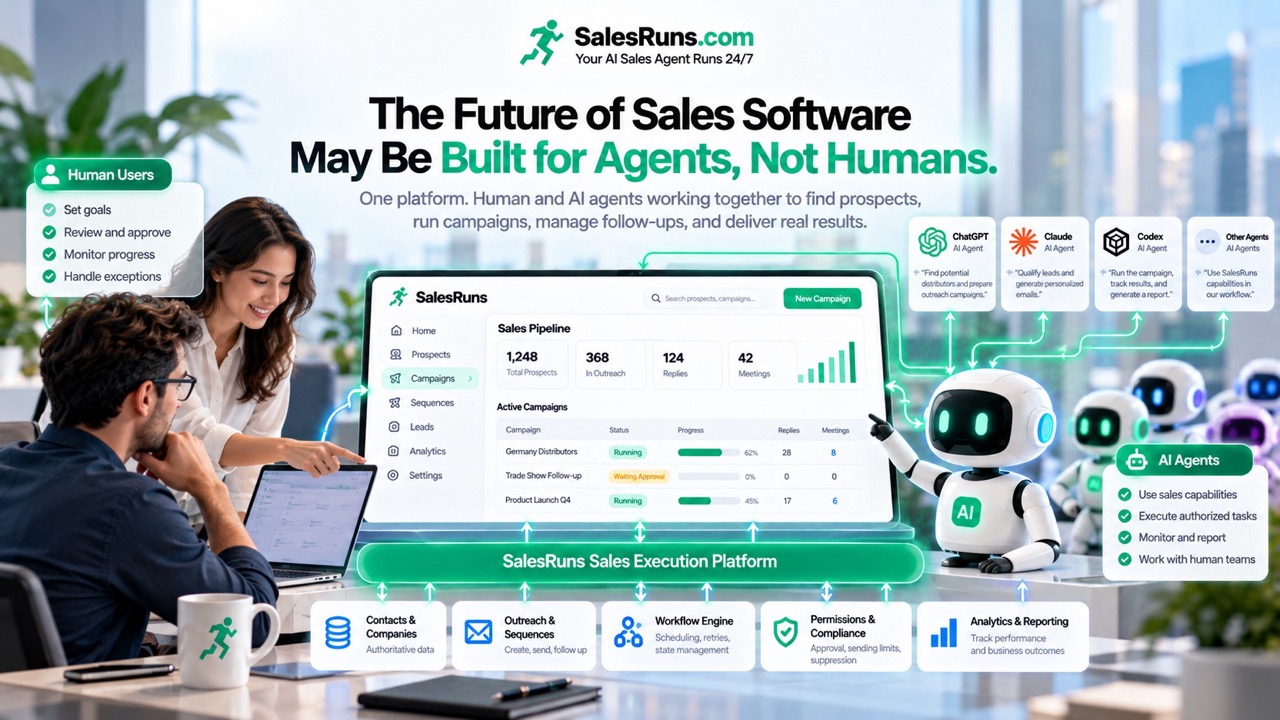
For most of software history, the assumption underneath every product was the same. A person sat at the interface. They read, they typed, they clicked, and the system responded. Sales software followed that rule without question: a rep logged in, opened a lead, wrote an email, marked a task complete.
That assumption is quietly breaking. An AI agent can now be given a goal, like find the warm leads from last week's trade show, draft the follow-ups, and queue them for approval, and it will work through the steps. The model reasons well. What it lacks is not intelligence. It lacks the operational surface: the records, the rules, the permissions, the execution path.
Closing that gap is the design problem at the heart of agent-first sales software. This series has built the technical pieces one by one. This article steps back and asks what the product itself should look like when one of its primary users is a program.
1. The Software User Is Changing
When you design for a human, you can lean on common sense. The user knows not to email the same person twice. They notice a bounced address and stop. They sense when a tone is wrong. The interface does not have to spell any of that out, because the operator carries it. An agent carries none of it by default. So the product has to. Suppression lists, send limits, consent checks, duplicate detection, escalation paths, these stop being nice-to-have UI warnings and start being things the system refuses to proceed without. The burden of correctness moves from the user's intuition to the product's guarantees. This is the same shift the move from answers to action described at the start of the series. The model can plan the work. The open question is whether the software around it can actually perform it.
2. What Agent-First Means (and What It Doesn't)
Agent-first does not mean no human. It means the product assumes one of its primary users might be a program, which is the central move in agent-first software design. The interface is specified, not merely drawn. The capabilities are enumerated, not implied. The boundaries are enforced, not suggested. Designing products for agents starts with a specific question during design: if an agent needed to do this task, what would it have to be given? The answer usually exposes gaps a human had been papering over with judgment. A few things agent-first is not:
- Not remove the UI. People still need to see, approve, and trust what happened. A screen remains one way to reach the system.
- Not let the model decide everything. The model proposes; the system enforces. The boundary between them is the product.
- Not ship an API and call it done. An interface is one layer. The guarantees behind it are the part that matters, which is why agents still need business systems built for the work.
Said plainly: software built for AI agents is software that takes the agent seriously as a user, and therefore takes correctness, permission, and audit seriously as features.
3. The Primary User Is No Longer Only Human
The practical effect shows up the moment you write a capability down. Prepare a follow-up for contact X. The human version of this task hides a dozen assumptions: X is the right person, the last message was received, no one already emailed them today, the content fits the relationship. An agent will not make those assumptions correctly unless the system tells it to. So the logic that a good rep runs in their head becomes explicit in the product. Duplicate detection, consent state, cadence rules, and relationship history turn into operations the system owns. This is exactly the discipline behind adaptive follow-up and the path from customer memory to the next best action. The rep's intuition does not disappear; it gets encoded where every user, human or agent, benefits from it.
4. Interfaces for Agents, Not Just Screens
A screen is a poor interface for an agent. It is optimized for eyes and hands. An agent wants structure: a named operation, a defined input, a predictable output, and a clear error when something is wrong. That implies a second surface beside the UI. The agent-first UI is the contract, not the canvas. Operations are exposed as capabilities with contracts. An agent calls "prepare follow-up for contact X," not "open the lead page and find the button." The human-facing screen stays; it becomes one of several ways to reach the same underlying operation. The 2026-07-28 Model Context Protocol is one concrete example of how compatible AI applications can reach external capabilities through a standardized protocol, with a stateless core and authorization hardening. It is not the only approach, and it does not replace the business logic underneath, a point covered in the connection layer and the MCP tool surface articles.
5. Data Contracts Are the New UI
If the interface is an operation, the contract is the specification. What does the agent send? What comes back? What happens when something is missing? A capability contract has five parts: a purpose, an input schema, an output schema, explicit error behavior, and documented limits on rate, scope, and side effects. These belong to the sales software architecture as first-class objects, not as comments in a codebase. Without contracts, agents guess. And guessing in sales means wrong contacts, duplicated messages, or broken consent. The contract is what makes an agent safe to delegate to. It is also what makes the work testable: you can verify that an operation behaves before you ever let an agent call it.
6. Authorization and Boundaries Belong in the Product
Who is allowed to do what, and who approved it? In human-first software this is often a setting buried in admin. In agent-first software it is load-bearing, because the agent acts with delegated authority that must be scoped to a workspace, a role, and a set of operations. Read, prepare, and execute are different operations with different risk. Drafting a message has no real-world effect. Sending one does. So consequential actions need explicit approval, ideally from a human for anything material. Enforcement lives in the execution system, not in a prompt that asks the model to please be careful. A prompt is advice. A boundary is a wall. This is the same separation the agents-need-systems argument makes at the architectural level, and it is what turns agent-accessible business software from a demo into something a company can run.
7. Human-in-the-Loop Is a Design Requirement
The phrase gets used loosely. Here it means something specific: at defined points, a human reviews or approves before the agent proceeds. It is not a fallback for when the AI is confused. It is a planned control point in the workflow, and it is the core of human-in-the-loop sales. Where do those points go? High-impact actions, such as sending to a new segment. Ambiguous ones, such as uncertain intent. Sensitive ones, such as a named executive. Anything with legal or consent weight. Everything else can run, with the human able to audit after the fact. In agent-in-the-loop terms, the human is not in every step; they are in the steps that matter.
Designing these points well is the difference between an agent people trust and an agent people fear. The diagram above is deliberately boring: a capability layer that takes in a request, a policy, and data, and produces an action, a record, and a recommended next step. Boring is what you want when real relationships are on the line.
8. The Spectrum: Human-First, Human-Plus-Agent, Agent-First
These are not rungs on a ladder where agent-first wins. They are positions on a spectrum, and most real products sit in the middle.
- Human-first. A person does the work, and the software records it.
- Human-plus-agent. The agent drafts and prepares; the person approves and sends.
- Agent-first. The agent executes routine paths end to end; the human sets policy and handles exceptions.
SalesRuns today sits between the second and third positions. An autonomous sales agent orchestrator runs follow-ups and outreach across channels, as part of broader autonomous sales workflows, including WhatsApp, Telegram, LINE, Slack, Discord, WeChat, and email, while a human defines the rules and can review at any time. The direction is toward more agent-executed paths with tighter oversight, not toward removing the human, which is the same balance described in the sales layer for the agentic internet argument.
9. Agent-First vs Human-First Sales Software
| Dimension | Human-first sales software | Agent-first sales software |
|---|---|---|
| Primary operator | A person at a screen | A person or an agent, both first-class |
| Interface | Visual UI optimized for eyes and hands | Visual UI plus structured capability contracts |
| Source of common sense | The user's judgment | The system's enforced rules |
| Correctness guarantee | Relies on the rep not making mistakes | Enforced at the boundary by the system |
| Approval | Manual, often after the fact | Built into the workflow at defined points |
| Duplicate or consent errors | Possible if the rep slips | Blocked by the execution layer |
| Audit | What the user chose to log | What the system executed, complete |
| Human role | Do the work | Set policy, handle exceptions, oversee |
| Distribution | The application itself | The app plus any agent that can call its capabilities |
The table is a contrast, not a verdict. Human-first software is still right for many teams, especially where volume is low and judgment is everything. Agent-first design earns its keep when the work repeats, the rules matter, and the cost of a mistake is real.
10. A Numbered Roadmap to Agent-First Sales Software
A concrete path, offered as a recommendation rather than a claim about any single product's current state:
- 1. Name the capabilities. List the operations an agent would need: lookup, prepare, schedule, execute, report. Start with the verb list, not the code.
- 2. Write the contracts. For each capability, define purpose, inputs, outputs, errors, and limits. This document is the spec.
- 3. Scope authorization. Decide what each role and workspace may do. Separate read, prepare, and execute explicitly.
- 4. Build the execution system. The component that actually performs and records the work. This is where the guarantees live.
- 5. Add human checkpoints. Mark which actions need approval and which can run with audit only. Make override possible.
- 6. Expose a structured interface. API or MCP or both, chosen from the agents your users actually run, not from fashion.
- 7. Package reusable skills. Common procedures become versioned, testable instructions that call only operations that exist, as the sales skill library and the case for skills over bigger prompts explain.
- 8. Measure outcomes, not calls. Track completion rate, failure rate, approval rate, and repeat usage. Ignore raw tool-call volume.
The order matters. Capability definition precedes the interface, and the interface precedes distribution, because an unreliable capability exposed widely is worse than a reliable one exposed narrowly.
11. The Risk of Forgetting the Human
The failure mode is obvious enough to name: build for the agent, forget the person. Then the humans who must trust, approve, and be accountable for the results get a black box. The symptoms are consistent: no review path, no explanation of what the agent did, no way to override, no audit, no escape hatch when something goes wrong. Each one erodes trust, and trust is the only thing that lets an agent act on your behalf at all. The balanced principle from earlier articles holds here too. Build agent-accessible capability where it creates measurable utility, while keeping strong human-facing workflows. A product that serves only agents has bet on a future that may not arrive the way it imagined. One that serves both has bet on a transition that is already underway.
12. Why Sales Is the Right Place to Start
Sales is a strong candidate for agent-first design for a reason that has nothing to do with hype. It is operational and relational. The work repeats, the rules matter, the records persist, and the outcomes are measurable. That is exactly the kind of work where a well-specified capability layer beats a clever prompt. It is also where the cost of guessing is high. A wrong message to a real buyer is not a funny demo; it is a lost relationship. So the incentives push toward enforcement rather than optimism, the same logic behind AI customer memory as the foundation for knowing who you are talking to. SalesRuns' bet is specific: build the sales execution layer so the next best action can be performed wherever the request comes from, a person's screen, an agent's call, or a workflow's trigger, while the records, the permissions, and the audit stay in one place. An AI-native sales platform only earns that name if the platform, not the prompt, owns the guarantees.
Sources
- Model Context Protocol specification, 2026-07-28. Linux Foundation / Model Context Protocol. https://modelcontextprotocol.io/
- "The 2026-07-28 Model Context Protocol specification is out." MCP Blog, July 28, 2026. https://blog.modelcontextprotocol.io/posts/2026-07-28/
- Agent Skills specification. agentskills.io. https://agentskills.io/
- "Agents API overview." OpenAI Developers documentation. https://developers.openai.com/api/docs/guides/agents-api/overview
- "Deep Agents." LangChain blog, October 7, 2026, on refactoring agent behavior into reusable tools and skills. https://blog.langchain.com/
What is agent-first sales software?
Agent-first sales software is software whose primary interface is designed so an AI agent can use it as a first-class user, not only a person clicking a screen. It specifies capabilities with contracts, enforces authorization at the system boundary, and builds human oversight into the workflow. The goal is not to remove people but to make the operational surface dependable enough that an agent can safely act on a user's behalf.
Is agent-first the same as no human involvement?
No. Agent-first means the product assumes an agent may be a primary user, not that humans are absent. High-impact, ambiguous, or sensitive actions still pass through a human at defined checkpoints. The human sets policy, handles exceptions, and can audit or override at any time. The phrase human-in-the-loop describes these planned control points, which are a design requirement rather than a fallback.
How is agent-first different from simply having an API?
An API is one layer; it exposes operations but does not by itself provide the guarantees an agent needs. Agent-first software also defines capability contracts, scopes authorization by workspace and role, separates read, prepare, and execute operations, enforces policy at execution time, records a complete audit, and provides human review paths. Exposing an endpoint does not make a system secure, interoperable, or production-ready.
What does human-in-the-loop mean in practice for sales?
It means specific workflow points where a person reviews or approves before the agent proceeds. Typical points are sending to a new segment, acting on uncertain intent, contacting a named executive, and anything with legal or consent weight. Routine, low-risk steps can run automatically with after-the-fact audit. The human is not in every step; they are in the steps that carry real consequences.
What should an agent-first sales tool enforce?
At minimum: identity and authorization scoped to the user or organization, permission-aware data access by workspace and role, explicit separation of read, prepare, and execute, approval for actions with material external effects, suppression and consent enforcement at execution time, rate limits, a durable audit record, and human review paths for sensitive actions. The enforcement belongs in the system that performs the operation, not in instructions the agent is trusted to remember.
Is SalesRuns an agent-first product today?
SalesRuns.com positions itself as your AI sales agent running 24/7 and already ships an autonomous agent orchestrator, a workflow engine, a Customer Memory and knowledge layer, multi-channel output, and CRM connectivity. It sits between the human-plus-agent and agent-first positions on the spectrum: the agent executes routine follow-up and outreach paths while a human defines the rules and can review. Universal compatibility with every external AI agent is not claimed, and agent-accessible interfaces remain a direction of the architecture rather than a promise of current coverage.