Find Prospects. Start Conversations. Follow Up. Grow Your Business.
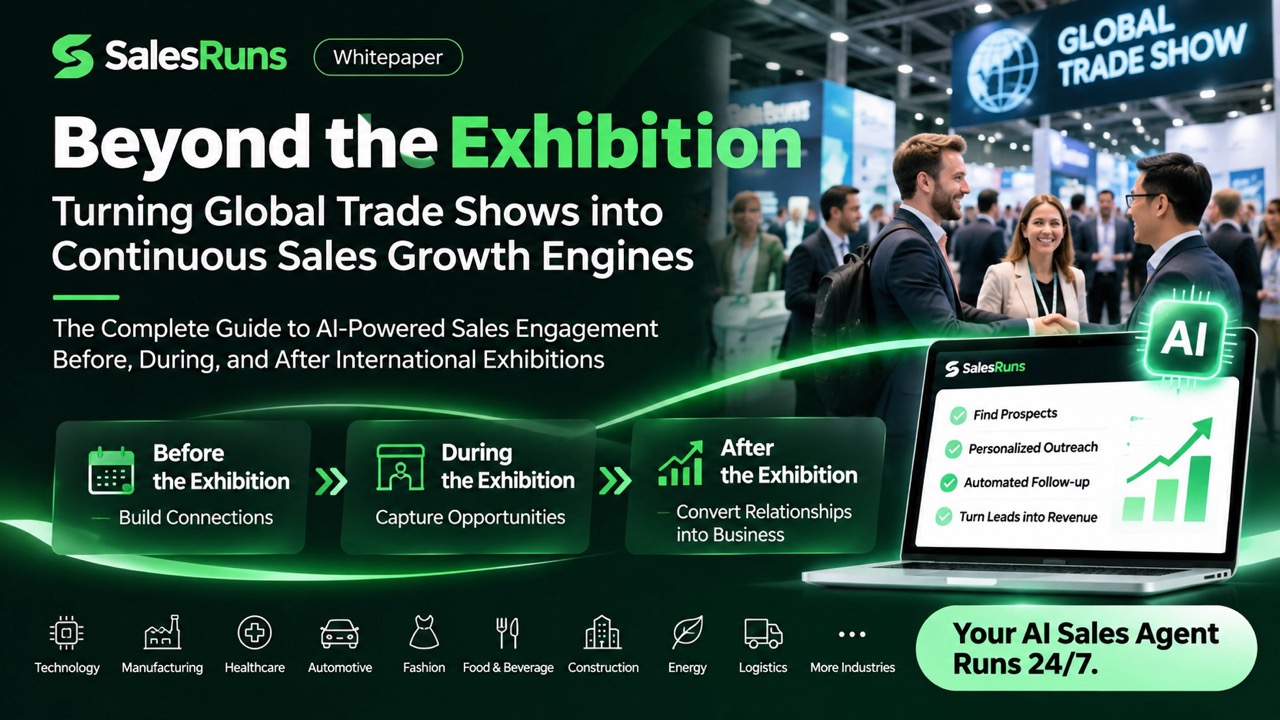
Your AI Sales Agent Runs 24/7.
Executive Summary
The Exhibition Is Only the Beginning of the Sales Journey
Every year, thousands of companies participate in international trade shows, exhibitions, industry conferences, and business events.
From consumer electronics and industrial manufacturing to healthcare, automotive, fashion, food, energy, and logistics, these events bring together companies, buyers, distributors, importers, suppliers, investors, and potential business partners from around the world.
For exhibitors, participating in a major trade show represents a significant investment.
Companies spend money on exhibition space, booth construction, product demonstrations, marketing materials, international travel, and sales personnel.
Yet one of the most important parts of the exhibition process is frequently underestimated:
What happens before, during, and especially after the exhibition.
Before an event, companies need to identify potential customers, introduce their products, develop business relationships, and arrange meetings.
During the event, sales teams must communicate with numerous visitors, answer inquiries, distribute product information, and identify promising business opportunities.
After the event, they must organize contacts, respond to inquiries, send quotations, arrange further discussions, and maintain relationships that may eventually become commercial partnerships.
These activities require time, consistency, and substantial human resources.
Unfortunately, many businesses struggle to manage them effectively.
Potential customers remain undiscovered. Invitations are never sent. Important conversations are delayed. Business cards are forgotten. Follow-up emails are postponed. Promising opportunities gradually disappear.
A successful exhibition does not automatically produce a successful sales pipeline.
The challenge is not simply generating more contacts. It is maintaining meaningful communication with the right people and consistently moving business opportunities forward.
SalesRuns is designed to address this challenge.
SalesRuns is an AI-powered sales engagement platform that helps businesses discover potential customers, organize contact resources, conduct personalized outreach at scale, manage customer conversations, and automate ongoing follow-up activities.
By connecting prospect discovery, personalized communication, and continuous follow-up, SalesRuns helps businesses transform isolated exhibition activities into a more structured and scalable sales development process.
This whitepaper explores how businesses can use AI-powered sales engagement to maximize the commercial value of global trade shows.
The central principle is simple:
Before the Exhibition: Build Connections.
During the Exhibition: Capture Opportunities.
After the Exhibition: Convert Relationships into Business.
The exhibition may last only a few days. The business opportunities it creates can continue for months or years.
1. The Hidden Sales Challenge Behind Every Trade Show
1.1 Exhibiting Is Expensive. Losing Opportunities Is Even More Expensive.
International exhibitions provide companies with valuable opportunities to:
- Introduce new products and technologies.
- Reach international buyers and distributors.
- Develop overseas sales channels.
- Identify suppliers and strategic partners.
- Strengthen existing customer relationships.
- Explore new markets and business opportunities.
- Build brand awareness and industry credibility.
However, the commercial value of an exhibition depends on more than the number of visitors who enter a booth.
A company may attract hundreds of visitors but fail to maintain contact with many of them.
It may exchange dozens of business cards without establishing a systematic follow-up process.
It may receive numerous inquiries but lack the resources to respond quickly and consistently.
The result is a gap between exhibition activity and actual business development.
1.2 Three Common Challenges Faced by Exhibitors
Challenge 1: Limited Pre-show Customer Development
Many companies rely on existing customers, social media announcements, and occasional email invitations to promote their participation.
Their sales teams often lack the time to identify and contact a sufficiently large group of relevant potential customers before the event.
As a result, valuable opportunities to arrange meetings and establish business relationships before the exhibition are missed.
Challenge 2: Too Many Conversations During the Exhibition
A busy exhibition creates multiple simultaneous communication demands.
Sales representatives may need to:
- Welcome booth visitors.
- Introduce products.
- Answer technical questions.
- Discuss pricing and distribution.
- Share product catalogs.
- Schedule business meetings.
- Communicate with existing customers.
- Follow up with prospects who have already left the booth.
Managing all these activities individually is difficult, particularly for small and medium-sized businesses with limited sales personnel.
Challenge 3: Inconsistent Post-show Follow-up
After the exhibition, sales teams return to their regular responsibilities.
Business cards need to be organized. Customer information needs to be entered into systems. Product inquiries need to be answered. Quotations need to be prepared. Follow-up conversations need to continue.
Without a structured process, important opportunities can become buried in personal inboxes, spreadsheets, messaging applications, or individual employees' memories.
Some prospects receive delayed responses. Others never receive a second message.
The biggest missed opportunity in many exhibitions is not the customer who never visited the booth. It is the customer who showed interest but was never properly followed up.
1.3 The Missing Link: Continuous Sales Engagement
Traditional exhibition management focuses heavily on the event itself.
But business development does not begin when the exhibition doors open, and it does not end when they close.
Companies need a continuous process that connects:
- Prospect discovery.
- Pre-event customer outreach.
- Exhibition engagement.
- Lead organization.
- Post-event follow-up.
- Long-term relationship development.
This is where AI-powered sales engagement becomes valuable.
2. The Complete Trade Show Sales Lifecycle
SalesRuns organizes exhibition-driven sales development into three connected stages.
2.1 Stage One: Pre-show Outreach
Build Relationships Before the Exhibition Begins
The most effective exhibition sales strategies start before the event.
Instead of waiting for potential customers to visit their booths, businesses can proactively identify and contact relevant prospects.
SalesRuns helps companies organize their existing contacts, discover additional potential business contacts, and conduct personalized outreach.
Typical pre-show activities include:
Reconnect with Existing Customers
Contact customers from previous exhibitions and existing business relationships.
Introduce new products, announce exhibition participation, and explore opportunities for further cooperation.
Discover New Potential Customers
Identify potential buyers, distributors, importers, wholesalers, agents, and business partners relevant to the company's products and markets.
Introduce Products and New Developments
Share information about new product launches, updated product portfolios, technical capabilities, and commercial opportunities.
Arrange Exhibition Meetings
Send personalized invitations to relevant prospects.
Encourage potential customers to visit the booth, schedule demonstrations, and arrange business discussions.
Develop International Distribution Channels
Contact potential regional distributors and channel partners before the exhibition.
Introduce cooperation opportunities and initiate discussions about market development.
Personalized Invitations at Scale
Different prospects have different business requirements.
For example:
- A technology company may be interested in technical integration and strategic partnerships.
- A distributor may want to understand regional distribution rights and commercial terms.
- A purchasing manager may prioritize pricing, specifications, and supply capacity.
- A retailer may focus on product positioning, margins, and market demand.
- An existing customer may be interested in new products and continued cooperation.
SalesRuns helps businesses develop personalized communication based on the recipient's company, industry, role, and available business context.
Instead of sending identical announcements to an entire contact list, companies can conduct more relevant one-to-one outreach at scale.
The objective: Start meaningful business conversations before competitors do.
2.2 Stage Two: During-show Engagement
Turn Every Business Interaction into an Opportunity
Once the exhibition begins, the focus shifts from prospect development to active customer engagement.
Companies need to maintain communication with existing customers, new visitors, potential distributors, purchasing teams, and strategic partners.
SalesRuns supports the communication and follow-up activities surrounding these interactions.
Typical activities include:
Personalized Customer Invitations
Invite selected prospects to visit the booth or attend product demonstrations.
Product Information Distribution
Share product catalogs, technical specifications, presentations, pricing information, and other relevant materials.
Meeting Coordination
Confirm exhibition locations, meeting arrangements, and business discussion details.
Customer Inquiry Management
Organize customer inquiries and support timely responses through supported communication workflows.
Business Opportunity Organization
Maintain contact information and communication context so that promising prospects can be prioritized for further discussions.
Follow-up After Booth Visits
Continue conversations with visitors who have demonstrated interest in products or services.
Different Customers. Different Conversations.
Not every exhibition visitor represents the same business opportunity.
SalesRuns helps businesses approach customer communication according to the recipient's business role and requirements.
| Prospect Type | Typical Communication Focus |
|---|---|
| Distributors | Distribution opportunities, territory, and commercial terms |
| Importers | Product portfolio, pricing, and supply capabilities |
| Retail Buyers | Product positioning, margins, and purchasing requirements |
| Technology Partners | Technical capabilities and integration opportunities |
| OEM/ODM Customers | Manufacturing capabilities and customization |
| Investors | Business model, market opportunity, and growth |
| Existing Customers | New products and ongoing cooperation |
| Suppliers | Supply capabilities and potential collaboration |
The objective: Increase customer engagement while reducing repetitive sales administration.
2.3 Stage Three: Post-show Follow-up
Turn Exhibition Leads into Long-term Business Relationships
The exhibition may last only a few days.
The business opportunities created there may take weeks or months to develop.
This is why post-show follow-up is one of the most important parts of exhibition-driven sales.
After an event, businesses need to maintain communication with different categories of prospects.
Examples include:
- Visitors who exchanged business cards.
- Buyers who requested product information.
- Distributors interested in regional cooperation.
- Companies that discussed OEM or ODM opportunities.
- Customers who requested quotations.
- Prospects who expressed interest but were not ready to purchase.
- Existing customers who discussed future projects.
SalesRuns helps businesses maintain structured, personalized follow-up activities.
Follow-up According to Customer Status
No Response
Continue appropriate follow-up at reasonable intervals, where permitted, instead of allowing the conversation to disappear.
Interested Prospects
Prioritize further discussions, provide requested information, and move toward commercial negotiations.
Quotation Requested
Continue communication regarding pricing, specifications, delivery, and purchasing requirements.
Meeting Completed
Record the next steps and maintain communication according to the agreed business objectives.
Long-term Prospects
Maintain relevant communication over a longer sales cycle, based on customer interest and appropriate contact preferences.
Deal Closed
Stop prospecting communications and transition the relationship into customer management and retention.
Configurable Follow-up Schedules
SalesRuns supports configurable follow-up intervals, including:
7 / 14 / 30 / 60 / 90 / 180 / 360 Days
These intervals allow businesses to establish structured communication schedules.
Follow-up should not mean repeatedly sending the same message.
It should mean continuing a relevant business conversation at the appropriate time.
Customer replies, opt-outs, and changes in opportunity status should influence subsequent communication.
The objective: Reduce missed opportunities and ensure that valuable exhibition connections receive appropriate attention after the event.
3. Four Ways SalesRuns Transforms Trade Show Sales
The three exhibition stages explain when sales activities happen.
The following four capabilities explain how SalesRuns helps businesses execute them.
3.1 Find the Right Contacts
Build a Sustainable Prospect Pipeline
Finding the right people is the starting point of effective business development.
SalesRuns helps businesses organize their existing customer databases and leverage its shared prospect pool to discover additional potential business contacts.
Businesses can:
- Organize existing customers and prospects.
- Discover relevant potential business contacts.
- Build prospect lists based on business requirements.
- Reduce duplicated contact records.
- Expand their potential customer pipeline.
- Maintain prospect information for future outreach.
Unlike conventional email tools that primarily start with an imported contact list, SalesRuns combines prospect discovery capabilities with ongoing customer engagement.
This provides businesses with a more continuous approach to building and maintaining potential customer resources.
The value: Spend less time building contact lists from scratch and more time connecting with relevant business opportunities.
3.2 Personalized Outreach at Scale
One-to-One Communication Without One-by-One Manual Work
Traditional bulk email campaigns often rely on the same message being sent to large groups of recipients.
However, business development is rarely that simple.
Different companies have different products, markets, purchasing needs, and cooperation objectives.
SalesRuns uses AI-powered assistance to help businesses prepare more relevant and personalized email communication at scale.
For example:
Technology and Electronics Companies
Focus on new product launches, technical capabilities, integration, and strategic partnerships.
Industrial Manufacturers
Focus on production capabilities, equipment specifications, manufacturing capacity, and procurement requirements.
Healthcare and Medical Companies
Focus on product specifications, intended applications, regulatory documentation, and distribution opportunities.
Fashion and Apparel Brands
Focus on product collections, materials, minimum order quantities, and regional distribution.
Food and Beverage Companies
Focus on product portfolios, certifications, packaging, supply capacity, and import opportunities.
Automotive Suppliers
Focus on components, technical specifications, OEM relationships, and supply chain cooperation.
Energy Companies
Focus on technical solutions, project opportunities, equipment capabilities, and distribution networks.
Existing Business Contacts
Use available interaction history and customer context to make follow-up communication more relevant.
The objective is not simply to replace a recipient's name in a generic template.
It is to make each message more relevant to the recipient's business context.
The value: Scale personalized business communication without scaling the sales workload at the same rate.
3.3 Automated Follow-up
Keep Business Conversations Moving
A single email rarely completes a business development process.
Some prospects respond immediately. Others need additional information. Many require several interactions before they are ready to discuss a commercial agreement.
SalesRuns helps businesses establish structured follow-up processes.
Examples include:
- Following up with prospects who have not responded.
- Continuing discussions with interested customers.
- Delivering requested product information.
- Maintaining communication after business meetings.
- Reconnecting with prospects over longer sales cycles.
- Adjusting communication according to customer status.
- Managing ongoing engagement with existing customers.
Businesses can configure follow-up schedules such as:
7 / 14 / 30 / 60 / 90 / 180 / 360 Days
The communication process should adapt to customer interactions rather than simply follow a fixed sequence regardless of circumstances.
For example:
- A prospect who replies should enter a response-handling process.
- A prospect who requests a quotation should receive relevant commercial follow-up.
- A prospect who declines further communication should be excluded from future outreach.
- A completed transaction should no longer receive prospecting messages.
The value: Make customer engagement a consistent business process rather than a task dependent on individual memory.
3.4 Turn Trade Show Leads into Revenue
The Real Value Is Not Sending More Emails. It Is Creating More Business Opportunities.
This is the central value proposition of SalesRuns.
A trade show generates potential business relationships.
But those relationships only become commercially valuable when companies continue the conversation, understand customer requirements, and move opportunities toward purchasing decisions.
SalesRuns connects:
- Prospect discovery.
- Personalized outreach.
- Customer communication.
- Follow-up execution.
- Long-term relationship development.
Instead of allowing exhibition leads to remain scattered across business cards, spreadsheets, and personal inboxes, businesses can establish a more organized and repeatable sales engagement process.
SalesRuns helps sales teams focus on the next meaningful action for each prospect.
The value: Turn temporary exhibition interactions into lasting business relationships and potential revenue.
4. From Exhibition Activity to a Continuous Sales Engine
Traditional exhibition sales are often organized around the event calendar.
Preparation happens before the exhibition.
Customer communication happens during the exhibition.
Follow-up happens after the exhibition.
These activities are frequently managed by different people, using different tools, with limited continuity.
SalesRuns encourages a different approach.
The Traditional Approach
Before the Exhibition
- Prepare marketing materials.
- Announce exhibition participation.
- Contact a limited number of existing customers.
- Wait for potential visitors to arrange meetings.
During the Exhibition
- Meet visitors.
- Exchange business cards.
- Demonstrate products.
- Record customer information.
- Try to manage conversations manually.
After the Exhibition
- Organize contact lists.
- Send follow-up emails.
- Respond to inquiries.
- Prepare quotations.
- Try to remember which prospects need additional attention.
The SalesRuns Approach
Before the Exhibition
- Discover potential business contacts.
- Organize prospect lists.
- Prepare personalized outreach.
- Introduce products and services.
- Arrange meetings with relevant prospects.
During the Exhibition
- Maintain customer conversations.
- Share relevant product information.
- Confirm meetings.
- Organize business opportunities.
- Identify prospects requiring further engagement.
After the Exhibition
- Continue personalized follow-up.
- Prioritize interested prospects.
- Respond to customer inquiries.
- Develop long-term business relationships.
- Maintain consistent communication.
The Difference Is Continuity
SalesRuns helps businesses move from isolated exhibition activities toward a repeatable sales engagement process.
Instead of treating every trade show as a separate marketing event, businesses can build a continuous customer development system that connects one exhibition to the next.
A contact discovered at one event may become a customer months later.
A distributor contacted before one exhibition may become a strategic partner at the next.
A visitor who is not ready to purchase today may become an important opportunity in the future.
The exhibition ends. The sales relationship continues.
5. The AI Sales Agent: Your Sales Engagement Runs 24/7
Sales teams should spend their time understanding customers, building relationships, negotiating, and closing deals.
They should not have to spend most of their working hours manually organizing contact lists, preparing repetitive emails, and remembering every follow-up task.
SalesRuns brings AI-powered assistance into the daily sales workflow.
Its purpose is to help businesses:
- Discover more potential customers.
- Organize customer and prospect information.
- Prepare personalized outreach.
- Maintain consistent follow-up.
- Respond to customer inquiries through supported workflows.
- Reduce repetitive sales administration.
- Develop customer relationships over longer sales cycles.
Human Relationships. AI-Powered Execution.
AI should not replace meaningful human business relationships.
Successful business development still depends on understanding customer needs, building trust, negotiating commercial terms, and making informed decisions.
The role of SalesRuns is to help sales teams execute repetitive communication and follow-up activities more efficiently.
It provides businesses with additional capacity to develop relationships and pursue opportunities.
Your AI Sales Agent Runs 24/7.
More opportunities.
More conversations.
More consistent follow-up.
More time for meaningful business development.
6. Cross-Industry Applications: One Sales Process, Different Markets
Trade shows exist across virtually every major industry.
Although the products and customers differ, exhibitors face similar sales engagement challenges.
SalesRuns provides a common sales engagement framework that can be adapted to different industries.
6.1 Technology and Consumer Electronics
Representative Exhibitions: CES, MWC, IFA, GITEX, Computex.
Typical target customers:
- Technology distributors.
- Consumer electronics retailers.
- Importers and wholesalers.
- System integrators.
- OEM/ODM manufacturers.
- Technology partners.
Typical sales activities:
- Introduce new products.
- Arrange product demonstrations.
- Develop international distribution channels.
- Discuss technical integration.
- Follow up on product and partnership inquiries.
6.2 Manufacturing and Industrial Equipment
Representative Exhibitions: Hannover Messe, EMO, IMTS, Canton Fair.
Typical target customers:
- Industrial purchasing managers.
- Manufacturing companies.
- Equipment distributors.
- Factory operators.
- Engineering companies.
- Industrial suppliers.
Typical sales activities:
- Introduce equipment and production capabilities.
- Share technical specifications.
- Discuss manufacturing requirements.
- Develop distributor relationships.
- Follow up on quotations and procurement projects.
6.3 Healthcare and Medical Technology
Representative Exhibitions: MEDICA, Arab Health, BIO International Convention.
Typical target customers:
- Medical distributors.
- Healthcare institutions.
- Procurement departments.
- Medical technology companies.
- Laboratory equipment suppliers.
- Pharmaceutical partners.
Typical sales activities:
- Introduce medical products and technologies.
- Provide product documentation.
- Identify distribution opportunities.
- Discuss intended applications.
- Follow up on technical and commercial inquiries.
Healthcare communications must account for applicable product registration, regulatory, and promotional requirements.
6.4 Fashion, Apparel and Textiles
Representative Exhibitions: MAGIC Las Vegas, Première Vision, Texworld.
Typical target customers:
- Fashion brands.
- Importers.
- Apparel wholesalers.
- Retail purchasing teams.
- Textile manufacturers.
- Sourcing companies.
Typical sales activities:
- Introduce seasonal collections.
- Share product catalogs and samples.
- Discuss materials and specifications.
- Communicate minimum order quantities.
- Develop retail and distribution partnerships.
6.5 Food, Beverage and Hospitality
Representative Exhibitions: SIAL, Anuga, Gulfood, FHA.
Typical target customers:
- Food importers.
- Supermarket purchasing teams.
- Restaurant groups.
- Food distributors.
- Hospitality operators.
- Food processing companies.
Typical sales activities:
- Introduce product portfolios.
- Share certifications and product documentation.
- Discuss packaging and supply capacity.
- Develop import and distribution partnerships.
- Follow up on samples and quotations.
6.6 Automotive and Mobility
Representative Exhibitions: IAA Mobility, Automechanika, SEMA.
Typical target customers:
- Automotive manufacturers.
- OEM suppliers.
- Parts distributors.
- Automotive retailers.
- Mobility technology companies.
- Fleet operators.
Typical sales activities:
- Introduce components and solutions.
- Share technical specifications.
- Explore OEM and supplier relationships.
- Develop regional distribution networks.
- Follow up on procurement and integration discussions.
6.7 Construction and Building Materials
Representative Exhibitions: BAU, CONEXPO-CON/AGG, Light + Building.
Typical target customers:
- Construction companies.
- Architects and engineering firms.
- Building material distributors.
- Contractors.
- Project developers.
- Procurement teams.
Typical sales activities:
- Introduce building materials and equipment.
- Share technical documentation.
- Discuss project requirements.
- Develop dealer networks.
- Follow up on quotations and project opportunities.
6.8 Energy and Environmental Technology
Representative Exhibitions: Intersolar, RE+, World Future Energy Summit.
Typical target customers:
- Energy project developers.
- EPC contractors.
- Equipment distributors.
- Renewable energy companies.
- Industrial customers.
- Infrastructure operators.
Typical sales activities:
- Introduce energy solutions.
- Share technical and commercial information.
- Identify project opportunities.
- Develop distribution partnerships.
- Follow up on project discussions.
6.9 Beauty and Personal Care
Representative Exhibitions: Cosmoprof, Beautyworld.
Typical target customers:
- Cosmetics distributors.
- Beauty retailers.
- Brand owners.
- Importers.
- OEM/ODM manufacturers.
- Professional beauty service providers.
Typical sales activities:
- Introduce new product collections.
- Share product catalogs and specifications.
- Discuss private-label opportunities.
- Develop regional distribution channels.
- Follow up on samples and commercial terms.
6.10 Logistics and Supply Chain
Representative Exhibitions: Transport Logistic, LogiMAT, MODEX.
Typical target customers:
- Freight forwarders.
- Logistics providers.
- Manufacturers.
- Warehousing companies.
- Supply chain operators.
- Enterprise procurement teams.
Typical sales activities:
- Introduce logistics services.
- Share operational capabilities.
- Identify transportation and warehousing needs.
- Develop strategic partnerships.
- Follow up on service proposals and quotations.
A Universal Sales Engagement Framework
| Industry | Target Customers | Communication Priorities |
|---|---|---|
| Technology | Distributors, retailers, partners | Products, technology, channels |
| Manufacturing | Factories, procurement teams | Equipment, capacity, pricing |
| Healthcare | Hospitals, distributors | Applications, specifications, documentation |
| Fashion | Brands, importers, retailers | Collections, materials, orders |
| Food & Beverage | Importers, supermarkets | Products, certifications, supply |
| Automotive | OEMs, suppliers, distributors | Components, specifications, cooperation |
| Construction | Contractors, project buyers | Materials, performance, projects |
| Energy | Developers, EPCs, distributors | Solutions, technology, projects |
| Beauty | Brands, retailers, agents | Products, formulations, distribution |
| Logistics | Shippers, logistics partners | Services, networks, costs |
Different industries require different conversations. SalesRuns helps businesses organize and execute those conversations through a consistent sales engagement framework.
7. Beyond the Exhibition: Building a Global Sales Development Strategy
The value of SalesRuns extends beyond individual exhibition events.
Many companies participate in multiple exhibitions throughout the year, targeting different markets and customer segments.
Without a structured process, each exhibition can become an isolated sales activity.
SalesRuns provides an opportunity to connect these activities.
7.1 From One Exhibition to Multiple Markets
A manufacturer may attend a European industrial exhibition in the first half of the year, an Asian trade fair later in the year, and an American industry conference toward year-end.
Each event creates new opportunities to:
- Discover potential customers.
- Develop regional distribution channels.
- Reconnect with previous prospects.
- Introduce new products.
- Continue ongoing business discussions.
SalesRuns helps businesses maintain their prospect development and follow-up activities across these events.
7.2 From Exhibition Leads to Long-term Customers
Not every prospect is ready to purchase immediately.
Some may need additional technical information.
Some may need to complete internal procurement procedures.
Some may be waiting for a new budget cycle.
Others may need to evaluate multiple suppliers.
A structured follow-up process helps businesses maintain relevant contact throughout these longer sales cycles.
7.3 From Event-based Marketing to Continuous Business Development
Instead of concentrating all customer development efforts around exhibition dates, businesses can maintain ongoing communication between events.
For example:
- Reconnect with prospects from previous exhibitions.
- Introduce new products to existing contacts.
- Identify new buyers in target markets.
- Follow up on previous quotations.
- Develop regional partnerships.
- Maintain relationships with customers who are not immediately ready to purchase.
SalesRuns helps businesses turn individual exhibitions into connected opportunities for long-term international business development.
8. A Practical Example: A Global Manufacturer Preparing for Multiple Exhibitions
Consider an industrial equipment manufacturer seeking to expand its international distribution network.
The company plans to participate in three exhibitions during the year:
- An industrial technology exhibition in Germany.
- A manufacturing trade show in Asia.
- An international industry event in the United States.
Its potential customers include:
- Industrial distributors.
- Factory purchasing managers.
- Engineering companies.
- Importers.
- Regional agents.
- OEM partners.
Before the First Exhibition
The company organizes its existing customer database and identifies additional potential business contacts.
SalesRuns helps prepare personalized outreach for different prospect categories.
The sales team introduces its equipment portfolio, shares relevant information, and invites selected prospects to schedule meetings.
During the First Exhibition
The team meets potential distributors and purchasing managers.
Customer conversations are organized according to business interests.
Relevant product information is shared, and interested prospects are prioritized for further discussions.
After the First Exhibition
The company continues communication with interested prospects.
A distributor requests regional pricing.
A factory asks for technical specifications.
An engineering company wants to discuss a potential project.
SalesRuns supports structured follow-up based on each prospect's requirements.
Before the Second Exhibition
The company reconnects with prospects from the first event.
It also identifies new potential customers in the Asian market.
Previous business discussions provide useful context for more relevant outreach.
After the Third Exhibition
The company has developed relationships across multiple markets.
Rather than treating each event as an independent activity, it has established a continuous process for prospect development and customer engagement.
The result is a more structured approach to international business development, extending far beyond individual exhibition dates.
9. Who Should Use SalesRuns?
SalesRuns is designed for businesses that need to develop customers, maintain business relationships, and manage ongoing sales communication.
It is particularly relevant for the following groups.
Small and Medium-sized Exhibitors
Companies with limited sales resources that need to reach more potential customers without building a large sales team.
International Brands and Manufacturers
Businesses looking for overseas distributors, importers, retailers, agents, and strategic partners.
Technology Startups
AI, robotics, smart hardware, IoT, software, and other technology companies seeking international customers and business partnerships.
Exporters and Trading Companies
Businesses that participate in international trade fairs and need to develop long-term overseas customer relationships.
B2B Sales and Business Development Teams
Sales professionals who manage large numbers of prospects, business inquiries, and ongoing follow-up activities.
Exhibition-driven Businesses
Companies that regularly participate in industry events and want to turn exhibition participation into a repeatable customer acquisition process.
10. Measuring the Value of Exhibition-driven Sales Engagement
Exhibition success should not be measured solely by booth visitors or the number of business cards collected.
Businesses should also evaluate what happens to those contacts afterward.
SalesRuns encourages a more comprehensive approach to measuring sales engagement.
Suggested performance indicators include:
| Measurement Area | Suggested KPI |
|---|---|
| Prospect Development | Relevant prospects identified |
| Contact Quality | Qualified prospects and valid business contacts |
| Pre-show Outreach | Personalized invitations delivered |
| Meeting Generation | Meetings arranged and confirmed |
| Exhibition Engagement | Meaningful customer conversations |
| Lead Management | Exhibition contacts organized |
| Follow-up Execution | Follow-ups completed on schedule |
| Customer Engagement | Relevant replies and ongoing discussions |
| Commercial Progress | Quotations, samples, and proposals |
| Sales Conversion | Opportunities converted into customers |
| Long-term Value | Repeat business and customer relationships |
Businesses can use these indicators to understand where their exhibition sales process is working and where improvements are needed.
From Activity Metrics to Business Outcomes
Sending more emails does not automatically mean generating more business.
The ultimate goal is to improve the quality and continuity of customer engagement.
SalesRuns focuses on helping businesses manage the activities that move prospects toward meaningful commercial discussions.
11. Responsible AI-powered Sales Engagement
Effective sales engagement requires more than automation.
It also requires relevant communication, responsible data handling, and respect for customer preferences.
SalesRuns supports a more structured approach to business communication.
Businesses should consider the following principles when conducting outreach:
Relevant Communication
Contact prospects based on legitimate business relevance, rather than sending indiscriminate messages.
Data Quality
Maintain accurate contact information and appropriate controls over prospect data sources.
Personalized Content
Ensure that messages reflect the recipient's business context and do not contain fabricated relationships, meetings, or product claims.
Respect for Customer Preferences
Honor opt-out requests, suppression lists, and applicable communication preferences.
Appropriate Automation
Use human review where commercial decisions, sensitive inquiries, or complex customer requirements require judgment.
Regulatory Compliance
Businesses must ensure that their outreach practices comply with applicable privacy, electronic marketing, and commercial communication laws in the countries where they operate.
This may include requirements under GDPR, CAN-SPAM, CASL, and other applicable national or regional regulations.
Automation should improve the quality and efficiency of business communication, not undermine customer trust.
The long-term value of sales engagement depends on building relationships that customers actually want to maintain.
12. The New Standard for Global Exhibition Sales
The traditional approach to exhibitions focuses on the event itself.
The next generation of exhibition sales should focus on the entire customer journey.
A booth creates visibility.
A meeting creates an opportunity.
A conversation builds trust.
Consistent follow-up develops a business relationship.
And a business relationship creates the possibility of revenue.
Companies that build a structured sales engagement process can make better use of the opportunities generated by international exhibitions.
The objective is not simply to collect more contacts.
It is to develop more relevant relationships, maintain consistent communication, and create a stronger foundation for long-term business growth.
SalesRuns helps businesses connect these activities into a continuous sales engagement process.
Don't Just Attend. Don't Just Exhibit. Build Relationships. Grow Sales.
13. Start Building Your Global Sales Pipeline
Your next exhibition is an opportunity to do more than display products.
It is an opportunity to:
- Discover new customers.
- Develop international distribution channels.
- Build strategic partnerships.
- Strengthen existing customer relationships.
- Expand into new markets.
- Create long-term business opportunities.
But the process should not begin when the exhibition opens.
And it should not end when the exhibition closes.
Start developing your prospects before the event.
Maintain meaningful communication during the exhibition.
Continue building relationships after the event.
Make every exhibition part of a larger business development strategy.
Don't Just Exhibit. Build Your Sales Pipeline Before, During, and After the Show.
BEFORE
Start conversations before your competitors do.
DURING
Turn every business interaction into a sales opportunity.
AFTER
Never let valuable business connections go cold.
GET YOUR FOREVER-FREE AI SALES AGENT
Your AI Sales Agent Runs 24/7.
Welcome to SalesRuns.com and get your own forever-free AI Sales Agent.
Automate sales follow-ups, respond to customer inquiries, and discover more potential customers — all with AI.
Spend less time managing repetitive sales tasks.
Spend more time building meaningful business relationships.
Find Prospects. Start Conversations. Follow Up. Grow Your Business.
Start Today
Visit: https://SalesRuns.com
About SalesRuns
SalesRuns is an AI-powered sales engagement platform designed to help businesses discover potential customers, conduct personalized outreach, manage customer conversations, and automate ongoing sales follow-up.
By connecting prospect discovery, personalized communication, and continuous engagement, SalesRuns helps companies establish a more consistent and scalable approach to customer development.
Whether participating in a global technology exhibition, an industrial trade fair, a healthcare conference, or an international sourcing event, businesses can use SalesRuns to extend their sales activities beyond the exhibition floor.
SalesRuns — Your AI Sales Agent Runs 24/7.
Website: https://SalesRuns.com
End of Whitepaper
Copyright © 2026 SalesRuns.com. All rights reserved.
This whitepaper is intended for general business and informational purposes. Product capabilities, integrations, and automation workflows are subject to the functionality available in the relevant SalesRuns subscription and product release.