Your Follow-Up Email Is Not a Second Introduction
Two emails land in the same inbox on the Monday after a trade show.
Generic: "Hi John, it was nice meeting you at the trade show. We are a leading manufacturer of high-quality products. Please find our company profile attached. Looking forward to hearing from you."
Contextual: "Hi John, it was good speaking with you at [Event] about your plans to expand your distributor network in Germany. You mentioned that product availability and delivery lead times mattered. I have included the specifications and delivery information we discussed."
The second message proves the sender remembers. It names the topic, repeats the requirement in the prospect's terms, and delivers what was asked for. Nothing in it is clever. It is specific.
How do you turn a short booth conversation into a follow-up email after meeting at trade show that deserves a response? No email can guarantee a reply. It can only make relevance, credibility, and the next action clear enough that responding is worthwhile.
1. Why Most Trade Show Follow-Up Emails Sound the Same
The grammar in most of these messages is fine. The writer simply has no context to work with, so a B2B sales follow-up email becomes a description of the sender instead. Eight habits cause that drift.
- Generic greetings. "Nice meeting you" says nothing. Open with the event and topic.
- Company-first copy. Answer their question, not your factory history. Lead with what they raised.
- One profile for everyone. An identical attachment signals a mail merge. Send only what was requested.
- No shared detail. Without one, it reads as cold outreach. Name something actually said.
- Vague questions. "Are you interested in cooperation?" cannot be answered. Ask about the stated need.
- Too many attachments. A catalogue and a price list bury the point. Keep one purpose.
- Meetings too early. A calendar invite before any value asks for commitment without a reason.
- No next step. End with one proportionate question, not "looking forward to hearing from you".
None of this is a vocabulary problem. It is missing context. When the booth note says only "interested", the writer reaches for a trade show follow-up email template to fill the gap. Templates organise; they cannot invent a conversation. U.S. rules also require subject lines that match the content (FTC guide).
| Element | Generic post trade show email | Personalized exhibition follow-up email |
|---|---|---|
| Opening | "It was nice meeting you" | "[Event], [topic discussed]" |
| Focus | Our company and product range | Your stated requirement |
| Attachment | Full company profile | The one document requested |
| Credibility | Claims about being "leading" | A detail only both parties know |
| Next step | "Hope to cooperate" | One specific question |
| Compliance | Unclear opt-out | Accurate subject, valid address, easy opt-out |
2. The Five Elements of a Strong Follow-Up Email
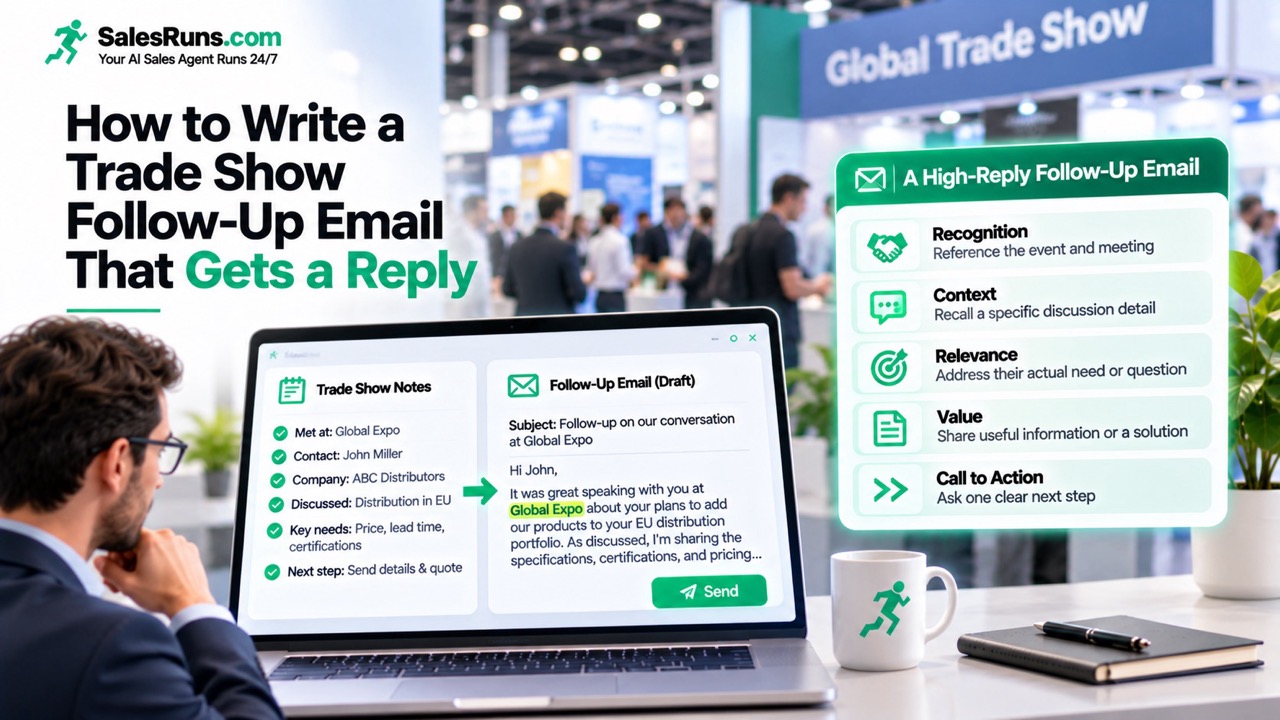
A reliable message has five parts. Recognition names where you met. Context recalls one detail. Relevance connects it to a business need. Value supplies an answer, a document, or a practical step. The call to action asks one proportionate thing. Together they read like a continuing business conversation rather than a campaign.
Subject: [Product] specifications we discussed at [Event]
Hi [Name],
Good speaking with you at [Event] about [stated requirement]. You asked whether [Product] meets [standard]. I have attached the test report and the dimensions sheet.
Would [specific question] help your team decide, or is a different format easier?
Best,
[Sender]
No company history, no claim about being a leading supplier, no second attachment. Every line traces back to something the prospect said or asked for.
3. How to Write a Subject Line That Establishes Context
The subject line is a label, not an advertisement. Its job is to help the reader recognise the conversation and the topic.
- Following up on our conversation at [Event]
- [Product] specifications we discussed at [Event]
- Delivery timeline for your [Country] project
- Follow-up on your [Product Category] inquiry
- The distributor opportunity we discussed
- Technical information for [Product Name]
- Next steps after [Event]
Use the event name when it genuinely helps recognition. Be specific without writing a paragraph. Avoid vague labels and manufactured urgency such as "Last chance" when nothing has expired. The FTC requires honest subject lines, and Google, Yahoo, and Microsoft publish authentication and complaint-rate requirements for high-volume senders. No single subject line works best for everyone; test against your own conversations.
4. Eight Trade Show Follow-Up Email Examples
Every message below is illustrative and contains placeholders. Replace each bracket with verified information from your notes. A business development email that guesses a requirement is worse than a short honest one. Keep the opt-out and postal address required in your jurisdiction.
Example 1: High-intent prospect who requested a quotation
Subject: Quotation for [Product], [Quantity] units, [Event]
Hi [Name],
Thanks for the discussion at [Event] on [Date]. You asked for pricing on [Quantity] units of [Product], delivered to [Destination], with [stated requirement]. The attached quotation covers those items and shows the lead time we discussed.
Could you confirm whether [Incoterm] and [packaging requirement] are correct before we finalise it?
Best,
[Sender]
Use when pricing on a specific product or quantity was requested. Fill in product, quantity, destination, requirement, and delivery term. Confirm commercial terms internally.
Example 2: Prospect who requested technical specifications
Subject: [Product] test report and dimensions from [Event]
Hi [Name],
You asked at [Event] whether [Product] complies with [standard] and fits [dimension constraint]. I have attached the test report, the drawing, and the declaration of conformity. The [specific value] is on page [number].
If your engineer needs the raw test data or a verification sample, reply and I will arrange it.
Best,
[Sender]
Use when the question was technical. Fill in standard, constraint, documents, and value. Do not claim compliance the documents do not support.
Example 3: Potential distributor or channel partner
Subject: Distribution in [Region]: our conversation at [Event]
Hi [Name],
Good to compare notes at [Event] on distribution in [Region]. You mentioned [stated channel challenge] is the main constraint for your current partners. I have attached a short overview of our range, certifications, and territories where agreements already exist. Nothing here assumes an arrangement between us.
Would an introductory call with [colleague] to compare coverage be useful next month?
Best,
[Sender]
Use when distribution came up. Fill in region, stated challenge, and colleague. Keep it exploratory.
Example 4: Interest with no immediate buying plan
Subject: [Product] information for your [Project] evaluation
Hi [Name],
At [Event] you mentioned [Project] is at an early stage and a decision is not expected until [timeframe]. That is useful to know. I am sending one short overview of [Product] and the [document] you asked about, with no action needed from you now.
If the specification changes as the project develops, I am happy to answer questions.
Best,
[Sender]
Use when a future project was mentioned. Fill in project, timeframe, and document. Do not invent a deadline.
Example 5: Prospect who asked for a product sample
Subject: Sample of [Product] discussed at [Event]
Hi [Name],
You asked at [Event] to evaluate a sample of [Product] in [variant]. Before we ship, could you confirm the delivery address, the contact for the parcel, and whether [specific condition] applies?
Once confirmed I will send the sample details and the expected dispatch date.
Best,
[Sender]
Use when a sample was requested. Fill in variant, address, recipient, and condition. Confirm the variant from your notes.
Example 6: Prospect who has not replied to the first email
Subject: Re: [Product] specifications from [Event]
Hi [Name],
I sent the [document] we discussed at [Event] on [Date]. One point may have been easy to miss: [specific detail].
If this is no longer relevant, reply "not now" and I will close the loop. Otherwise, is [one short question] still useful?
Best,
[Sender]
Use when a reasonable interval has passed. Fill in document, date, detail, and question. Add something new.
Example 7: Brief booth visit with limited context
Subject: Following our short conversation at [Event]
Hi [Name],
We spoke briefly at [Event]. I do not want to guess at your requirements, so here is a one-page overview of [Company] and the [Product Category] we showed.
If [specific topic] is relevant to your work, I can send the details that apply. If not, no reply is needed and I will not follow up again.
Best,
[Sender]
Use when the booth chat was too short for a real requirement. Fill in event, company, category, and topic.
Example 8: Prospect who needs internal approval
Subject: Material for your internal review of [Product]
Hi [Name],
At [Event] you said the decision on [Project] involves [decision group]. To make that discussion easier, I have attached a one-page summary covering [price structure], [lead time], and [certification], plus the full technical file.
Is [date or timeframe] a sensible point to check back?
Best,
[Sender]
Use when colleagues or management must approve. Fill in project, decision group, summary items, and a check-back point.
5. Before Writing, Turn Your Meeting Notes Into Useful Context
Personalisation starts at the booth, not in the compose window. A note reading "Met John at the exhibition. Interested in our products." gives a writer nothing. Rewrite it as a record with fields.
- Contact: [Name] / Company: [Company]
- Event: [Event] / Date: [Date]
- Product discussed: [Product]
- Stated requirement: [Requirement]
- Question raised: [Question]
- Agreed next step: send technical specifications
- Follow-up owner: [Name] / Due: [Date]
That record produces the opening line, the attachment, and the question without invention. Separate four things: facts the prospect stated, details you observed, assumptions you made, and information still needing verification. Never invent a budget, purchasing authority, timeline, or intention. If a field is empty, ask rather than fill it.
6. Personalization Does Not Mean Writing a Completely Different Email Every Time
Teams need reusable structure and individual context at once. A personalized sales email is not one written from scratch for every contact; it is one where the context is real.
- Template structure: reusable message organisation.
- Customer context: actual details from the conversation.
- Value proposition: information relevant to that situation.
- Next action: one specific, appropriate request.
The formula is simple: relevant context + specific need + useful information + clear next step. Inserting a first name and a company name is a mail merge, not personalisation. AI can summarise notes and prepare drafts, but generated details must be checked against the actual conversation and reliable company information before anyone sends them (NIST AI RMF).
7. How Long Should a Trade Show Follow-Up Email Be?
There is no universal word-count rule. A short email works when the next step is simple. A technical question may need more explanation, a quotation may need supporting documents, and a partnership discussion may need a structured summary. Length should follow the reader's task.
- Remove the generic company introduction.
- Do not replay the entire conversation.
- Keep one primary purpose per email.
- Use short paragraphs.
- Put the most relevant information first.
- Make the requested next step easy to understand.
8. What to Do When the Prospect Does Not Reply
Silence has many explanations: a busy week, bad timing, a delayed project, the need for internal input, a message that missed the point, or simple disinterest. It is neither rejection nor hidden interest.
- Check that the first email was appropriate and correctly addressed.
- Allow a reasonable interval before writing again.
- Send a short message that adds context or value.
- Do not repeat the original email word for word.
- Stop when the recipient opts out, declines, or further contact is inappropriate.
Subject: Re: [topic] from [Event]
Hi [Name],
One addition to my note of [Date]: [new, verified detail]. If the timing has changed, a one-line reply is enough and I will follow your lead.
Best,
[Sender]
Honour an opt-out immediately and remove the address from every sequence. The FTC requires a working opt-out honoured within 10 business days; UK ICO guidance gives business contacts the right to object to direct marketing.
9. International B2B Follow-Up: Language, Time Zones, and Business Context
International sales follow-up adds friction that copy alone cannot fix. Write for readers whose first language is not English.
- Use plain English; avoid idioms and unnecessarily complex vocabulary.
- State dates and times with the time zone written out.
- Give measurements and specifications with units and standards.
- Follow the recipient's stated communication preferences.
- Route technical and commercial questions to the right colleague.
- Localise for clarity, never for national stereotypes.
Rules differ by jurisdiction, so do not apply one blanket policy. The FTC CAN-SPAM guide explicitly covers B2B email: accurate headers, an honest subject line, a postal address, and an opt-out. In the EU, Article 13 of the ePrivacy Directive sets a prior-consent rule for direct marketing, transposed differently per member state. UK ICO PECR guidance distinguishes corporate subscribers from sole traders, while UK GDPR still applies to personal data.
10. Where AI Can Help With Trade Show Email Follow-Up
AI sales email writing is most useful before the draft, on the notes. Practical assistance looks like this:
- Summarise meeting notes
- Extract explicitly stated requirements
- Flag missing information
- Suggest a relevant structure
- Draft from approved company information
- Prepare alternative versions for review
- Organise follow-up tasks
- Summarise incoming replies
Without appropriate controls, AI should not do the following:
- Invent conversation details
- Fabricate product specifications
- Make unauthorised price or delivery commitments
- Send without required authorisation
- Ignore opt-outs or communication restrictions
- Present uncertain information as confirmed fact
That line separates AI-assisted drafting from reliable sales execution. The NIST AI RMF treats human oversight and documented verification as design decisions. Someone accountable must check the draft against the recorded conversation and approved product facts. RFC 8058 is a reminder that even consent mechanics are explicit standards.
11. How SalesRuns Fits Into the Follow-Up Process
Good writing is one part of follow-up. Teams also have to remember whom to contact, what was discussed, what should happen next, and whether it happened. SalesRuns.com positions itself as Your AI Sales Agent Runs 24/7, a platform for building and running autonomous AI sales agents.
Its verified architectural pieces include an AI agent orchestrator for reasoning and multi-step planning, a workflow engine for pipelines and retries, Customer Memory plus a knowledge base for long-term context, multi-channel output across email and messaging platforms, and MCP connectors for business systems.
- Customer and prospect information
- Follow-up preparation
- Communication workflows
- Follow-up scheduling
- Reply and activity tracking
- Next-action visibility
A sales execution platform is designed to address the coordination between these. A potential workflow could keep a conversation record linked to its next action until someone closes it. That is a concept, not a shipped feature: we do not claim SalesRuns generates or sends emails, scans badges, or integrates with a particular event platform. For the wider process, see The Trade Show Follow-Up Gap; for context beyond events, see existing-customer opportunities, specialised sales skills, and agent-first sales software.
Sources
- Google, Email sender guidelines FAQ: bulk sender authentication.
- Yahoo, Sender Best Practices: SPF, DKIM, DMARC, one-click unsubscribe.
- Microsoft, Policies, Practices, and Guidelines: Outlook.com high-volume rules.
- FTC, CAN-SPAM Act: A Compliance Guide for Business: commercial email, including B2B.
- ICO, Electronic and telephone marketing (PECR): consent and direct marketing.
- ICO, Business-to-business marketing: corporate subscribers and UK GDPR.
- EUR-Lex, ePrivacy Directive, Article 13: unsolicited communications.
- IETF, RFC 8058: one-click List-Unsubscribe.
- NIST, AI Risk Management Framework and NIST-AI-600-1: human oversight.
How soon should you send a follow-up email after a trade show?
Send it while the conversation is fresh, usually within a few business days. No fixed window guarantees a reply. Verify the notes, the document, and the address first.
What should you write in a trade show follow-up email?
Name the event, recall one detail, connect it to the stated need, provide what was asked for, and ask one clear question. Leave out the company introduction.
What is a good subject line for a trade show follow-up?
One that identifies the conversation, such as "[Product] specifications we discussed at [Event]". It must match the content. Avoid vague labels and invented urgency.
How long should a trade show follow-up email be?
As long as the reader's task requires. A simple next step needs a few lines; a technical answer may need an attachment. There is no universal word count. Cut boilerplate first.
How many follow-up emails should you send?
No universal number. Re-check the first message, allow a reasonable interval, and send one short second touch only if you can add value. Stop on an opt-out or a decline.
How do you personalize a follow-up email after an exhibition?
Use verified facts from the meeting note: stated requirement, question asked, document promised, and agreed next step. Reusable structure plus real context is enough. A first name alone is a mail merge.
Can AI help write trade show follow-up emails?
Yes, for summarising notes, flagging gaps, and preparing drafts for review. It should not invent details, fabricate specifications, or send without approval. Someone accountable must verify the draft.