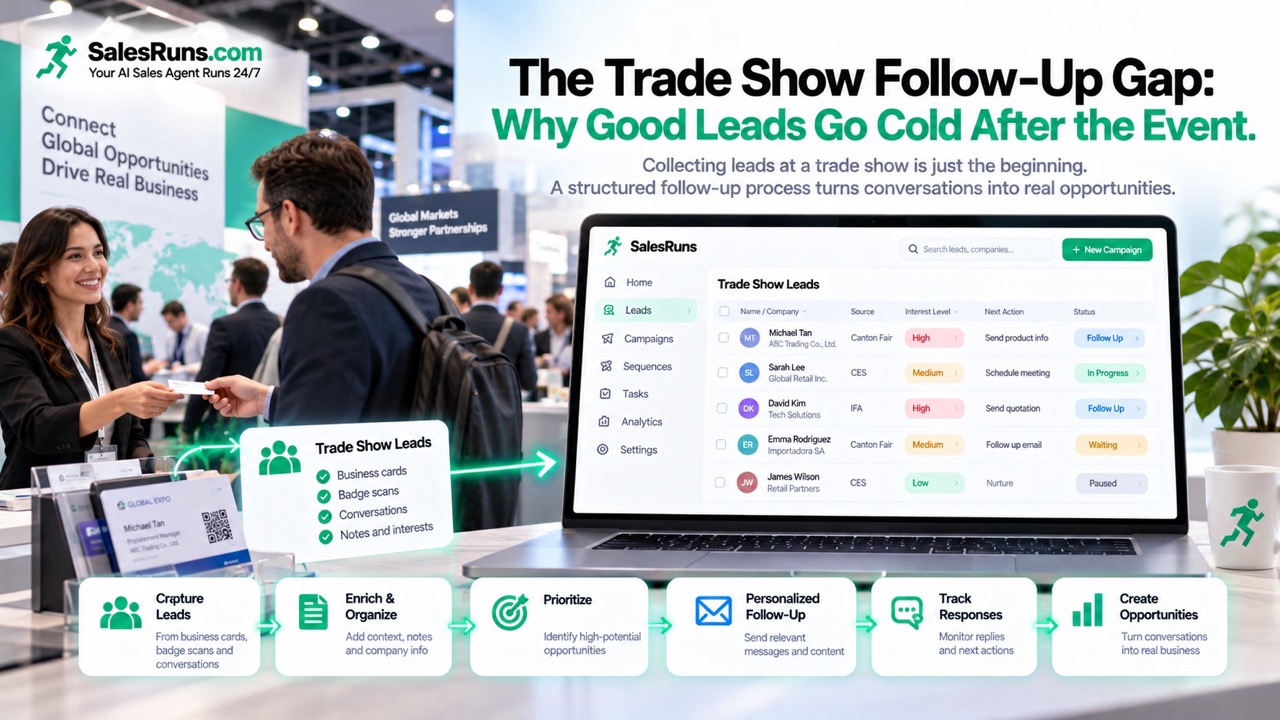
Introduction - The Show Is Over. The Sales Work Has Just Begun.
A team exhibits at an international trade show. Someone collects contact details, scans a badge, or photographs a business card before the team flies home optimistic about the pipeline they just built. Then ordinary work returns. Inbox backlogs, existing accounts, and the next deadline take over. A few prospects get a quick note. Others receive a delayed, generic email weeks later. The most promising conversations are sometimes forgotten until a name resurfaces by accident months later. The real question is how much of the event's value depends on what the sales team does in the following days and weeks. Strong trade show lead follow-up discipline is what separates a trade show that produced pipeline from one that produced a stack of business cards. This article is about building that discipline, not about blaming individual salespeople. The problem is usually the absence of a repeatable process.
1. Why Collecting Leads Is Not the Same as Creating Opportunities
B2B event lead generation produces a list of contacts. Turning that list into pipeline is a different discipline, and most teams lack a defined trade show follow-up strategy, which is why collecting leads and creating opportunities feel like the same step. Several distinct things get flattened together the moment someone writes '200 leads' on a post-event slide. A contact is a name and a way to reach them. A qualified lead has a need, a fit, and enough signal to justify the next step. A customer is someone who bought. Treating them all as one number hides the real state of the pipeline. A badge scan proves attendance, not buying intent. The practical takeaway is to capture the context of each interaction, not just the person's name and email. A contact without context is a cold start for the next person who touches it, and cold starts are where conversations get forgotten and their value quietly drains away.
2. Five Reasons Good Trade Show Leads Go Cold
Most failed follow-up is not a mystery. It follows a small set of recognizable failure modes. Naming them is the first step to designing around them.
- 1. Follow-up starts too late. The team lands, the details fade, and the conversation that felt urgent on the show floor is hard to reconstruct a week later.
- 2. Every lead receives the same message. A generic note ignores what the prospect asked about, the problem they described, and the next step they discussed.
- 3. No one owns the next action. A lead is assigned to a salesperson, but no clear next step or deadline is recorded. Ownership and visible status turn intent into a tracked commitment.
- 4. Follow-up is treated as a single email. One unanswered message is read as rejection, and the prospect leaves the process. A bounded cadence treats non-response as one signal among several, not a closed door.
- 5. The team cannot see what is happening. Managers cannot tell leads awaiting first contact from those who replied. Visibility and an execution record are what make correction possible.
Each failure mode has the same consequence: a real opportunity is dropped, and B2B lead conversion falls because the next action was forgotten, delayed, or poorly coordinated. The fix for all five is the same shape: write it down, assign it, schedule it, and track it.
3. Build a Lead Record While the Conversation Is Still Fresh
Knowing how to follow up with trade show leads starts with the record. The most useful lead record is captured before the next conversation, not typed during a quiet moment weeks later. A practical post-event record contains more than a name and an email:
- Name and company
- Role and decision-making context, when known
- Product or service discussed
- The prospect's stated problem or objective
- Specific questions they raised
- Buying timeline, if explicitly discussed
- The agreed next step
- The assigned owner
- The follow-up deadline
- Relevant communication permissions and preferences
The discipline that matters most is separating observed facts from assumptions. 'Asked about delivery lead times' is an observed fact. 'Ready to purchase this month' is an assumption unless the prospect actually said so. Recording the difference protects the team from confident mistakes. A vague note such as 'Met at booth, interested' becomes an actionable record when rewritten as: 'Operations manager at a contract manufacturer. Asked about ERP integration and delivery for a 500-unit pilot. Owner: Dana. Due: follow-up within 48 hours.' That second version tells the next person exactly what to do. Customer memory of this kind is what lets follow-up pick up where the conversation stopped.
4. Prioritize Leads by Evidence, Not Excitement
Effective trade show lead management assigns a tier, an owner, and a deadline to every actionable contact. Prioritization should follow what the team learned, not how enthusiastic the conversation felt at the time. A simple three-tier framework works for most teams:
| Tier | What it looks like | Next action | Sign it is working |
|---|---|---|---|
| A - Explicit near-term opportunity | A defined business need, a concrete product or commercial question, an agreed next step or stated purchase timeline | Personalized follow-up within 24 hours; prepare the quote or technical information promised | A reply, a meeting booked, or the next step confirmed |
| B - Relevant potential opportunity | Clear product or market fit and meaningful interest, but no confirmed near-term buying process | Relevant follow-up in 2 to 5 days; share one useful item matched to their question | A reply, or interest that holds on a second touch |
| C - Early-stage or unclear interest | Limited conversation context, exploratory curiosity, no identified next step | A light, honest touch; label it and revisit only if a real signal appears | Any explicit signal that moves it to A or B |
These are suggested operational categories, not a universal qualification standard. A medical device buyer and a promotional-products buyer will not have the same tiers, and that is fine. The point is that prioritization decides the relevance and urgency of the next action, not a license to send more messages. Customer intelligence and clear buying signals are what separate Tier A from Tier C, and the difference should be visible to everyone on the team.
5. What a Strong Trade Show Follow-Up Email Looks Like
A strong trade show email follow-up references the event, shows you listened, and delivers something useful. Keep it short and easy to answer. The structure below works across tiers; the content changes with the lead.
Example A - a high-intent prospect. Subject: Follow-up from [Trade Show] - the [product discussed] question Hi [Name], good to meet you at [Trade Show]. You asked about [specific technical or commercial detail], and I pulled together the short answer plus a one-page overview. Are you available for a 20-minute call next Tuesday or Wednesday? I can also send the reference spec first if that is easier. Either way, happy to help you pressure-test the plan.
Example B - a relevant but early-stage prospect. Subject: Notes from [Trade Show] - [topic they cared about] Hi [Name], thanks for the conversation at [Trade Show] about [topic]. I thought this short piece on [relevant subject] might help given what you described. Happy to share how a similar team handled [their stated problem] when the timing is right.
Example C - a prospect who has not replied. Subject: Closing the loop on [Trade Show] Hi [Name], I sent a note after [Trade Show] about [topic] and have not heard back, which is completely fine. I will stop here unless it is useful to continue. If the project picks up later, just reply and I will pick up where we left off. Wishing you a good [quarter or season]. Example C should be sent only when the original outreach and any later contact remain appropriate under applicable law, recipient preferences, and company policy. A polite close protects the relationship better than a fifth unanswered nudge.
6. Build a Follow-Up Cadence Without Becoming a Spammer
A post-event sales follow-up cadence makes sure the right action happens at the right time. It is not a license to send a fixed number of emails to every contact. The schedule below is an illustrative starting point to adapt, not a universal prescription:
- Day 0 to 1: Capture the conversation and prioritize the lead.
- Day 1 to 3: Send relevant follow-up to high-priority prospects, matched to what they asked.
- Day 4 to 7: Provide useful additional information where it is genuinely warranted.
- Day 8 to 14: Follow up on unresolved questions or the previously proposed next step.
- After that: Continue only when there is a valid reason and a suitable communication basis; otherwise pause or close the sequence.
Timing should vary with the prospect's stated timeline, the product and sales cycle, the value and complexity of the opportunity, and previous communication. A prospect who asked for a quotation tomorrow should not receive the same treatment as someone exploring a product for a project next year. The next best action is whatever the recorded context points to, not the next slot in a fixed sequence.
7. The International Trade Show Adds More Complexity
Teams exhibiting internationally take the same problems and multiply them. Time zones delay every reply. Language and localization change what a message means. Business communication norms differ by market. Coordination between sales, engineering, and management slows when everyone is in a different city. Trade show prospect nurturing across markets fails fast when conversation context is lost in translation. The fix is a process that preserves context and routes each question to the right person. A lead record written in clear, factual language travels across time zones and departments without losing its meaning. Avoid broad assumptions about any nationality or market; treat each prospect's stated preferences as the source of truth. The goal is simply that a question asked in one language gets answered correctly in the next.
8. Where Automation Helps, and Where Humans Must Stay Involved
Some parts of post-event follow-up are tedious and repeatable, which makes them good candidates for tooling. Others are judgment-heavy, which makes them poor candidates for silent automation.
- Automation can help with: organizing lead records, flagging missing information, assigning follow-up tasks, preparing draft messages from verified notes, scheduling reminders, and highlighting overdue actions.
- Humans must stay involved in: interpreting ambiguous buying signals, handling commercial negotiations, answering technical questions outside the system's verified knowledge, approving sensitive external communications, resolving objections, and deciding when a relationship needs a personal conversation.
Teams that automate sales follow-up should keep humans on the judgment calls. The line that matters is between preparing an action and executing it. A system can draft the message, surface the context, and queue the task. It should not silently send messages or make commercial commitments beyond its authorization. The useful pattern is human-plus-agent: the tool does the remembering and the preparing, the person does the judging and the committing. That balance is exactly what adaptive follow-up is meant to support, and it is the same boundary that keeps real relationships safe.
9. How SalesRuns Fits Into the Post-Event Follow-Up Problem
SalesRuns.com positions itself as your AI sales agent running 24/7. Its value maps onto this problem: teams need a dependable process for turning customer information into relevant follow-up actions. The platform is built around an AI agent orchestrator, a workflow engine, a Customer Memory and knowledge layer, multi-channel output across channels such as WhatsApp, Telegram, LINE, Slack, Discord, WeChat, and email, and MCP connectors that can reach external systems including common CRMs. Those are the current architectural pieces. How a team might use them is best described as a conceptual workflow unless each piece is verified against the live product:
- Consolidate lead and contact information in one place after the event.
- Turn conversation notes into structured follow-up tasks and sequences.
- Prepare relevant outreach from the recorded context, for a person to review.
- Show workflow status across the team: who owns what, what is due, what is overdue.
- Track replies and surface the next action, including cases that need a human.
What is deliberately not claimed here: SalesRuns is not represented as automatically importing trade show badge scans, connecting to a specific event platform, or replacing human judgment in high-value relationships. The value proposition is narrow and useful. It is to reduce the chance that a meaningful business conversation is lost because the next action was forgotten, delayed, or poorly coordinated. That is a process guarantee, not a volume promise, and it is the same idea behind treating CRM as one system among several rather than the whole answer.
10. A Practical 48-Hour Post-Event Operating Plan
A small B2B team can use this checklist immediately after an event. The timing is a practical recommendation, not a rule; adapt it to event size, lead volume, business norms, and customer expectations.
- Within the first 12 hours: consolidate notes and contact details, remove obvious duplicates, record explicit customer requests, and flag missing information.
- Within 24 hours: prioritize leads based on evidence, assign an owner to each actionable lead, identify promised deliverables and deadlines, and draft personalized follow-up for the highest-priority prospects.
- Within 48 hours: send appropriate follow-up to qualified contacts, confirm that promised documents or answers are delivered, schedule the next action for leads needing attention, and record replies while flagging cases that need human intervention.
11. Measure Follow-Up Quality, Not Just Lead Volume
Lead count is a vanity metric if no one measures what happened next. A useful measurement framework tracks process quality against the team's own baselines, then improves them over time. Do not invent benchmark targets; establish yours and beat them.
- Percentage of leads with complete conversation context
- Time from event interaction to first relevant follow-up
- Percentage of actionable leads with an assigned owner
- Percentage of promised deliverables completed on time
- Reply rate, interpreted with appropriate context rather than as a verdict
- Meetings or qualified next steps generated
- Opportunities created
- Documented reasons for disqualification
- Follow-up tasks overdue
- Opt-outs, complaints, and deliverability problems
One caution worth stating plainly: open rates are not a measure of interest or success. A message can be opened and ignored, or filtered and missed, for reasons unrelated to the prospect. Treat open rate as one weak signal among many, and weight it far below replies, next steps, and opportunities created.
Sources
- CAN-SPAM Act: A Compliance Guide for Business. Federal Trade Commission (FTC). Official U.S. email marketing requirements, including identifiable sender, clear subject, opt-out, and prompt removal of opt-outs. https://www.ftc.gov/business-guidance/resources/can-spam-act-compliance-guide-business
- General Data Protection Regulation (GDPR). European Union. Rules on lawful basis, consent, and direct marketing in the EEA. https://gdpr.eu/
- Email sender guidelines. Google Workspace / Gmail. Sender identity, authentication (SPF, DKIM, DMARC), and complaint or spam-rate expectations for bulk mail. https://developers.google.com/gmail/mass-mailing
- Lead response research. Multiple B2B sales studies on lead response time have consistently found that faster first contact improves the chance of making contact and qualifying a lead. Treat this as a directional principle, not a fixed percentage, and build your own baseline.
How soon should you follow up with trade show leads?
Start within 24 to 48 hours while context is fresh. Tier A leads with a stated need or timeline get personalized follow-up inside 24 hours. Exact timing depends on the prospect's schedule, your sales cycle, and what was promised at the booth. Act before the conversation fades, not to hit a universal deadline.
What should a trade show follow-up email include?
Reference the event, one specific detail that proves you listened, a useful response to the prospect's question, a single clear next step, and a low-pressure close. Keep it short. Skip the generic blast; it should read as if a real person wrote it from real notes.
How do you prioritize trade show leads?
Prioritize by evidence, not excitement. Tier A: defined need plus concrete question plus agreed step or timeline. Tier B: clear fit, no near-term process. Tier C: early or unclear. The tier sets the speed and relevance of the next action, not how many messages everyone receives.
How many times should you follow up after a trade show?
No fixed number fits every industry. A reasonable cadence: relevant follow-up in days 1 to 3, useful information in days 4 to 7, a check on the open question in days 8 to 14. After that, continue only with a valid reason. A polite close beats repeated nudges.
How can a small sales team manage trade show leads?
Capture context while fresh, de-duplicate fast, assign an owner to every actionable lead, track status in one place. A 48-hour plan helps: consolidate in 12h, prioritize and assign in 24h, reach out and record replies in 48h. Tooling prepares drafts; a named owner moves leads forward.
Can AI help with trade show lead follow-up?
Yes, for the repeatable parts: organizing records, flagging gaps, assigning tasks, preparing drafts from verified notes, reminders, surfacing overdue actions. AI should not silently send messages or commit beyond its authority. Humans stay on ambiguous signals, negotiations, and sensitive approvals.
How do you measure the success of post-event follow-up?
Measure process quality, not just lead volume. Track complete-context rate, time to first follow-up, owned-actionable rate, on-time deliverables, replies, next steps, opportunities, disqualification reasons, overdue tasks, and opt-outs. Open rate alone is a weak signal.