A salesperson attends CES. Then Hannover Messe. Then a regional trade show. Between events they join meetings, collect business cards, connect on LinkedIn, exchange emails, book demos. The pipeline looks full.
Six months later, most of those relationships have gone silent.
Not because the customers were not interested. Because nobody consistently maintained the relationship. The rep who owned those conversations got pulled into a deal that closed this quarter, then another deal, and the threads that were not urgent quietly went cold. This is not a story about one salesperson. It is how most B2B revenue organizations actually operate. They are good at starting conversations. They are inconsistent at keeping them alive.
The fastest path to more revenue is not always another lead generation campaign. It is building stronger engagement with the customers and prospects you already know.
1. More Leads Do Not Automatically Create More Revenue
If you ask a VP of Sales what they need, the answer is almost always "more leads." It is the default reflex. Paid ads get budgeted. Outbound campaigns launch. Contact lists get purchased. Cold outreach tools get deployed. And the top of the funnel fills up. But here is what happens next: those new leads land in a system that is already struggling to engage the existing ones. A typical SaaS company has thousands of "open" opportunities that have not been touched in 90 days. A manufacturing exporter has a spreadsheet of five hundred trade show contacts from the last two years, maybe twenty percent of whom received a second message. A professional services firm has a list of webinar attendees who downloaded a white paper and never heard back. Acquisition without engagement does not create growth. It creates an expanding list of forgotten opportunities. You are pouring water into a bucket with holes in it, then buying more water instead of patching the holes.
The math is uncomfortable but straightforward. If your team converts three percent of the leads you generate, and you double lead volume without changing anything about how you follow up, you do get roughly twice as many deals — but you also get roughly twice as many ignored prospects, twice as many cold threads, and twice as much wasted spend on acquisition. The real leverage is not in the numerator (more leads). It is in the denominator (better conversion through better engagement).
2. Every Existing Customer Relationship Is an Asset
Think about what happens in a single meaningful sales conversation. The customer tells you their business priorities. They mention a buying timeline. They name internal stakeholders who need to sign off. They express interest in specific products or features. They raise objections that reveal what they actually care about. They reference competitors they are also talking to. Each one of these data points is valuable. Together, they form something richer than a contact record: they form context. And context is what separates a generic follow-up email from one that makes the recipient think, "They actually remember what we talked about."
The problem is that this context depreciates fast. A conversation from three months ago might as well be from three years ago if nobody wrote down the important parts, and even if they did, that note lives in one person's CRM, visible only when someone thinks to look for it. Meanwhile, the customer's situation has evolved. Their priorities shifted. Their timeline moved. A new stakeholder entered the picture. The information you gathered is now partially stale, and nobody noticed. Customer relationships should be treated like long-term business assets that appreciate when maintained and lose value when neglected. Most companies are sitting on assets they do not even realize they own.
3. Customer Engagement Is the Real Growth Engine
There is a pattern that shows up repeatedly in sales data: the companies with the highest revenue per rep are not necessarily the ones generating the most leads. They are the ones doing the best job of staying relevant to the prospects and customers they already have. Consistent engagement produces things that one-off outreach cannot: **Trust.** Customers buy from people and companies they trust. Trust builds through repeated, relevant touchpoints over time, not from a single polished pitch. **Referrals.** The strongest source of new business is a recommendation from someone who has already bought from you. But referrals only come from relationships that feel genuine, not transactional. **Repeat purchases and expansion.** Existing customers are far cheaper to sell to than new ones, and they often want to buy more — if someone notices the signal and acts on it. **Faster decisions.** When a prospect has been engaged consistently, the buying cycle compresses because the foundational work (understanding needs, building credibility, addressing concerns) was spread across months of light touches instead of crammed into a few heavy meetings near the end. This is what we call Continuous Customer Engagement: not blasting messages, but maintaining a rhythm of relevant, contextual interaction with every relationship that matters.
4. How AI Sales Agents Scale Customer Engagement
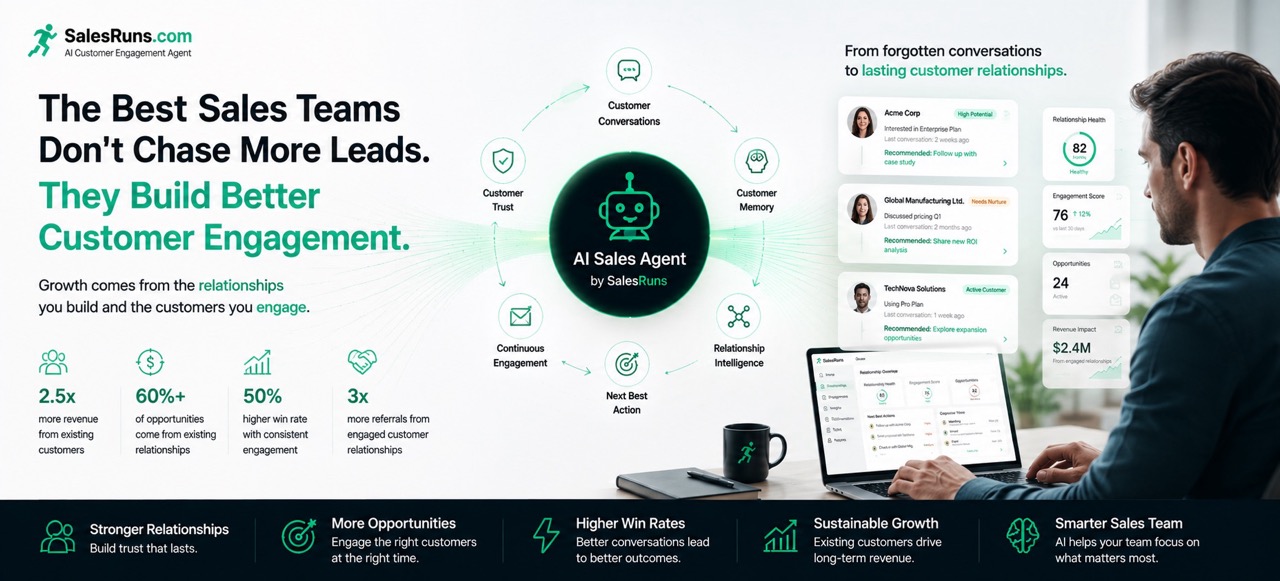
An AI Sales Agent is not a chatbot that answers questions. It is an intelligent system that helps sales teams execute the work of customer engagement at scale: remembering conversations, understanding where each relationship stands, prioritizing who needs attention, and recommending what to do next. Think of it as a layer of judgment on top of the data you already collect. Your CRM knows who was contacted and when. An AI Sales Agent understands whether that contact moved the relationship forward or backward, what the customer actually cares about based on everything they have ever said, and which of your three hundred open opportunities should be contacted today versus which one should wait two weeks.
Four things an AI Sales Agent actually does: It remembers. Every email, every meeting note, every objection, every buying signal gets captured and preserved in Customer Memory. When you reopen a conversation six months later, the context is there. It understands. By analyzing patterns across all your customer interactions, it builds Relationship Intelligence: which relationships are warming up, which ones are cooling down, what signals indicate a buying window, and what the common blockers are. It prioritizes. Out of hundreds of relationships, it can tell you which ten need attention this week and why — not by arbitrary scoring rules, but by reading the actual state of each relationship. It recommends action. For each priority relationship, it suggests the Next Best Action: the specific thing to say or do that moves the conversation forward, grounded in what that particular customer has already told you.
Here is what it does not do: replace salespeople. The AI handles the repetitive, memory-intensive work — tracking, analyzing, prioritizing, drafting. The human handles the parts that require judgment, creativity, and relationship instinct: the nuanced negotiation, the complex objection, the strategic account decision. Good AI makes humans better at being human. It does not try to be human.
5. Why Customer Memory Matters
Without Customer Memory, every new touchpoint with a customer starts from scratch. Or worse, it starts from a wrong assumption because the person reaching out did not read the last three emails. The customer can tell. They can always tell. With Customer Memory, every conversation continues naturally. The AI knows that this prospect mentioned a Q4 budget review in March. That this customer prefers short emails on Tuesdays. That this account has a champion in operations but the decision-maker is in finance. That the last conversation ended with a specific question about API integration that was never answered. This is not a nice-to-have. In competitive B2B markets, the vendor that remembers the details usually wins. Not because their product is dramatically different, but because the customer feels understood. Feeling understood is a differentiator that is very hard to copy.
6. SalesRuns: Building an AI Customer Engagement Agent
SalesRuns is an AI Sales Agent and AI Customer Engagement Agent designed to help companies transform customer conversations into long-term customer engagement. It works across the channels your team actually uses — email, WhatsApp, LinkedIn, Telegram, enterprise WeChat — and it brings the same capabilities we just discussed to every relationship in your pipeline:
- Remember every customer. Customer Memory captures conversations, preferences, buying signals, and relationship history so nothing falls through the cracks.
- Understand every relationship. Relationship Intelligence reads engagement signals across all channels to tell you which relationships are heating up and which need attention.
- Identify engagement opportunities. The system spots signals that a human would miss at scale: a dormant account showing renewed activity, a prospect mentioning a competitor for the first time, a customer whose usage pattern suggests expansion.
- Recommend the Next Best Action. Instead of a generic "follow up," you get a specific suggestion grounded in what that customer has actually told you: send the case study they asked about, check in on the pilot they launched, reconnect around the budget cycle they mentioned.
- Maintain thousands of relationships consistently. An AI Sales Agent does not get busy, distracted, or pulled into a fire drill. Every relationship gets the attention cadence it deserves, every time.
SalesRuns is not a CRM replacement. It is an execution layer that sits on top of your existing workflow and makes sure the relationships you worked hard to build keep producing value long after the initial conversation.
What This Looks Like in Practice
Trade Show: 800 Contacts, Zero Follow-up?
A manufacturing company returns from a major trade show with eight hundred scanned badges and a stack of business cards. Traditionally, maybe fifty get a follow-up email within two weeks. The rest sit in a spreadsheet that nobody opens again. With an AI Sales Agent, every conversation becomes searchable relationship intelligence. The system categorizes contacts by role, region, and expressed interest. It drafts personalized follow-ups referencing the actual booth discussion. It sequences the outreach so high-intent prospects hear back within 48 hours and lower-priority contacts enter a nurturing cadence. Eight hundred contacts stop being a guilt pile and start becoming a structured pipeline.
The Eight-Month Pause
A prospect engaged seriously, asked detailed questions, then went quiet for eight months. Budget freeze, they said. Call me in Q3. Most reps would either forget entirely or send a generic "just checking in" that the prospect ignores. An AI Sales Agent remembers exactly what was discussed: the product configuration they liked, the objection about implementation timeline, the name of the stakeholder who needed to approve. When Q3 arrives, the re-engagement message references the real conversation, not a template. The prospect feels remembered because they actually were.
Expansion Signal Missed
An existing customer has been using your platform for eighteen months. Their usage data shows a 40% increase in seat count over the past quarter. Someone in their organization posted a job description that mentions your product category. These are expansion signals. Without a system watching, these signals pass unnoticed until the customer calls you — or worse, until a competitor calls them first. With Relationship Intelligence, the AI flags the signal and recommends proactive outreach: "This account is growing. Now is a good time to discuss expansion pricing." The conversation starts with you leading, not reacting.
Key Takeaways
- More leads without better engagement = more wasted opportunities. The bottleneck for most B2B companies is not discovery. It is consistent, contextual follow-through.
- Every customer relationship is a business asset. Each conversation generates context (priorities, timelines, stakeholders, interests) that appreciates when maintained and loses value when neglected.
- Continuous Customer Engagement drives trust, referrals, repeat purchases, and faster deals. These outcomes come from sustained relevance, not from one-off outreach blasts.
- AI Sales Agents scale engagement by remembering, understanding, prioritizing, and recommending. They handle the memory-intensive work so humans can focus on judgment, creativity, and closing.
- Customer Memory is the unfair advantage. In competitive markets, the vendor that remembers the details wins because the customer feels understood — and feeling understood is hard to copy.
- The next decade belongs to companies that build the strongest relationships, not the largest databases. AI Sales Agents make that possible at scale.
Conclusion
The companies that will grow fastest over the next decade will not necessarily be the ones with the largest lead databases or the biggest outbound budgets. They will be the ones that build the strongest customer relationships and maintain them consistently over time. That used to require an army of account executives with perfect memories and infinite discipline. It now requires an AI Sales Agent that remembers every conversation, understands every relationship, and ensures that no opportunity goes cold simply because nobody got around to following up. SalesRuns helps sales teams turn every customer interaction into lasting knowledge, every relationship into meaningful engagement, and every engagement into sustainable revenue growth. The leads are probably already there. The question is whether you are engaging them.