Monday morning. A salesperson opens the CRM and watches the screen fill up.
Four hundred contacts. Thirty-one open opportunities. Nine customers who were promised a reply last week and never got one. Three prospects whose activity jumped on Friday afternoon. Two renewals that need a real conversation instead of another automated touch.
Nothing on that screen is broken. The data is clean, the tasks are assigned, the reminders are firing on schedule. That is precisely the problem. This salesperson has no shortage of information and no shortage of things they could do. What they lack is an answer to a single question:
What should I do next?
That question is where most sales technology quietly gives up. CRMs record what happened. Sequences schedule what should happen at fixed intervals. Dashboards summarize what sits in the pipeline. None of them tell you which of those four hundred relationships deserves your attention this morning, or what a useful action would even look like.
Next Best Action exists to close that gap.
1. Sales Teams Don't Have an Activity Problem
Ask a sales leader what is slowing their team down and you will usually hear something about effort. Not enough calls, not enough follow-ups, not enough pipeline generated. The fix sounds obvious: more activity. Look at how a seller actually spends a Tuesday and the diagnosis changes. The modern sales stack is already extremely good at producing work. There are CRM tasks waiting to be closed. There are email sequences that will send themselves whether or not sending is appropriate. There are reminders, notifications, lead scores, dashboard alerts, and a growing pile of automated nudges all competing for the same finite attention. The bottleneck is not output. It is judgment. A rep on a mid-market team might carry two hundred open relationships at any moment. Perhaps six of them genuinely warrant action today. Finding those six inside the two hundred is the actual job, and it is the part no tool has really helped with. What most platforms do instead is add to the pile. One more task. One more sequence step. One more notification announcing that a prospect opened an email. More tasks do not produce more revenue. Relevance does. And relevance requires knowing something specific about the relationship in front of you, which is a different problem from scheduling.
2. What Is Next Best Action in Sales?
Next Best Action is an AI-driven recommendation that identifies the most appropriate action a salesperson should take for a specific customer or opportunity, based on context, engagement, timing, and relationship history. Two parts of that definition carry the weight. The first is specific. A useful recommendation is addressed to one customer, not to a segment. The second is context. The recommendation has to be grounded in what has actually happened between the two of you, not in a playbook that assumes every customer behaves the same way. Next Best Action is frequently confused with three things it is not:
- Generic task automation. Automation creates the task "follow up with Acme." Next Best Action explains why Acme, why today, and what the conversation should be about.
- Scheduled reminders. A reminder fires because a timer elapsed. A recommendation fires because something changed in the relationship.
- Fixed sales sequences. A sequence treats the fifth touch as identical for everyone. A recommendation treats it differently for a customer who just added a stakeholder than for one who has gone quiet.
The distinction is not sophistication for its own sake. It is about what happens after the recommendation lands. A rep who understands why an action matters will take it. A rep who receives another unexplained task will clear it or ignore it, and the CRM will record the activity either way.
3. Why Context Matters More Than Activity
Consider a single instruction: follow up with this customer. On its own, that sentence is close to useless. It carries no information about what to say, when to say it, or whether saying anything at all is a good idea. Two salespeople can receive the identical instruction and produce wildly different outcomes, because the instruction never contained the part that mattered.
Now attach context. This customer raised an expansion question six weeks ago, went silent for a month, opened the revised proposal twice last week, and added their operations director to the thread on Thursday. The instruction has not changed. What changed is that it is now actionable. The rep knows the opening line, knows who else should be on the call, and knows they are not interrupting a dormant relationship with noise. Same words. Same customer. Completely different quality of decision. This is why activity metrics struggle to predict anything useful. Counting touchpoints aggregates away the very differences that determine whether a follow-up lands or annoys. A customer with twelve interactions this quarter might be drifting. A customer with three might be ready to buy. The number tells you volume. It does not tell you direction. Genuine context comes from a handful of specific places:
- What was actually said, across every channel, not only the ones that sync to the CRM
- Which stakeholders have joined, left, or gone quiet
- Where commitments were made, and whether they were kept
- What this customer has objected to before, and what resolved it
- How long the relationship has been moving, and in which direction
Without that material, any recommendation is guesswork wearing a confident font.
4. Customer Memory Is What Makes Next Best Action Possible
An AI system cannot recommend a meaningful action if it does not understand what came before. That sounds obvious, and it is the reason so much "AI in sales" fails in practice: the model is capable, the history is missing. Customer Memory is the persistent, structured record of a customer relationship built from every conversation, email, meeting, and interaction over time. It is not a snapshot of the last touch. It is the accumulated record that gives any single activity its meaning. What Customer Memory typically holds:
- Conversation history. What was discussed, what was promised, what was left unresolved.
- Product interest. Which capabilities came up repeatedly, and which ones the customer dismissed.
- Objections. The specific concerns raised, and what eventually moved the conversation past them.
- Stakeholder map. Who is involved, who influences, who has gone silent, who just appeared.
- Preferences. Channel, tone, cadence, and the level of detail this particular buyer expects.
- Timeline. When things started moving, when they stalled, and what triggered each shift.
The practical effect is that isolated activities become a relationship narrative. A proposal view stops being a row in an analytics table and becomes a data point set against six weeks of silence that preceded it. A new name on a thread stops being a contact record and becomes evidence of internal alignment. Customer Memory is what allows an AI Sales Agent to say something more useful than "this deal has not moved in eleven days." It allows the system to say the deal has not moved because the person who raised the budget objection has not been in a conversation since March, and the operations lead who just joined the thread is the one who can unblock it. That is a different level of information, and it points at a different action.
We wrote about how this works in practice in Why AI Sales Agents Need Customer Memory to Build Better Relationships.
5. Relationship Intelligence Connects Signals to Decisions
Customer Memory on its own is an archive. It becomes valuable when something reads it for meaning. That is the job of Relationship Intelligence: the layer that interprets stored context and turns it into an understanding of where a relationship stands and where it is heading. The chain runs in a specific order, and skipping a link breaks the result.
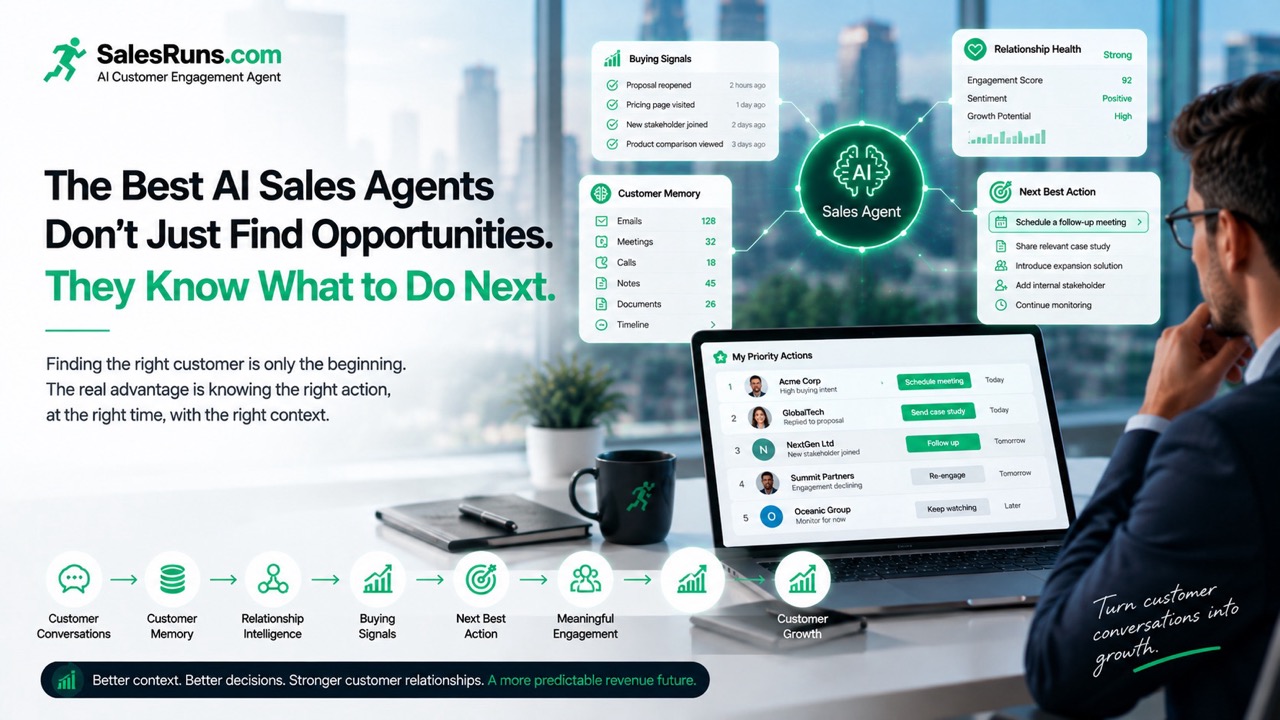
Customer Data → Customer Memory → Relationship Intelligence → Buying Signals → Next Best Action Each stage has a distinct responsibility.
Customer Data is raw. Emails, calls, meeting notes, replies, website visits, documents exchanged. On its own it is volume. Customer Memory structures that raw material into a persistent relationship record: what was said, by whom, with what outcome, and what remains open. Relationship Intelligence reads the record for patterns. Is engagement accelerating or fading? Has the tone shifted? Is the conversation widening to more stakeholders or narrowing to one? Is this customer moving toward a decision, or quietly stepping back? Buying Signals are the specific, time-bound events suggesting something may be changing right now. A dormant prospect opens an old proposal. A customer who only ever spoke with one team suddenly adds three people. Pricing pages get revisited after a long gap. Signals tell you when attention is warranted. Next Best Action turns that understanding into a recommendation: connect with this person, share this specific case study, bring in an executive, open the expansion conversation, or hold and keep watching. The order matters because each stage depends on the one before it. Signals without memory are noise. A pricing page visit means nothing unless you know the visitor had a budget conversation two months ago and never got an answer. Recommendations without signals are generic. And if nothing has changed, the honest recommendation is often to wait, which brings us to the next section.
We covered signal detection in more detail in Why AI Sales Agents Should Understand Buying Signals, Not Just Customer Data.
6. Not Every Customer Should Receive a Message
This is the design choice that separates a real AI Sales Agent from an outreach machine, and it is worth being blunt about. A sophisticated system should know when not to engage. Most sales tooling is structurally biased toward action. Sequences are built to send. Dashboards are built to prompt. Almost nothing in the standard stack is designed to tell a rep "leave this one alone for now," because that does not show up in a weekly activity report. But the honest range of valid next actions includes several that produce no outbound activity at all:
- Follow up now, because something meaningful changed
- Send something genuinely useful, tied to a specific stated interest
- Schedule a meeting, because the relationship has reached that point
- Contact a different stakeholder, because the current one has gone quiet
- Wait, because the customer is mid-evaluation internally and another nudge would be noise
- Continue monitoring, because something is starting to move but has not moved yet
The last two are the ones most systems cannot express. They matter because a message sent at the wrong moment costs more than a message not sent. It resets the customer's patience, adds a data point that says you were not paying attention, and in a crowded inbox it teaches the recipient to filter you out. The objective was never maximum activity. It is maximum relevance. Sometimes relevance looks like silence, plus a note in the file that says watch this account closely for the next ten days.
Follow-up timing is not a detail. Why Great Salespeople Always Follow Up covers why persistence is what separates good sellers from average ones, and that principle holds. It just works in both directions. A follow-up that arrives at the wrong moment undoes the persistence that came before it. We looked at the same idea from another angle in The Hidden Cost of Forgotten Conversations. The damage usually is not caused by an over-eager message. It is caused by a good moment nobody noticed in time.
7. SalesRuns: From Customer Intelligence to Next Best Action
SalesRuns is an AI Customer Engagement Agent built to help sales teams manage customer relationships at scale. Not by sending more, but by helping teams decide what actually deserves attention. The platform combines four capabilities that only work as a set:
- Customer Memory — every conversation, across every channel, retained and structured as a persistent relationship record instead of scattered notes.
- Relationship Intelligence — that record is analyzed continuously for engagement trends, stakeholder dynamics, sentiment shifts, and momentum.
- Buying Signals — meaningful changes surface as they happen, not in a monthly summary.
- Next Best Action — signals and context are converted into a specific, contextual recommendation for a specific person.
Taken together, they answer four questions a CRM is not built to answer:
- Who deserves attention? Which relationships have changed in a way that warrants action.
- Why now? What actually happened to make this the right moment rather than last week or next month.
- What should happen next? Which action fits, given the relationship history and the current stage.
- What should the salesperson say or do? The specific angle, reference point, or resource that suits this conversation.
SalesRuns is not designed to automate mass outreach. It is designed to help sales teams make better customer engagement decisions, which is a different category with a different measure of success. The number that matters is not how many messages left the building. It is how many relationships moved forward. This is also where Next Best Action differs from health tracking alone. Health tells you where a relationship stands. Next Best Action tells you what to do about it. We explored the measurement side in The Best AI Sales Agents Don't Just Track Customers. They Measure Relationship Health. and the category difference in AI Sales Agent vs CRM: Why Modern Sales Teams Need Relationship Intelligence.
Practical Examples
Example 1 — Prospect re-engagement. A prospect went quiet in April after a promising first round. Then three things happen inside one week. They reopen the proposal you sent in March, spend time on the pricing page, and reply to an email from four months ago with a short question. A sequence would notice an engaged lead and fire the next scheduled template. Next Best Action sees a relationship reawakening after a specific stall, and recommends a contextual re-engagement that references the original conversation and the unresolved question from March. The gap in response rate between those two approaches is not subtle.
Example 2 — Existing customer expansion. A long-standing customer has been consistently engaged, a new stakeholder joins the conversation, and product discussions start drifting into an adjacent category they have never bought. The system reads three things together: healthy momentum, widening stakeholder involvement, and interest in new territory. Each alone is ambiguous. Combined, they point to expansion, and the recommended action becomes a conversation about the next category rather than another check-in call.
Example 3 — The wrong time to contact. A customer has low engagement, no recent buying signals, and has not responded to the last two touches. Nothing in this relationship is moving. The default behaviour of most tools is to send another message, because the sequence is not finished. The correct behaviour is to recommend waiting, and to keep the account under active monitoring so that the moment something changes, the team knows immediately. That recommendation is uncomfortable for teams conditioned to count touchpoints. It also tends to produce better outcomes than another unanswered email.
The Next Best Action Flywheel
Every interaction feeds the loop, and the loop is what makes recommendations improve over time.
AI Sales Agent vs Sales Automation
The difference between these two categories is not how advanced the technology is. It is what the system is responsible for.
| Sales Automation | AI Sales Agent | |
|---|---|---|
| **Core function** | Execute predefined workflows | Understand customer context |
| **Optimizes for** | Volume and consistency of touches | Relevance of decisions |
| **Input** | Contact records, sequence rules, schedules | Conversation history, engagement patterns, stakeholder dynamics |
| **Trigger** | A timer or a workflow step | A meaningful change in the relationship |
| **Output** | A task, a scheduled message, a completed step | A recommendation with reasoning and context |
| **Response to silence** | Sends the next message in the sequence | May recommend waiting and continued monitoring |
| **Personalization** | Merge fields and templates | Conversation-specific angles drawn from memory |
| **Success metric** | Emails sent, tasks completed, activities logged | Relationships advanced, decisions improved |
| **Failure mode** | Irrelevant touches that train customers to ignore you | Recommendations that lose rep trust |
The short version: automation executes, intelligence decides. Both are useful, and they solve different problems. A team that only automates gets faster at doing things that may not need doing. A team that adds intelligence on top gets better at choosing what to do in the first place.
Key Takeaways
- More activity is not the answer. Sales teams are not short on tasks, sequences, or notifications. They are short on decisions about which relationships deserve attention today.
- Next Best Action means one specific recommendation for one specific customer, grounded in context, engagement, timing, and relationship history.
- Context is the whole difference. The same instruction produces completely different results depending on what the system knows about the customer's history.
- Customer Memory makes recommendations possible. Without a persistent record of what has been said and done, an AI Sales Agent is guessing with better grammar.
- Relationship Intelligence turns memory into meaning. It explains why a signal matters, which is what separates a useful recommendation from a raw alert.
- Not engaging is a valid recommendation. A system that cannot say "wait" is not making decisions. It is executing.
- Automation executes; intelligence decides. The two categories complement each other, and only one of them answers the question of what to do next.
- SalesRuns combines Customer Memory, Relationship Intelligence, Buying Signals, and Next Best Action to help teams understand who should be engaged, why, when, and what should happen next.
Frequently Asked Questions
What is Next Best Action in sales?
Next Best Action is an AI-driven recommendation that identifies the most appropriate action a salesperson should take for a specific customer or opportunity, based on context, engagement, timing, and relationship history. Unlike a task or a reminder, it explains why the action is appropriate now and what the conversation should be about.
How does an AI Sales Agent determine the Next Best Action?
It combines four inputs: Customer Memory (what has been said and done across every channel), Relationship Intelligence (patterns and momentum in that history), Buying Signals (recent events that indicate something is changing), and timing. Together these let the system identify which relationship has changed, why it matters, and which action fits the current stage.
What is the difference between Sales Automation and an AI Sales Agent?
Sales automation executes predefined workflows: it sends scheduled messages, creates tasks, and moves contacts through fixed sequences. An AI Sales Agent interprets context and recommends decisions. Automation executes; intelligence decides. Automation optimizes for volume and consistency, while an AI Sales Agent optimizes for the relevance of each action.
How does Customer Memory improve sales recommendations?
Customer Memory supplies the history that makes a recommendation meaningful. Without it, a system can only react to the latest event. With it, the same event can be interpreted against months of context: what was promised, which stakeholders are involved, what objections were raised, and where the relationship stalled. That context is what turns a generic nudge into a specific, usable action.
What is Relationship Intelligence?
Relationship Intelligence is the layer that reads Customer Memory for meaning. It interprets engagement trends, stakeholder dynamics, sentiment shifts, and momentum to explain where a relationship stands and where it is heading. Buying Signals tell you something may be changing. Relationship Intelligence explains why it matters.
Can an AI Sales Agent recommend when not to follow up?
Yes, and it should. A sophisticated AI Sales Agent recognizes that some of the most valuable recommendations involve no outbound activity: waiting while a customer completes an internal evaluation, or continuing to monitor an account that is beginning to move. The objective is maximum relevance, not maximum activity.
How does SalesRuns use Next Best Action?
SalesRuns is an AI Customer Engagement Agent that combines Customer Memory, Relationship Intelligence, Buying Signals, and Next Best Action. It helps sales teams answer four questions: who deserves attention, why now, what should happen next, and what the salesperson should say or do. SalesRuns is built to improve engagement decisions rather than to automate mass outreach.