Two prospects enter the same sequence on the same Monday.
They get the same introduction email. The same value message on day four. The same case study on day nine. The same check-in on day sixteen.
By then their situations have nothing in common. One has forwarded your pricing page to a colleague and asked about implementation timelines. The other has opened nothing since day two and stopped visiting the site entirely.
The sequence treats them identically, because the sequence has no idea either of them exists as anything more than a row in a table.
That is not a failure of effort. Both prospects received exactly what was planned. It is a failure of judgment, and judgment was never part of the design.
Sales follow-up is not optional. Most B2B deals require multiple touches, and sellers who win tend to be the ones who stay present without becoming noise. The problem is that "follow up automatically" and "follow up intelligently" got treated as the same sentence. They are not. This article is about the second one.
1. Why Traditional Sales Follow-Up Automation Is So Rigid
Start with what automation genuinely fixes, because the case against rigidity is not a case against automation.
- Remembering. A seller managing two hundred open relationships will forget things. Software does not.
- Cadence. Without a schedule, follow-up happens when someone finds time, which is to say unevenly.
- Coverage. Automation ensures no opportunity disappears simply because nobody got to it.
- Consistency. New reps inherit a working process instead of inventing one from scratch.
Those are real gains. The rigidity is not in the automation. It is in what the automation is allowed to assume. Every sequence rests on three assumptions: that timing should be uniform, that message content should be uniform, and that the customer journey has a predictable shape. Day one, day seven, day fourteen, day thirty. The schedule is the strategy. That worked in a world where buyers moved through a funnel at roughly the same speed. B2B buying stopped working that way years ago. Buying groups expanded, evaluation cycles became non-linear, and a substantial share of decisions now begin before anyone talks to a salesperson. The sequence keeps ticking on day count regardless.
2. Customers Don't Follow Sales Sequences
Ask any account executive what actually happens between first touch and a decision, and the answer sounds nothing like a cadence.
- A prospect replies within an hour because a budget cycle just opened and the timing is suddenly right.
- A prospect goes silent for five weeks because a reorg moved the project to someone else.
- A new stakeholder appears in the middle of a thread, usually without introduction.
- A proposal gets reopened three weeks after it was sent, at eleven at night.
- A customer asks about pricing for something they were never pitched.
- A priority changes and the whole initiative pauses until next quarter.
- Someone who said no in March comes back in September with a different problem.
Each of those events changes what the right next move is. None of them change the day counter. That is the mismatch in one sentence. Sequences are organized around elapsed time. Customers are organized around events. This is also why the follow-up question is not really a scheduling question. Why Great Salespeople Always Follow Up makes the case that persistence separates good sellers from average ones, and that holds. But persistence in the wrong direction is just noise delivered on schedule.
3. What Is Adaptive Sales Follow-up?
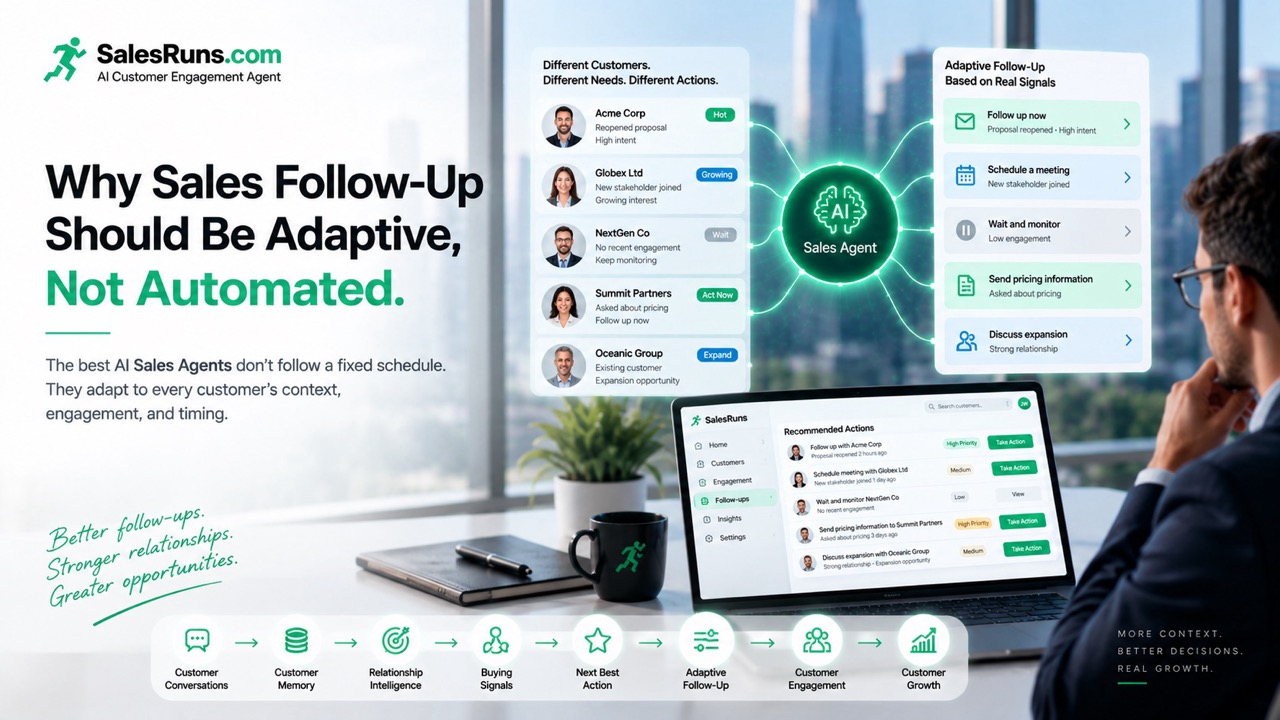
Adaptive Sales Follow-up is an AI-driven approach that adjusts follow-up timing, content, channel, and action according to customer context, engagement, relationship history, and buying signals. The definition has four moving parts, and all four have to move for it to mean anything.
Timing. When should this customer hear from you? Not the day after the last message, but when something has changed. A reopened proposal can justify contact within a few hours. A quiet account with no signal may justify three weeks of silence, and that silence is a decision rather than an omission.
Content. What is the conversation actually about? A generic check-in asks the customer to do the work of remembering why they cared. Contextual follow-up continues a thread that already exists, which is a much smaller ask.
Channel. Email is the default because it is cheap and asynchronous, not because it is always right. Sometimes the next interaction should be a call, a meeting, a document sent to a different stakeholder, or a short message to the person who actually owns the budget.
Action. This is the part most automation cannot express. The next thing that should happen may not be a message at all. It might be an internal task, a meeting request, a case study, an introduction, or nothing. Adaptive follow-up is not a longer sequence with more branching. It is a decision made per customer, informed by everything known about them.
4. Customer Memory Makes Follow-up Relevant
Without Customer Memory, an AI system can still send messages. It will send them on time, in a reasonable tone, with the customer's name spelled correctly. It just will not know what happened before. With Customer Memory, follow-up stops being a broadcast and starts being a continuation. Customer Memory is the persistent, structured record of a relationship: what was said, by whom, when, and what it implies. In practice that has to cover:
- Conversations. Emails, calls, meetings, chat, notes, across every channel the relationship touches
- Product discussions. Which capabilities came up, what was evaluated, what got ruled out
- Objections. What the customer pushed back on, and whether it was ever actually resolved
- Priorities. What the customer said matters this quarter, in their own words
- Commitments. What you promised, what they promised, and which side is behind
- Relationship history. Who has been involved, who left, who joined, who decides
The value compounds over time. A message that references a specific objection raised in May and resolved in June reads like a seller paying attention. The same message sent without that context reads like a template, because it is one. Buyers are efficient at telling the two apart, and they respond accordingly. We covered the mechanics in Why AI Sales Agents Need Customer Memory to Build Better Relationships. The short version is that memory is what turns an outreach list into a set of relationships with histories. And The Hidden Cost of Forgotten Conversations explains the cost of the opposite: what it takes from a relationship when a customer has to repeat themselves.
5. Buying Signals Should Change the Follow-up Strategy
A buying signal is a change in customer behavior that suggests something is moving. Not every signal deserves a message, and that is precisely the point.
- Proposal reopened → follow up sooner, while the document is still fresh in their mind
- New stakeholder joins → introduce relevant context and treat it as a new relationship rather than a name added to a CC line
- Engagement declines → reconsider the approach instead of increasing frequency
- Pricing question appears → prioritize an immediate, specific response, because pricing questions have short half-lives
- No meaningful signal → keep monitoring and let the account rest
The key principle: not every signal means send an email. A signal with no clear implication is better handled by waiting than by manufacturing activity that only looks like progress. Signal detection and its failure modes deserve their own treatment. We went deeper in Why AI Sales Agents Should Understand Buying Signals, Not Just Customer Data.
6. Next Best Action Is More Important Than Next Scheduled Message
Here is the question that separates the two categories of tooling. Traditional automation asks: what message should be sent next? An AI Sales Agent should ask: what is the best action for this customer right now? The second question allows answers the first cannot even express.
- Follow up, with a specific angle drawn from the relationship
- Schedule a meeting, because the conversation has outgrown email
- Share a case study, matched to a concern the customer actually raised
- Bring in another stakeholder, on your side or theirs
- Discuss expansion, because the account is already asking about it
- Change the communication approach, because the current one is not landing
- Wait, because nothing has changed and another message would cost more than it earns
That last option is the tell. A system that cannot recommend waiting is not making a decision. It is executing a schedule and calling the output a decision. We laid out the full argument in The Best AI Sales Agents Don't Just Find Opportunities. They Know What to Do Next. Relationship Health sits underneath all of this. To recommend an action, a system needs some working notion of whether a relationship is strengthening, flat, or slipping. That measurement is what makes a recommendation more than a confident guess. The Best AI Sales Agents Don't Just Track Customers. They Measure Relationship Health.
7. SalesRuns: Adaptive Customer Engagement
SalesRuns is an AI Customer Engagement Agent built for teams managing more relationships than any individual seller can hold in their head. It is an AI Sales Agent designed to treat the customer relationship as the unit of work, rather than the message. Four capabilities support adaptive follow-up:
- Customer Memory: every conversation across every channel, retained as structured relationship history
- Relationship Intelligence: patterns in that history, including momentum, engagement shifts, stakeholder dynamics, and risk
- Buying Signals: meaningful changes surfaced as they happen rather than at the next pipeline review
- Next Best Action: a specific recommendation, with reasoning, for what should happen next
Together they answer four questions a CRM was never built to answer:
- Who deserves attention today? Which relationships have changed in a way that makes now different from last week
- Why now? What specifically happened that justifies acting
- What should the conversation be about? Which thread to continue, which concern to address
- What should the seller say or do? The concrete next step, not a reminder to think of one
One thing worth stating plainly. SalesRuns is not designed to maximize the number of messages sent. Sending more is easy, cheap, and mostly counterproductive. SalesRuns is designed to maximize the relevance of customer engagement, which sometimes means recommending that nothing be sent at all. If the category distinction matters to you, AI Sales Agent vs CRM: Why Modern Sales Teams Need Relationship Intelligence covers where relationship intelligence diverges from record-keeping.
The Adaptive Engagement Flywheel
Adaptive follow-up is not a one-time configuration. It improves as a byproduct of being used, which is what makes it compound rather than decay.
Practical Examples
Example 1: Proposal reopened. A customer opens a proposal that was sent three weeks ago and has been quiet since. Fixed automation sees nothing worth doing until the next scheduled step, which is nine days away. An adaptive AI Sales Agent reads the signal, recognizes that the document is actively being considered, and recommends a contextual follow-up within hours. Same account, same offer, better moment.
Example 2: Customer goes silent. A prospect stops responding after a promising second call. Fixed automation continues the sequence on schedule, which mostly teaches the prospect to filter your address. Adaptive AI recognizes declining engagement, considers what changed in the relationship recently, and recommends either a different approach or a period of deliberate silence with continued monitoring. Sometimes the recommendation is to keep the account warm and out of the inbox.
Example 3: New stakeholder appears. A second decision-maker joins the thread midway through evaluation. Fixed automation carries on with the same message track aimed at the original contact. Adaptive AI treats the arrival as a change in the buying group: a new relationship with its own context, its own concerns, and its own need to be brought up to speed. The recommended action becomes a conversation adapted to who just joined, not another nudge to whoever answered first.
Example 4: Expansion opportunity. An existing customer mentions, almost in passing, a problem belonging to a different product category. Fixed automation keeps running the original post-sale sequence. Adaptive AI recognizes the opening and recommends an expansion conversation, because the account has already told you where the next deal lives.
Adaptive Follow-up vs Traditional Automation
The two models differ less in how advanced they are than in what they are built to optimize.
| Traditional Automation | Adaptive AI Sales Agent | |
|---|---|---|
| **Cadence** | Fixed intervals set in advance | Determined by customer events |
| **Message content** | Predefined templates with merge fields | Composed from the specific conversation history |
| **Unit of work** | The sequence | The relationship |
| **Trigger** | A timer or a workflow step | A meaningful change in engagement |
| **Response to silence** | Send the next scheduled message | Change the approach, or wait |
| **Personalization** | Name, company, and industry | Objections, commitments, stakeholders, timing |
| **Optimizes for** | Volume and consistency of touches | Relevance of the next interaction |
| **Failure mode** | Irrelevant touches that train customers to ignore you | Recommendations the seller does not trust |
The short version: automation follows rules, intelligence adapts to reality. Both statements can be true at once, which is why the useful question is not whether to automate follow-up. It is what the automation is allowed to decide.
Key Takeaways
- Automation solved memory, not judgment. Scheduling follow-up reliably was a real problem and it is largely solved. Deciding what the follow-up should be was never part of the job description.
- Sequences run on elapsed time; customers run on events. That mismatch is the entire problem, and it does not shrink as sequences get longer or better written.
- Adaptive Sales Follow-up adjusts four things, not one. Timing, content, channel, and action all move together. Changing only the send date is a reschedule, not an adaptation.
- Customer Memory is the precondition. Without a persistent record of what was said and promised, relevance is guesswork wearing a confident font.
- Signals change strategy, not just urgency. A reopened proposal, a new stakeholder, and a pricing question call for three different responses. None of them call for the next message in the sequence.
- Waiting is a legitimate recommendation. A system that cannot recommend restraint is not deciding anything.
- The goal is the next meaningful interaction. Not the next message, and not the largest number of touches a tool can produce.
Frequently Asked Questions
What is Sales Follow-up Automation?
Sales Follow-up Automation is software that schedules and sends follow-up messages according to predefined rules, typically a fixed cadence of emails or tasks after each stage of a sales process. It ensures consistency and prevents opportunities from being forgotten, but it responds to a timer rather than to changes in the customer relationship.
What is Adaptive Sales Follow-up?
Adaptive Sales Follow-up is an AI-driven approach that adjusts follow-up timing, content, channel, and action according to customer context, engagement, relationship history, and buying signals. Instead of asking which message is due next, an AI Sales Agent asks which action is appropriate for this specific customer right now, and may recommend waiting rather than sending.
How is adaptive follow-up different from automated follow-up?
Automated follow-up executes a predefined sequence on a predefined schedule; its output is a sent message or a completed task. Adaptive follow-up decides which action is most appropriate for a specific relationship at a specific moment; its output is a recommendation with reasoning. Automation is measured by activity, while adaptive engagement is measured by whether the interaction advanced the relationship.
How do AI Sales Agents decide when to follow up?
An AI Sales Agent evaluates recent changes in the relationship rather than elapsed time. It looks at engagement trends, buying signals such as a reopened proposal or a pricing question, stakeholder changes, outstanding commitments, and overall Relationship Health. A meaningful change triggers a recommendation; the absence of change may trigger a recommendation to wait.
What role does Customer Memory play in sales follow-up?
Customer Memory supplies the context that makes follow-up relevant. It retains what was discussed, which objections were raised, what the customer said matters, what was promised on both sides, and who is involved. Without it, an AI system can send messages on time but cannot make them specific to the relationship, which is the difference between a continuation and a template.
What is Next Best Action?
Next Best Action is an AI-driven recommendation identifying the most appropriate action for a specific customer or opportunity, based on context, engagement, timing, and relationship history. It differs from a task or reminder because it explains why the action is appropriate now and what the conversation should be about.
How does SalesRuns improve sales follow-up?
SalesRuns is an AI Customer Engagement Agent that combines Customer Memory, Relationship Intelligence, Buying Signals, and Next Best Action to support adaptive customer engagement. It helps sales teams determine who needs attention, why now, what the conversation should be about, and what to do next. It is designed to maximize the relevance of engagement rather than the volume of messages sent.