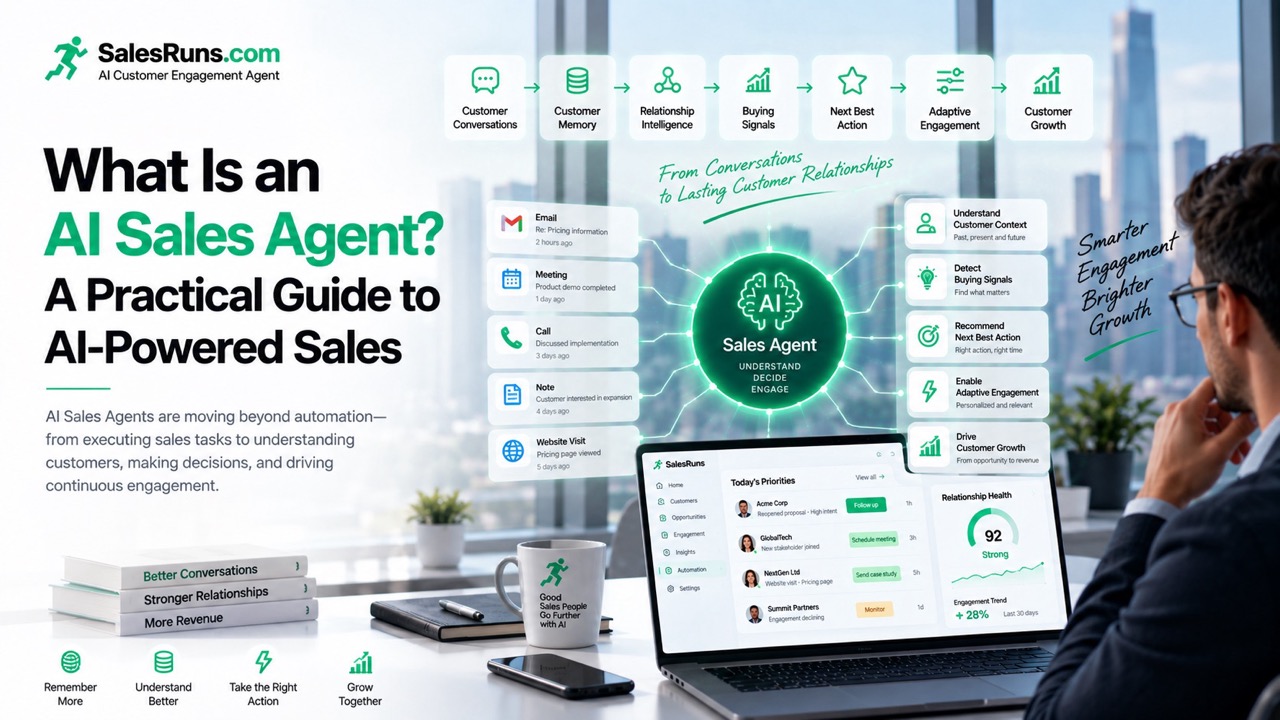
A sales director we know used to keep a paper notebook next to her laptop. Not because she distrusted software. Because it held something her CRM could not: what each customer actually cared about, in their own words. It filled up over four years. Then she changed companies, and it went in a box.
Her story repeats across thousands of revenue teams. We have spent three decades building better systems for recording what happens in sales, and almost no time building systems that understand it. CRM gave us a place to put contacts, deals, and notes. Sales automation gave us sequences that run on schedule whether or not anyone is listening. Then AI arrived, and most of it arrived as a writing assistant.
That last step is where the confusion begins. Bolting a language model onto a CRM does not produce an AI Sales Agent. It produces a CRM that talks. The question is not whether AI can draft a message, since plenty of tools can. The question is whether AI can hold a relationship in mind, notice when something changes inside it, and tell a salesperson what to do about it.
Introduction: How Sales Technology Got Here
Sales technology has moved through five recognizable stages. Each one solved a specific problem and left a specific gap behind.
Notice what the first four stages share. All of them assumed a human would supply the understanding. Someone still had to remember the conversation from March, sense that the buyer's tone had shifted, and decide that today was the day to pick up the phone. That job never scaled, because it runs on attention, and attention runs out.
So the question worth asking now is narrow and practical. What makes an AI Sales Agent different from simply adding AI to the sales software you already own? The answer is not autonomy, and it is not model size. It is what the system is responsible for.
1. What Is an AI Sales Agent?
An AI Sales Agent is a system that keeps customer context over time, reads the signals inside a sales relationship, recommends or carries out the appropriate sales action, and sustains engagement with that customer for as long as the relationship lasts.
Read that definition closely and you will notice something missing. It never mentions sending email. That omission is deliberate, because anyone comparing AI sales software should test a vendor against the whole definition rather than the first clause.
A capable AI Sales Agent should be able to:
- Understand context: who the buyer is, what their business needs, where the relationship stands.
- Remember history: what was discussed, what was promised, what was left open.
- Recognize buying signals: the behavior changes that indicate movement or risk.
- Determine priorities: which relationships need attention today, and which can wait.
- Recommend next best actions: the specific move that fits this customer now.
- Support or execute activities: draft the message, use the right channel, log the outcome.
- Adapt continuously: adjust timing, content, channel, and strategy as behavior changes.
The gap between that list and what most tools deliver is the real story of this category. Plenty of products write a competent follow-up email. Very few can tell you which account went quiet in a way that matters, or why the buyer who asked about pricing twice this month needs a different response from the one who asked once in June.
An AI Sales Agent is not simply an AI email writer. An email writer has no memory of last quarter, no view of relationship strength, and no opinion about who you should call tomorrow. Strip away the understanding and what remains is a grammar engine with a sales vocabulary. Customer Memory is what separates the two.
2. AI Sales Agent vs AI Sales Assistant
These two get used interchangeably, and the distinction matters because they solve different problems.
An AI Sales Assistant helps the salesperson with a task. It answers questions, generates content, summarizes a call, cleans up notes. The unit of work is the individual task, and the human carries context between tasks. It can search your notes to tell you what changed last month. It cannot tell you whether that change matters, because it has no model of what normal looks like.
An AI Sales Agent maintains its own view of the relationship. It holds context between interactions instead of losing it at the end of each prompt, monitors for signals, identifies opportunities and risks, and recommends what to do next. It can also execute defined actions when the situation calls for it: send the follow-up, update the record, notify the right teammate.
One clarification matters, because the marketing here often overreaches. Not every AI Sales Agent needs to operate fully autonomously. Autonomy is a spectrum.
| Level | What the AI does | Where it fits |
|---|---|---|
| Assist | Drafts content, answers questions on request | A rep who wants speed and already knows the account |
| Recommend | Watches relationships, surfaces priorities and next actions | A team with more accounts than it can track manually |
| Execute with approval | Prepares an action and waits for a human to send it | Teams that want volume without losing control |
| Execute within limits | Sends, follows up, and escalates inside agreed rules | High-volume coverage, long tails, routine nurture |
The right level depends on deal size, risk tolerance, and how much of the pipeline is routine. A company selling six-figure contracts to eight named accounts wants a very different setting from one managing five thousand smaller relationships across three continents. Both can call themselves AI Sales Agents. Only one needs to send anything without asking.
3. AI Sales Agent vs CRM
This comparison gets framed as a competition, and that framing is wrong. CRM is not the enemy of an AI Sales Agent. CRM is the substrate.
A CRM manages structured customer information: contacts, accounts, opportunities, stages, activities, and notes. It is excellent at consistency, reporting, and shared visibility, and nobody seriously argues for going back to spreadsheets.
What a CRM cannot do is interpret.
"What do we know about this customer?"
An AI Sales Agent operates on top of that information and answers harder questions.
- What does this information actually mean?
- What should we do next?
- When should we engage?
- Why does this customer matter right now?
Here is the practical version. A CRM tells you a deal moved from stage two to stage three, three weeks after the last logged touch. An AI Sales Agent notices that a buyer who used to reply within a day has gone quiet, that a procurement contact appeared on the thread for the first time, and that the last conversation ended with an unresolved question. Same data, different conclusion. One system records the change; the other interprets it and proposes a response.
That is the distinction in one line. CRM stores. AI Sales Agents understand and act. Teams that have spent years watching their CRM accumulate data nobody reads are usually the fastest to recognize the gap.
4. AI Sales Agent vs Sales Automation
Traditional sales automation follows predefined rules. It is a sequence with a clock attached.
- Day 1: introduction email.
- Day 7: follow-up.
- Day 14: second follow-up.
- Day 30: final check-in.
This works, up to a point. It made teams more consistent, and consistency matters. But the sequence is indifferent to the person on the other end. The same message goes out whether the customer is ready to sign or has been silent for two months because their budget got frozen. A fixed cadence cannot tell the difference, because nobody gave it the information.
An AI Sales Agent adapts according to context: customer behavior, engagement patterns, buying signals, relationship health, and what was actually said in previous conversations. Timing stops being a calendar question and becomes a judgment about readiness.
The clean way to hold the difference: automation follows a sequence, and an AI Sales Agent responds to context. A sequence can be long and sophisticated and still blind. A response requires knowing what changed.
This is also why Adaptive Sales Follow-up cannot be bolted on later. If the system has no memory of the last conversation and no model of the relationship, it has nothing to adapt to. It sends the day-7 email on day 7 and calls that personalization because it inserted a first name.
5. The Five Capabilities of a Modern AI Sales Agent
Strip the category down and five capabilities do the real work. If a product is missing one, something downstream breaks.
1. Customer Memory
Customer Memory is the ability to retain and use what a relationship has produced over time: conversations, stated preferences, product discussions, and the accumulated record of how this customer works. It is not a search box over old threads. Memory means surfacing the right context at the moment of decision, unprompted. Ask what this customer cared about six months ago, then ask whether that changed. Answer both and you have memory. Answer only the first and you have an archive.
2. Relationship Intelligence
Traditional sales automation measures activity: messages sent, calls logged, tasks completed. Relationship Intelligence measures understanding: how strong the relationship is, how engaged the customer has been, whether momentum is building or draining, and who the actual decision-makers are. The difference shows up in the trivial case. A prospect stops replying. Automation records a non-open and moves on. Relationship Intelligence asks why, and notices that this silence followed a proposal. Activity tells you effort was spent. Relationship tells you whether it is working.
3. Buying Signal Detection
A buying signal is a meaningful change in customer behavior: renewed engagement after a quiet period, proposal activity, repeated pricing questions, a new stakeholder on a thread, interest in a specific product line. Signals are easy to miss because they rarely arrive as events. They arrive as small deviations inside a stream of ordinary messages. The system must know what normal looks like before it can flag what is unusual, which is why signal detection depends on memory rather than sitting alongside it.
4. Next Best Action
Knowing a lot is not the same as knowing what to do. Next Best Action turns context into a recommendation: who to engage, why now, what to do, and whether the better move this week is to wait. Waiting is a legitimate recommendation, and systems that cannot output it are optimizers for volume. This capability most clearly separates an agent from an assistant. An assistant produces what you ask for. An agent tells you what deserves attention, including relationships you had stopped thinking about.
5. Adaptive Customer Engagement
The last capability is the ability to adjust continuously. Timing shifts when the customer's activity shifts. Content changes when a new stakeholder joins. The channel changes when a buyer stops answering email but replies on WhatsApp within minutes. Adaptive engagement is what makes the other four matter: memory, intelligence, and signals are inputs, and adaptation is where they change what your team does.
6. What Does an AI Sales Agent Actually Do?
Imagine a prospect who went quiet in June. In mid-September, they open four emails in a week, revisit the pricing page twice, and a second person from the same company joins the next call. A salesperson might catch one of those signals if the account happened to be top of mind. Usually it is not.
An AI Sales Agent works through the same situation in a sequence:
Step six is the one everyone already builds. Steps one through five decide whether it is worth sending. A message written without them is just a follow-up. A message written with them references the concern raised in June, answers the objection that stalled the deal, and brings in the right colleague for the stakeholder who just appeared.
That is the difference between generating text and understanding a relationship.
7. Where AI Sales Agents Create the Most Value
Value concentrates where human attention is the binding constraint.
Lead Engagement
When a team handles hundreds or thousands of prospects, context fragments fast. An AI Sales Agent holds context across channels and handoffs, so a lead from six weeks ago is not treated like a stranger.
Sales Follow-up
Follow-up is where good pipelines quietly die. Not from rejection, but from forgetting. A system that remembers every open thread and surfaces it with context attached turns follow-up from a memory test into a decision. The cost of forgotten conversations is revenue nobody ever reports.
Customer Expansion
The fastest revenue is usually already inside the account. Existing customers mention new divisions, rising usage, or adjacent problems, and those mentions scroll past in a support thread. Signal detection turns them into a conversation with a name attached.
Account Management
Customer needs change, and the account plan lags behind. Relationship Intelligence tracks how priorities shift, including stakeholders who never talk to sales directly but decide whether the renewal happens.
Long Sales Cycles
Enterprise deals run for nine, twelve, eighteen months. Sustaining relationship intelligence across that span is beyond human memory, especially when the account changes hands. Memory that survives turnover beats memory that lives in one head.
International Sales
Teams covering multiple markets deal with time zones, languages, and inconsistent coverage. A system that maintains context across markets keeps the relationship active during the hours your team is asleep.
8. SalesRuns: An AI Customer Engagement Agent
SalesRuns is an AI Sales Agent built around one conviction: the most valuable thing a sales system can do is maintain an accurate, living understanding of every customer relationship. It runs as an AI sales employee across WhatsApp, Telegram, LINE, Slack, Discord, WeCom, and email, so relationship context follows the customer across the channels they actually use instead of stopping at the inbox.
The intelligence rests on five pieces that map onto the capabilities above: Customer Memory, Relationship Intelligence, Buying Signals, Next Best Action, and Adaptive Follow-up.
In practice that means SalesRuns helps teams remember every customer relationship, understand each conversation, identify signals that deserve attention, prioritize what matters now, and determine the next action for each. Underneath sit the components real infrastructure requires: an AI Agent Orchestrator for reasoning and multi-step planning, a Workflow Engine for pipelines and retries, a Customer Memory layer backed by a knowledge base and retrieval, and connectors to the tools a team already runs, including HubSpot, Salesforce, and Stripe.
The positioning is deliberate. SalesRuns is an AI Customer Engagement Agent for sales teams, not a cold outreach tool, not a lead database, and not an email platform with better scheduling. It is the layer that decides what a relationship needs next, then helps deliver it. Teams that want to see this in practice can start with relationship health and Next Best Action.
The AI Sales Agent Architecture
It helps to see the whole system as one pipeline. Each layer depends on the one above it, and skipping a layer is what produces tools that generate text without understanding anything.
9. What an AI Sales Agent Should NOT Do
The failure modes here are predictable, and worth stating plainly because most look like success in a dashboard.
- Send as many messages as possible. Volume is easy to measure and almost never the constraint. More noise damages the relationship the system was supposed to protect.
- Automate every interaction. Some conversations need a person, and a system that cannot tell which ones produces the wrong outcome at scale.
- Contact customers regardless of context. Reaching out because a sequence says so, right after the customer asked for space, tells them their context was never tracked.
- Replace human relationships. Trust in a large deal is built between people.
- Optimize for activity volume alone. Emails sent and tasks completed are inputs. Nobody buys because a rep hit a number.
The objective is more relevant customer engagement, not more activity. A team that sends forty percent fewer messages but times each one to a real signal will outperform a team that doubles volume. A well-timed follow-up lands differently on a customer who had been waiting for someone to remember what they asked.
10. The Future of AI-Powered Sales
CRM becomes the system of record. It holds the structured truth: who the customer is, what they bought, what stage the deal is in. That function does not disappear.
An AI Sales Agent becomes the system of intelligence and action. It reads the record, adds interpretation, and operates on it: recognizing signals, prioritizing relationships, recommending moves, and executing the routine ones.
The human salesperson becomes the relationship owner and decision maker. Not a data-entry clerk, and not a message-sending machine. The person who carries trust, exercises judgment in negotiation, and decides what the relationship needs when the situation is truly novel.
The strongest model is human and AI working together, with a clean division of labor:
- AI handles memory, analysis, prioritization, recommendations, and repetitive execution.
- Humans handle trust, judgment, negotiation, complex relationships, and strategic decisions.
The practical consequence is that the job gets better, not smaller. A salesperson freed from remembering four hundred relationships and re-reading threads before every call can spend that attention on the conversations that reward it. What disappears is the administrative tax.
Key Takeaways
- An AI Sales Agent understands customer context, reads signals, recommends or executes the right action, and sustains engagement over time.
- AI Sales Assistant helps with individual tasks. AI Sales Agent maintains its own view of the relationship between tasks.
- CRM stores customer information and answers what we know. An AI Sales Agent interprets that information and answers what should happen next.
- Sales automation follows a predefined sequence. An AI Sales Agent responds to context, including the option to wait.
- The five defining capabilities are Customer Memory, Relationship Intelligence, Buying Signal Detection, Next Best Action, and Adaptive Customer Engagement.
- Autonomy is a spectrum. Match the level to deal size, risk, and how much of the pipeline is routine.
- The goal is more relevant engagement, not more activity. Volume does not compound; relationship context does.
What is an AI Sales Agent?
An AI Sales Agent is an AI-powered system that understands customer context, analyzes sales signals, recommends or executes appropriate sales actions, and continuously supports customer engagement throughout the sales relationship. Unlike an assistant, it keeps a persistent view of each relationship.
How does an AI Sales Agent work?
It captures conversations into Customer Memory, analyzes that memory for relationship change, detects buying signals as they occur, and converts them into a Next Best Action. The outcome feeds back into memory.
What is the difference between an AI Sales Agent and a CRM?
A CRM is a system of record. It stores contacts, opportunities, and activities, and answers what we know about a customer. An AI Sales Agent operates on that information to answer what it means, what should happen next, and when to engage.
What is the difference between an AI Sales Agent and sales automation?
Sales automation executes predefined rules on a schedule, such as email on day 1 and follow-up on day 7. It cannot tell whether the customer is ready. An AI Sales Agent adapts timing, content, channel, and strategy based on behavior, engagement, and buying signals.
What is the difference between an AI Sales Agent and an AI Sales Assistant?
An AI Sales Assistant helps with individual tasks such as drafting content or summarizing a call, and the human carries context between tasks. An AI Sales Agent maintains customer context itself, monitors signals, and can execute defined actions. The assistant is task-scoped; the agent is relationship-scoped.
Can AI Sales Agents replace salespeople?
No. AI Sales Agents handle memory, analysis, prioritization, and repetitive execution at a scale no person can match. Humans handle trust, judgment, negotiation, and strategic decisions. Each salesperson ends up covering more relationships at higher quality.
What are AI Agents for Sales?
AI Agents for Sales are systems that handle parts of the selling workflow with awareness of customer context, including engagement, follow-up, and nurturing. Their defining trait is deciding based on the state of the relationship rather than executing a fixed sequence.
What is an AI Customer Engagement Agent?
An AI Customer Engagement Agent is an AI Sales Agent focused on sustaining engagement over time. It maintains Customer Memory, reads Relationship Intelligence and Buying Signals, and determines the Next Best Action for each relationship. SalesRuns is an AI Customer Engagement Agent for sales teams.
How does SalesRuns use AI Sales Agents?
SalesRuns runs as an AI sales employee across WhatsApp, Telegram, LINE, Slack, Discord, WeCom, and email. It combines Customer Memory, Relationship Intelligence, Buying Signals, and Next Best Action so teams can remember every relationship, understand each conversation, and act at the right moment.