Priya had what most sellers would call a healthy account.
Her champion at a 1,200-person logistics company answered every email within a day. He took her calls from the airport. He had already sketched out where the software would sit inside the operations workflow, and he had told her more than once that this was going to happen.
The CRM agreed with him. Last activity: two days ago. Stage: evaluation. Twelve logged touches and a clean activity trail.
Then four things happened in the same month.
The company hired a new VP of Operations who wanted to know who owned the vendor relationship. Procurement sent a short note asking for a contract summary. A security engineer Priya had never spoken to requested documentation. And her champion went quiet.
None of those events produced a warning, because none of them were missing data. Every one of those people was already sitting in the CRM as a contact row. What the CRM could not say was that the shape of the deal had changed. The relationship Priya had built was still real. It had simply stopped being the relationship that would decide the outcome.
That is the gap this article is about. Not contact data. Stakeholder Intelligence.
1. One account can contain many different relationships
A contact list flattens an account into rows. An account is not rows. It is a network of people with different jobs, different concerns, and very different amounts of say over whether the deal happens at all.
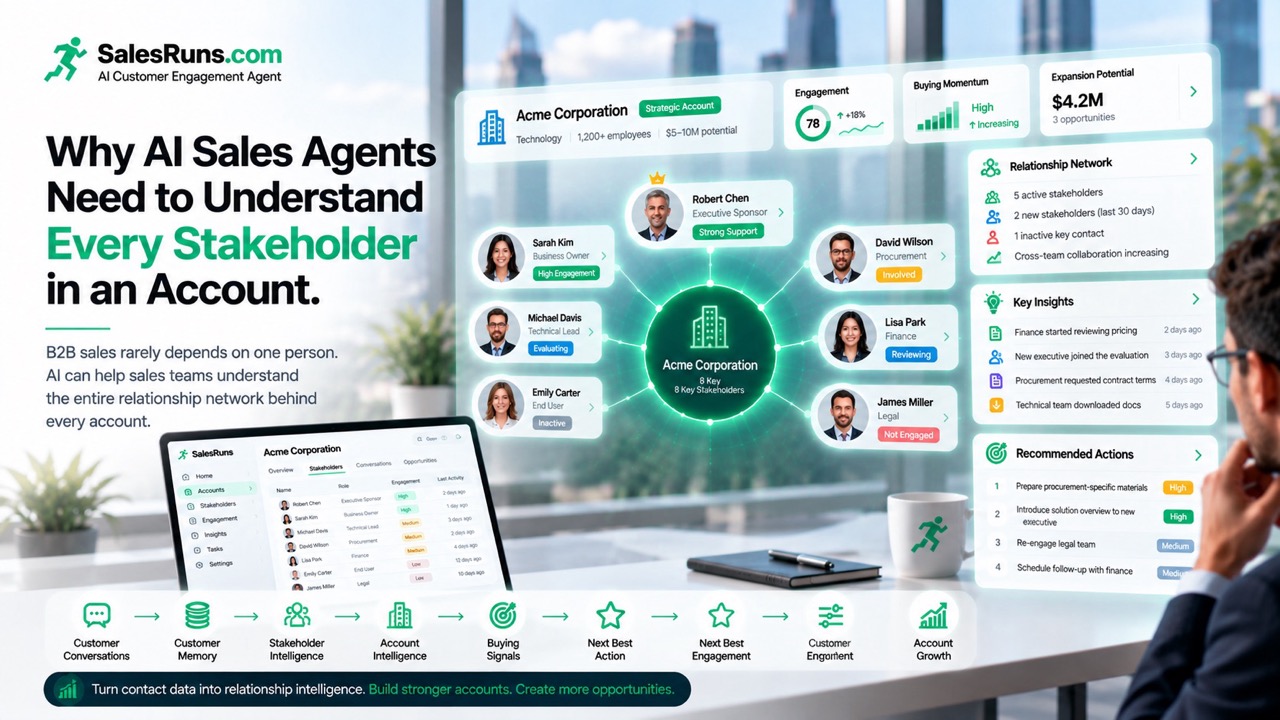
A mid-size enterprise purchase can easily involve eight or nine people. The chart below is the one most sales teams would draw from memory, and it is also the one most CRMs cannot draw for them.
The mistake is treating these people as variations of the same buyer. They are not. Each one has a different goal, a different fear, and a different definition of a good outcome.
- Goals. The operations director wants fewer manual handoffs. The CFO wants a defensible number in next year's plan. Those are not the same conversation.
- Concerns. A security engineer cares about data residency. Procurement cares about liability caps and payment terms. Neither will be moved by a product demo.
- Influence. A champion can carry your case into rooms you never enter, and one quiet objection from legal can hold up a signed contract.
- Engagement. One person replies in three minutes. Another reads everything and says nothing until the day they need something.
- Priorities. Interest in your category can move up or down for reasons that have nothing to do with your product, like a hiring freeze or a new board mandate.
- Communication preferences. Some people want a one-page summary. Some want a call. Some want to be left alone until there is something real to say.
2. What is Stakeholder Intelligence?
Stakeholder Intelligence is the ability to understand the roles, relationships, engagement, influence, and interactions of the people involved in a customer account. It is not a field on a contact record. It is a working model of a group of people and how that group changes over time.
Stakeholder Intelligence is the ability to understand the roles, relationships, engagement, influence, and interactions of the people involved in a customer account.
The cleanest way to see the difference is to compare the questions each discipline answers.
- Contact data asks: who is this person? What is their title, their email, their phone number, their logged activity?
- Stakeholder Intelligence asks: why does this person matter to this account, and how does their position change what we should do next?
Both are useful. Only one of them helps you decide what to do on a Tuesday morning when your champion has stopped replying and a name you do not recognise has started asking about pricing.
3. Why CRM contact lists are not enough
Traditional CRM was built to solve record-keeping, and it solves that well. What it stores about a person is a stable, well-understood set of facts.
- Name and title
- Email and phone number
- Company and reporting line
- Activity history
- Deal stage, plus every field an admin decided to add along the way
The trouble is that these fields describe individuals in isolation. The questions that actually decide deals are relational, and most of them do not have a column.
- Who is genuinely championing this internally, and who is just being polite?
- Who has the authority to stop it, and have we ever spoken to them?
- Who is becoming more engaged this month, and who has quietly gone cold?
- Which relationships would survive a difficult message, and which are one unanswered email away from nothing?
- Who joined the conversation recently, and what do they care about?
- Where is the gap in the buying group that nobody has covered?
A CRM will tell you that you have six contacts on an account. It will not tell you that three of them are the same functional voice, that the real economic buyer has never heard your name, and that the person you call your champion has been copied on fewer messages every week for a month.
CRM records the participants. Relationship Intelligence explains the relationships, and that distinction is the whole reason this category exists. We wrote about the wider pattern in AI Sales Agent vs CRM and about measuring relationship strength instead of guessing at it in Relationship Health.
A useful test is to ask what would have to change for the CRM to warn you. Contact records do not raise alarms. They update when someone edits them, which means a system of record is always describing the account as it was last touched. Coverage is the same problem seen from another angle. Almost every team can name its champion. Far fewer can say who inside the account has never been contacted at all, or which of the six people on the opportunity has said nothing for six weeks. Those gaps are rarely deliberate. They are simply invisible, because a contact list has no way of showing you an absence.
4. Customer Memory connects conversations across stakeholders
Here is a pattern that shows up in almost every complex deal. Four conversations happen in four different weeks, each with a different person, and each one holds a piece of the same answer.
- John, the finance lead, explains that the budget has to land before the fiscal year closes.
- Sarah, the operations manager, describes how the rollout would be sequenced across two warehouses.
- David, in security, asks what happens to data at rest and who can access it.
- Lisa, in procurement, mentions that any new vendor has to clear a legal review that takes three weeks.
Four disconnected notes produce four disconnected replies. Connected to the same account, they produce something else entirely: a timeline, a set of constraints, and a fairly obvious sequence of next steps.
This is what Customer Memory looks like at account level rather than contact level. The AI is not keeping five separate histories. It is holding one picture of the account and attributing each new fact to the right person inside it. We covered the mechanics in Why AI Sales Agents Need Customer Memory.
5. How AI can build a stakeholder map
A stakeholder map is a working model of who is inside an account, what each person cares about, and how the group is moving. It should read like a short briefing rather than a directory.
| Stakeholder | What they care about | Signal worth watching |
|---|---|---|
| Executive Sponsor | Budget, risk, timing | Joins a meeting for the first time |
| Decision Maker | Commercial terms, internal defensibility | Requests a proposal comparison |
| Champion | Making the internal case work | Forwards your material to others |
| Technical Evaluator | Fit, security, integration | Asks for documentation or a sandbox |
| End User | Daily effort, training, workflow change | Attends a demo or pilot session |
| Procurement | Terms, compliance, process | Asks about contract structure |
| Finance | Cost, payback period, budget cycle | Requests pricing or ROI detail |
What makes the map useful is that it does not stay still. People join the account, leave the company, change roles, delegate their attention, and go quiet. A static map is out of date the week it is drawn, which is why the map has to be rebuilt from evidence instead of maintained by hand.
- Role in the buying group. Champion, evaluator, economic buyer, blocker, or unknown.
- Engagement level. How much this person is actually participating, not how many times they were emailed.
- Relationship strength. Whether the conversation would survive a difficult message.
- Recent activity. What changed in the last two weeks, which is usually where the interesting information sits.
- Conversation history. What has been discussed, promised, objected to, or left unresolved.
- Buying signals. Evidence of movement, interest, or hesitation attached to a specific person.
- Potential influence. An estimate, clearly marked as an estimate, of how much this person can move the decision.
- Relationship changes. New names appearing, familiar names fading, and the reasons behind both.
Unknowns deserve their own place on the map. Most accounts contain people you have evidence about, people you suspect matter, and people you have never heard of. The third group is where deals get lost, because a reorganisation, a new hire, or a standard approval step can add a decision maker without anyone telling you. A map that only shows known contacts is a map of your own activity. The useful version shows what is known and what is missing, including roles the buying group should contain that currently have no name attached to them.
6. Multi-threaded sales and AI
Multi-threaded sales is an approach where a sales team develops relationships with multiple relevant stakeholders within the same customer account, instead of routing the whole deal through one person.
Multi-threaded sales is an approach where a sales team develops relationships with multiple relevant stakeholders within the same customer account.
The reason it gets recommended so often is structural. A single-threaded deal inherits the availability, enthusiasm, and tenure of one person. If that person moves teams, takes leave, or simply loses interest, the deal does not slow down so much as disappear. Additional relationships distribute that risk.
It is worth being honest about the limits, though. Multi-threading is not automatically better. In a small company where one owner genuinely makes every decision, extra relationships mostly add noise and slow things down. Its value depends on how the account is structured and how that particular buying process works. Threading is a response to complexity, not a universal best practice.
Where AI helps is in noticing when threading is missing or breaking, which is exactly the kind of audit nobody has time to run by hand across forty accounts.
- Missing stakeholder relationships, such as an account with no engaged finance contact in the final month of a fiscal year
- Inactive relationships that used to be strong
- New stakeholders who appeared without an introduction
- Changes in account structure, like a reorganisation that moved your champion under a new leader
- Relationship gaps, where the buying group has a role nobody has ever spoken to
There is a cost to getting this wrong in both directions. Single-threaded deals fail suddenly, which is unpleasant but at least legible. Over-threaded deals fail slowly, with six polite relationships and nobody willing to sponsor a decision. The difference is not the number of contacts. It is whether the relationships cover the roles that actually decide. That is a judgment about structure, and structure is exactly what a stakeholder map makes visible. Once you can see which roles hold real authority and which are merely present in the thread, the question stops being how many people to talk to and becomes which conversation is missing.
7. Buying signals become more meaningful across stakeholders
One person opening one email is a weak signal. It is barely a signal at all, and treating it as one is the fastest way to build a system that pings you constantly and tells you nothing.
Move the same event up a level and it changes character. Three different stakeholders inside the same account becoming active in the same week is a different kind of information. It suggests the account itself is moving, rather than that one person happened to check their inbox.
- An executive joins a meeting for the first time after months of delegating
- The technical team requests documentation and asks about integration limits
- Procurement asks how the contract would be structured
- Finance asks for pricing detail and a payback estimate
- Additional users attend a demo that was originally booked for one team
- A previously engaged contact stops opening anything at all
The useful question is rarely what a single signal means. It is what the combination means. Procurement entering, finance asking about payback, and legal requesting a template inside the same fortnight is one story. Any of those alone is just an event. AI Sales Agents that score signals one contact at a time will miss the account-level pattern, which is why signal interpretation belongs next to the stakeholder map rather than in a separate notification queue. We went deeper on this in Buying Signals, Not Just Customer Data.
8. From Stakeholder Intelligence to Next Best Action
Stakeholder Intelligence is only worth building if it changes a decision. The output should read like advice from a colleague who has been paying attention.
- Instead of: "Follow up with John."
Recommend: "John is still engaged, but Sarah from procurement became active last week. Prepare procurement-specific material before the next commercial discussion." - Instead of: "Send the third follow-up email."
Recommend: "Your original champion has gone quiet and a new VP now sits in the reporting line. Consider re-engaging at sponsor level before continuing the existing sequence." - Instead of: "No activity. Escalate."
Recommend: "Two of four stakeholders are active and one is unreachable. The account is not stalled, coverage is uneven. The gap is legal."
Notice what these recommendations have in common. None of them say contact more people. The objective is not volume. The objective is understanding the account well enough that the next interaction is worth someone's time, which is also the argument behind Next Best Action and adaptive follow-up.
The distinction matters because it changes what a sales team reports on. Activity metrics reward motion: emails sent, calls logged, touches per account. Stakeholder coverage rewards understanding: how many decisive roles have a real relationship, how many have gone cold, and how many have never been approached. A team can hit every activity target for a quarter and still lose the account. That is a dull observation until you watch it happen twice in the same year. The recommendation layer exists so that it is not the first time anyone notices.
9. SalesRuns: AI Sales Agent for relationship networks
SalesRuns is an AI Sales Agent and AI Customer Engagement Agent built for sales teams that manage complex accounts. It works across email, WhatsApp, Telegram, LINE, Slack, Discord, and WeCom, and it keeps a persistent Customer Memory of what has been said, to whom, and in what context.
The parts that matter for this topic combine into a single loop.
- Customer Memory holds conversations, commitments, objections, and context at account level
- Stakeholder Intelligence attributes that context to the right people and tracks how each relationship is moving
- Account Intelligence assembles roles, coverage, and structure into a view of the whole buying group
- Relationship Intelligence measures the strength of each connection instead of assuming it
- Buying Signals detects movement across stakeholders rather than reacting to isolated events
- Next Best Action turns all of it into one recommendation about what should happen next
In practice, that means the system can answer questions a contact list has no way of answering:
- Who is involved in this account, and who has never been spoken to?
- What does each stakeholder actually care about, based on what they have said?
- Who is engaged this week, and who has drifted?
- Which relationships are weakening, and which are holding?
- Where are the gaps in the buying group?
- What signals are emerging across the account as a whole?
- Given all of that, what should happen next?
SalesRuns is not designed to contact more people inside an account. It is designed to help a team understand the account well enough that the people they do contact are the right ones, at a moment that makes sense.
The Stakeholder Intelligence flywheel
Read the loop as a chain rather than a slogan. Conversations are the raw material, and they are the only part of the system a customer experiences as effort. Memory is what stops that material from evaporating when a seller changes territory or a deal goes quiet for a quarter.
Stakeholder Intelligence is the step most teams skip. It takes the same conversation and asks who said it, what role they play, and whether their position in the account is getting stronger or weaker. Account Intelligence then zooms out to the buying group as a whole, showing coverage and gaps instead of a list of names.
Relationship Intelligence and Buying Signals are where measurement replaces assumption. Instead of asking a seller how the account feels, the system tracks what is actually happening across people. Next Best Action collapses all of it into a single choice, and Customer Engagement is where that choice meets a human being. Account growth, the part everyone cares about, tends to be an outcome of the earlier stages rather than something that can be engineered directly.
10. Practical examples
Example 1 — Champion dependency
A seller builds the whole deal around one operations manager. She leaves the company. In the CRM, one contact goes inactive and the opportunity keeps its stage.
An AI Sales Agent reading the same account registers a structural risk: the only engaged relationship has ended, while the buying group still contains a sponsor and an evaluator who have never met the team. The recommendation is not to send another email to a departed address. It is to establish a second relationship before the account cools.
Example 2 — A new executive joins
A new executive arrives and within a fortnight is asking who owns the vendor relationship. That is a signal about process, not product.
The useful move is preparation. A short account history, a clear statement of what has been agreed and with whom, and a decision about whether executive-level engagement is appropriate. Doing nothing is also a decision, and it is the one most teams make by default.
Example 3 — Procurement enters the process
Procurement becoming active usually means the deal has moved from interest to purchase. That is good news which teams frequently misread as interference.
An adaptive system treats it as a stage change. The conversation shifts from capability to terms, timeline, and internal approvals, and the sequence designed for an evaluation phase stops being appropriate.
Example 4 — Expansion
Multiple departments start engaging with a product that was originally bought by one team. Individually, each conversation looks like support. Together they look like an expansion pattern.
Recognising that pattern early is what allows a team to have the commercial conversation at the right moment instead of two quarters later. We covered the dynamics in Customer Expansion.
11. Stakeholder Intelligence vs contact management
| Contact management | Stakeholder Intelligence |
|---|---|
| Stores people | Understands stakeholder roles |
| Stores titles | Connects people to account context |
| Stores contact information | Maps relationships between people |
| Records activities | Detects changes in engagement |
| Tracks communication | Identifies relationship gaps |
| Reports on volume | Connects buying signals across stakeholders |
| Answers where things stand | Supports Next Best Action |
Contact management tells you who people are. Stakeholder Intelligence helps explain how they matter to the account. Both are necessary. Only one of them tells you that the person you have been treating as your champion is no longer the person who decides.
12. What AI should not assume about stakeholders
This is the part most articles skip, and it is the part that determines whether a system gets trusted. Inference inside a customer account is useful and imperfect at the same time. A credible AI Sales Agent should be explicit about what it is guessing.
- Title is not authority. A director can carry more weight than a vice president in the same organisation, and titles mean different things across companies and countries.
- Activity is not intent. Someone reading every email may be evaluating a competitor. Someone silent may be waiting for a budget cycle to open.
- Silence is not disinterest. Deals routinely go quiet for reasons entirely outside your product, from hiring freezes to reorganisation to one unanswered internal question.
- One stakeholder is not the account. The most talkative person in a thread is often not the most decisive one.
- Inferred influence is an estimate. Any model of who matters is a hypothesis built from evidence, and it should be presented that way.
So the right division of labour is straightforward. The system surfaces evidence, tracks change, and proposes an action. A person decides what that evidence means for the relationship. Recommending that a conversation should happen with a specific stakeholder is useful. Deciding to escalate over your champion's head without telling them is a judgment call, and it belongs to the seller.
One practical rule follows from all of this. When an AI Sales Agent makes a claim about a person, it should be able to show its work: the conversation, the meeting, the request, or the silence that produced the inference. Recommendations with visible evidence get used. Assertions without evidence get ignored, or worse, followed.
Frequently asked questions
What is Stakeholder Intelligence?
Stakeholder Intelligence is the ability to understand the roles, relationships, engagement, influence, and interactions of the people involved in a customer account. It goes beyond storing contact details and models how the people in a buying group relate to each other, and how those relationships change over time.
What is multi-threaded sales?
Multi-threaded sales is an approach where a sales team develops relationships with multiple relevant stakeholders within the same customer account, rather than relying on a single champion. It reduces dependency on one relationship, though its value depends on the account structure and the buying process involved.
Why are multiple stakeholders important in B2B sales?
Because most B2B purchases are group decisions. Budget holders, technical evaluators, procurement, finance, and legal each control a different part of the process. A deal built on one relationship is exposed to that person's availability, priorities, and tenure.
How can AI Sales Agents map stakeholders?
An AI Sales Agent builds a stakeholder map from conversation history, engagement patterns, and account context. It attributes what has been discussed to the right person, estimates each person's role and influence, tracks engagement changes, and flags roles inside the buying group that nobody has spoken to yet.
What is the difference between contact management and Stakeholder Intelligence?
Contact management records who people are: names, titles, contact details, and activity history. Stakeholder Intelligence explains how those people matter to the account, including their roles, relationships, relative influence, and how their engagement is changing.
How does Customer Memory work across multiple stakeholders?
Customer Memory operates at account level rather than contact level. Instead of keeping separate histories for each person, it maintains one picture of the account and attributes each conversation, commitment, and objection to the relevant stakeholder, so context from one conversation informs the next.
How does Stakeholder Intelligence improve Account Intelligence?
Account Intelligence describes the buying group as a whole: who is engaged, who is missing, how many relationships are active, and whether the deal is properly covered. Stakeholder Intelligence supplies the underlying detail about individual roles and relationships that makes that account-level view accurate.
How does SalesRuns use Stakeholder Intelligence?
SalesRuns combines Customer Memory, Stakeholder Intelligence, Account Intelligence, Relationship Intelligence, Buying Signals, and Next Best Action. It maintains account-level memory across channels including email, WhatsApp, Telegram, LINE, Slack, Discord, and WeCom, tracks how each relationship changes, and recommends what should happen next.